Work in progress. Updated 19/04/2006
Note: This web page is part of a research blog, and will expand.
Chapter
1.
"Bloody invasion, Christianity,
and the Vagrancy Act (1836)"
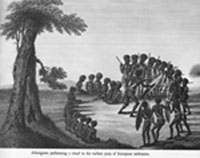
"Aborigines performing a ritual in the earliest years of European settlement."
[Source: Turnbull, C., A Concise History of Australia (Thames and Hudson, 1965) p.11]
Commentary on the documents 1771 - 1837
incomplete
Cook and Banks, and Military Governors from Phillip to Snodgrass: Orders to Governors about Aborigines,
some Standing Orders, two Proclamations (1835 and 1837) and the 1836 Vagrancy Act , all referring to Aborigines
Preliminary note: - to read the chronologically organised, complete texts of the digitised documents referred to, without this commentary, click Chapter 1, Documents only (1771-1837) Highlighted by the use of red font in the following primary source documents, are any references to New South Wales Government military action against Aboriginal people; references to the use of firearms against the Aborigines by the settlers; references to specific Aboriginal rights, and references to the extinguishment of specific Aboriginal rights by Government Proclamation or Standing Order. The documents are organised in strict chronological order, so that the story can be seen to unfold from day to day, month to month, and century to century in following Chapters (incomplete.)
Chapter 1 covers the period 1771 - 1837, including documents deriving from Cook and Banks, and Military Governors from Phillip to Snodgrass. This period also generates some Standing Orders, two Proclamations, and the 1836 Vagrancy Act, the first Act referring to Aboriginal people to be passed by the New South Wales Government. The function of the documents is to be a brief of evidence. The Commentary points out the relevant words in each document, providing Webster's Twentieth Century Dictionary definitions of key terms, to show that every New South Wales Government administration was to flout every part of Governor Philip's instructions of 1787, and was able to carry out the progressive extinguishment of Aboriginal rights with impunity.
Between 1788 to 1837, the period of administration examined in Chapter 1, which ends at the commencement of the era of the Gipps Government, the New South Wales Government is considered as a self-perpetuating, self-rewarding entity whose political affiliations, in any particular era, are not considered relevant by this critique; as the words of the Military Governors' correspondence, the Debates as revealed in the New South Wales Legislature's Votes and Proceedings, and in the Statutes passed by the Government; of any time, and of any political affiliation; reveal, with a very few exceptions, an equally repugnant policy towards the rights and welfare of New South Wales Aborigines, on the part of every single Governor, Member of Parliament, and political party in power, from 1788 to today.
From the moment when Governor Phillip unfurled the British flag in Sydney Cove on the evening of 26 January 1788, and made his claim for sovereignty in the name of the British Crown, "centuries of development of English law took instant root in Australian soil. For, carrying it as 'invisible baggage', the colonists brought the law with them, 'as the law is the birthright of every subject'. So much was the well-settled English common law of the 18th century, at least in the case of 'settled' colonies — that is to say, peaceful settlements or previously unoccupied or practically unoccupied territory. In his classic exposition some twenty years earlier, Sir William Blackstone had distinguished settled colonies from those which had been conquered or ceded:
... 'if an uninhabited country' be discovered and planted by English subjects, all the English laws then in being, which are the birthright of every subject, are immediately there in force. But this must be understood with very many and very great restrictions. Such colonists carry with them only so much of the English law, as is applicable to their own situation and the condition of an infant colony ... But in conquered or ceded countries, that have already laws of their own, the king may indeed alter and change those laws; but, till he does actually change them, the ancient laws of the country remain, unless such as are against the law of God, as in the case of an infidel country." [Source: Coper, M; Encounters With the Australian Constitution CCH Australia Ltd, NSW (1988) Page 52]
During
the process of declaring Aboriginal land theirs by Proclamation, with the
support of their guns; and ensuring that any rights the Aboriginal people
possessed as British subjects (and later, Australian citizens) were
progressively extinguished by Acts of Parliament, a series of New South Wales
Government documents was created, to stretch like a paper-trail from in 1771,
to today.
The
documents relevant to this study of the wrongful extinguishment of Aboriginal
rights by New South Wales Government Statute commence in 1770. In Captain
Cook’s Journal during his Voyage … in M.M. Bark Endeavour 1768-71,
Cook, who had been officially instructed to act, during his voyages, with a
sensitivity towards Aboriginal rights, commented on the Aborigines' value
system in comparison with his own.
"From
what I have said of the Natives of New Holland they may appear to some to be
the most wretched people upon Earth; but in reality they are far happier than
we Europeans, being wholly unacquainted not only with the Superfluous but with
the necessary Conveniences so much sought after in Europe; they are happy in
not knowing the use of them. They live in a Tranquility
which is not disturbed by the Inequality of Condition. The Earth and Sea of
their own accord furnishes them with all things necessary for Life. They covet
not Magnificent Houses, Household-stuff etc., they live in a Warm and fine
Climate and enjoy a very wholesome Air, so that they have very little need of Cloathing;
and this they seem to be fully sencible of, for
many of whom we gave Cloth etc., left it carelessly upon the Sea beach and in
the Woods, as a thing they had no manner of use for; in short, they seem’d
to set no Value upon anything we gave them, nor would they ever part with
anything of their own for any one Article we could offer them. This in my
opinion argues that they think themselves provided with all the necessaries of
Life, and that they have no Superfluities …. "
Cook
was a humane and intelligent man for his times, and his insight reflected the
Enlightenment rather that the capitalist pragmatism of Banks, who expressed
his puzzlement at anyone who didn't understand agrarianism and money. In
1779 Banks described the Aborigines of “New Holland” to a Committee of the
House of Commons as 'naked, treacherous, and armed with Lances, but extremely
cowardly'. Although his evidence before the Beauchamp
Committee in 1785 was more circumstantial, its main intent was to show that
the Aborigines were a nomadic people, with no trace of political authority,
social organisation or religious belief, and that the east coast of New
Holland was, accordingly, terra nullius, open to European settlement
and dominion. The First Fleet, with all that followed, was now not far
distant.
The Charter of Justice, dated 2 April 1787 (UK) is the authority for the establishment of the first New South Wales Courts of Criminal and Civil Jurisdiction, which were make available the processes of the law to the subjects of the Crown in the Colony. The Charter of Justice was in the form of Letters Patent providing for a Deputy Judge-Advocate and six court officers to be appointed by the Governor and the establishment of a Civil Court. The Governor was required to give his permission to any death sentence imposed by the Court, and was empowered to give pardons. The Civil Court had the power to deal with disputes over property and had jurisdiction over wills and estates.
The New South Wales Court Act 1787 provided for the establishment of the first New South Wales Courts of Criminal and Civil Jurisdiction by executive action, achieved with the issue of these Letters Patent. Although the British intended to transport English law and legal proceedings along with the convicts, in practice there were significant departures from English law in the new and distant Colony. Notably, the first civil case heard in Australia, in July 1788, was brought by a convict couple. They successfully sued the captain of the ship in which they had been transported, for the loss of a parcel during the voyage. In Britain, as convicts, they would have had no rights to bring this case. [Source: http://www.foundingdocs.gov.au] But in the new Colony, the Aborigines were to have even less rights than convicts.
Australian law and policy respecting the Aboriginal population originated with the instructions to the first Governor of New South Wales: Governor Phillip, the first Governor of the Colony of New South Wales, in April 25, 1787, was explicitly instructed, that he was
" ... to endeavour by every possible means to open an intercourse with the natives, and to conciliate their affections, enjoining all our subjects to live in amity and kindness with them. And if any of our subjects shall wantonly destroy them or give them any unnecessary interruption in the exercise of their several occupations it is our will and pleasure that you do cause such offenders to be brought to punishment according to the degrees of the offence. You will endeavour to procure an account of numbers inhabiting the neighbourhood of the intended settlement, and report your opinion to one of our Secretaries of State in what manner our intercourse with these people may be turned to the advantage of this colony."
The existence of Philip's Instructions plainly establishes that in 1787, the Aborigines of New South Wales had rights able to be recognised, defined and protected by British law; that it was an important task ("endeavour by every possible means"); and that this must include communication, conciliation, and cooperation. The word "enjoining" demonstrates the status of this document as a command which has been imposed with authority. The instructions are plain, and the definitions of the words used make no ambiguity possible.
That document was to be the first of a series of communications to the New South Wales Governors referring to the protection of the subject rights (though never the land ownership rights) of the Aboriginal native inhabitants. And all the subsequent governors of New South Wales up to and including Sir Thomas Brisbane were to be given exactly the same instructions. [Source: Woolmington J.; Aborigines in Colonial Society (Cassell Australia, 1973) page 3]
In 1787, the British Crown formally announced its ownership of Aboriginal tribal territories from Cape York to South Cape. Phillip was appointed Captain-General and Governor-In-Chief:
“in and over our territory
called New South Wales, extending from the Northern Cape or extremity of the
coast called Cape York, in the latitude of ten degrees thirty-seven minutes
south, to the southern extremity of the said territory of New South Wales or
South Cape, in the latitude of forty-three degrees thirty-nine minutes south,
and of all the country westward as far as the one hundred and thirty-sixth
degree of east longitude reckoning from the meridian of Greenwich, including
all the islands adjacent in the Pacific Ocean within the latitudes aforesaid
of ten degrees thirty-seven minutes south and forty-three degrees thirty-nine
minutes south'."
"The Governor's choice of the site of the present metropolis of Australasia was determined by the fact that an apparently perennial stream of the purest water was found discharging itself into a beautiful sandy cove ... " [Source: Coghlan. TA, Government Statistician The wealth and Progress of New South Wales 1887-88, Sydney: Charles Potter, Government Printer (1888) page 8] It was:
"... at the head of the cove, near a run of fresh water, which stole silently
through a very thick wood, the stillness of which then, for the first time
since the creation, had been interrupted by the rude sound of the labourer's
axe and the downfall of its ancient inhabitants - a stillness and tranquility
which from that day were to give place to the voice of labour, the confusion
of camps and towns, and the busy hum of its new possessors ..."
[from Jose, Arthur W.,
History of Australasia from the Earliest Times to the Present (Sydney,
Angus and Robertson, 1913) Page 20]
No permission was sought from the Aboriginal
possessors of the soil, nor was any acknowledgement made of any rights they
may have to it.
"According
to the cases, the common law itself took from indigenous inhabitants any right
to occupy their traditional land, exposed them to deprivation of the
religious, cultural and economic sustenance which the land provides, vested
the land effectively in the control of the Imperial authorities without any
right to compensation and made the indigenous inhabitants intruders in their
own homes and mendicants for a place to live. Judged by any civilized
standard, such a law is unjust and its claim to be part of the common law to
be applied in contemporary Australia must be questioned." Mabo
By 1790 the Aborigines were showing open hostility towards the white invaders.
Phillip did his best to treat them kindly, but few of the settlers followed
his example; stragglers from the township were killed by way of revenge, and
the bush was set on fire whenever the white men turned their stock into it for
pasturage.
In A Narrative of the Expedition to Botany Bay, published at London by Watkin Tench in 1789 and here transcribed by Manning Clark; the Aborigines are described as:
"aloof, out of reach, elusive, practising a stand-offishness which puzzled and exasperated the bearers of such gifts. They remained shy in the company of the white man, though they had been treated with kindness and loaded with presents. They seemed either to fear or to despise the white man too much to be anxious for a closer connection. The more the white men learned of their way of life and view of the world, the more they were puzzled: they observed no degree of subordination in their society; they remained strangers to their religious rites and opinions. By the end of February, however, the aborigines inferred from the building that the white man intended to stay. At the end of that month they stoned white men who attempted to land in one of the coves of the harbour; they stole the white man's tools; they stole his food; on 30 May they murdered two rush-cutters and mutilated their bodies in a shocking manner. Such behaviour quickly changed the white man from a delighted observer of the picturesque and the quaint into a partisan defending his civilization. After six months, one of them wrote of the aborigine as a creature deformed by all those passions which afflicted and degraded human nature, unsoftened by the influence of religion, philosophy and legal restriction. The behaviour of the white man was equally disgusting to the aborigine. To teach the aborigine the ways of the civilized, Phillip instructed his men to gather as many as possible to witness a flogging. The few aborigines who watched manifested only symptoms of disgust and terror. In this way, the efforts to conciliate their affections and to diffuse amity and kindness degenerated into theft and murder, as goodwill was pushed aside by the more primitive passions of an eye for an eye and a tooth for a tooth." [Source: Clark, C.M.H; A History of Australia (Melbourne University Press (1962) Page 116]
The Daruk people of the Hawkesbury opposed the first white settlement of the rich agricultural district in the early 1790s. The settlers retaliated with great cruelty and parties of the corps were despatched to the river to intervene and to suppress Aboriginal resistance. By May 1795 the soldiers were involved in what was described as 'open war' along the Hawkesbury, the beginning of a savage guerilla struggle which ended twenty years later with the extinction of the Daruk. The men of the corps were inexperienced in such warfare. A party sent out by Captain William Paterson to 'destroy as many as they could meet with of the wood tribe' expected to strike terror into the Daruk by erecting gibbets in the bush: the Daruk were only later to realise what they signified.
[Source: http://www.militarybadges.info/brits/eras/02-nsw-corps.htm]
After his return to Europe Tench wrote A Complete Account of the Settlement at Port Jackson, which was published in 1793. Manning Clark, with Watkin Tench's account as authority, says that:
"All attempts to convert the aborigine to their civilization had proved as futile as ever. In May 1791 a convict had been caught stealing fishing tackle from the aborigines. Phillip decided to have him flogged in the presence of the aborigines that they might again see that British law governed the relations between white man and aborigine and that there was not one law for the white man and another for the white man's relations with the aborigine. Again, as with their aversion to the first flogging, the aborigines were shocked. By nature they were not of a sanguinary and implacable temper; though quick to bear resentment, they were not nevertheless unforgiving of injury. The women were particularly affected: one of them shed tears, another snatched a stick and menaced the flogger.
[Source: Clark, C.M.H; A History of Australia (Melbourne University Press (1962) Page 126]
Major Grose and Captain Paterson, Officers in charge of the military, administered the Government from 1792, until the arrival of Governor Phillip's successor. In 1795, Captain Hunter arrived as the second Governor and sixty men of the New South Wales Corps were sent from Sydney to the Hawkesbury settlements to combat the Daruk Aborigines.
Manning Clark, in A History of Australia, says that Governor Hunter, for all his efforts, was impotent in the face of men with evil and malice and madness in their hearts. The Europeans complained that the aborigines repaid kind treatment with base ingratitude; that they were thieves, burning and plundered the white man's property. "In 1799, five white settlers on the Hawkesbury, angered by such thefts, burnings and a murder, met in the home of the widow of the murdered man to exact revenge, captured two suspected aboriginal boys, tied their hands behind their backs with rope used ordinarily to tie up the dogs in the yard, marched them outside and shot them."
Hunter was horrified. He charged the five men with murder. In their defence the accused pleaded vengeance and justified murder of black men on the grounds that the aborigines were a treacherous, evil-minded, bloodthirsty set of men.
[Source: Hunter to Portland, 2
January 1800, H.R.A., 1, 2, p.401 et
seq., in Clark, C.M.H; A History of
Australia (Melbourne University Press (1962) Page 145]
The Aborigines' position as British subjects raised several complicated legal questions. The British Justice system made it impossible for them to swear the accepted Christian oath and therefore made it impossible for them to give testimony in the courts of law. Aborigines' ignorance of the workings of the law, coupled with language barriers and their illiteracy, militated against their using the law for their own defence. So then as now, they were separated from the benefits of legal protection, ignorant about the law and scared to make use of it.
This document from 1799 reveals not only the difficulty of gaining evidence of white atrocities against natives, but also the problem the Governor faced when confronted by the power of white supremacist land owners and developers whose attitudes towards the Aborigines were mirrored by the judiciary. Hunter said they were, in his opinion, too lenient on the whites. When the court returned a verdict of guilty, Hunter appealed to London for guidance. By the time the reply came he had left the colony. It would have been far more surprising for the reader, to find that Hunter was anything more than pusillanimous when confronted by the power of those capitalists and their representatives who really ran the Colony and the Military, and who had the most to gain from denying subject rights to Aborigines and thereby guaranteeing the violent destruction of their society.
"Two native boys have lately been most barbarously murder'd by several of the settlers at the Hawkesbury River, notwithstanding Orders have upon this subject been repeatedly given pointing out in what instances only they were warranted in punishing with such severity. The above two youths had been in the habit of being much with the settlers, but from the manner in which this shocking murder was perpetrated I judg'd it highly necessary to have the murderers taken immediately into custody, and a court was instantly ordered for their trial. The court having unanimously found the prisoners guilty of killing two natives, were divided with respect to the nature of the sentence, as your Grace will discover by the trial, which is herewith, sent at the instance of the majority of the court. The manner in which this decision appears to have been come to, I conceive, my Lord;, not to have been correct. I am of opinion that a reference to His Majesty's Minister shou'd have been recommended by the court to the Governor, and not from the court directly and independently of the Commander-in-Chief, because the power either to approve and confirm or to moderate the severity of any criminal sentence is delegated by His Majesty to him.
Those men found guilty of murder are now at large and living upon their farms, as much at their ease as ever. I conceive, from the nature of the Governor's authority, I might have rejected the bail and kept the prisoners under confinement until the effect of the special reference was known; but I have been unwilling to shew to the colony that any difference is likely to take place between the judicial and executive authoritys, particularly when in the smallest degree inconsistent with lenity. If I am mistaken in my ideas upon the above trial, I hope and request to be instructed.
You will discover, my Lord, what a host of evidence is brought forward from that quarter to prove what numbers of white people have been kill'd by the natives; but cou'd we have brought with equal ease such proofs from the natives as they are capable of affording of the wanton and barbarous manner in which many of them have been destroy'd, and to have confronted them with those of the white inhabitants, we shou'd have found an astonishing difference in the numbers. Every information within my power respecting the light in which the natives of this country were to be held as a people now under the protection of His Majesty's Government was laid before the court. The Order given upon that subject, both before my time and since, was made known to it. I also laid before its members an article in His Majesty's instructions to the Governor, which is strong and expressive, and is as follows:
'... to endeavour by every possible means to open an intercourse with the natives, and to conciliate their affections, enjoining all our subjects to live in amity and kindness with them. And if any of our subjects shall wantonly destroy them or give them any unnecessary interruption in the exercise of their several occupations it is our will and pleasure that you do cause such offenders to be brought to punishment according to the degrees of the offence. You will endeavour to procure an account of numbers inhabiting the neighbourhood of the intended settlement, and report your opinion to one of our Secretaries of State in what manner our intercourse with these people may be turned to the advantage of this colony.'
The intentions of His Majesty from this part of the Governor's Instructions are clear and evident. The above cruel act is the second which I have brought before a Court of Criminal Judicature in order to prevent, as far as in my power, this horrid practice of wantonly destroying the natives. Much of that hostile disposition which has occasionally appear'd in those people has been but too often provoked by the treatment which many of them have received from the white inhabitants, and which have scarsely been heard of by those who have the power of bestowing punishment. [Source: Hunter to Portland, 2 January 1800, H.R.A., I, ii, pp. 401-2; in Woolmington J.; Aborigines in Colonial Society (Cassell Australia, 1973) page 127-8]
Philip Gidley King
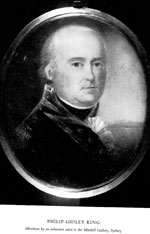
The next Governor was Phillip Gidley King ... (Governor,
26/9/1800-12/8/1806). The New South Wales Corps, a military body enlisted for
service in the Colony, (the first detachments of which had arrived in 1790),
formed an efficient garrison. The New South Wales Corps' " sole work would
consist in acting as a prison guard, or, at most, in making a few raids, in
alleged reprisals for the misdeeds of the ill used, and often sorely provoked,
aborigines." [Source:
Coghlan. TA, Government Statistician The wealth and Progress of New South
Wales 1887-88, Sydney: Charles Potter, Government Printer (1888) Page 12]
A. G. L. Shaw says of King that
"he ... strove to keep peace
with the Aboriginals. These, he told Governor Bligh, he 'ever considered the
real Proprietors of the soil'. He refused to allow them to be worked as
slaves, tried to protect their persons and their property and to preserve 'a
good understanding' with them; but he found them 'very capricious',
often 'sanguinary and cruel to each other', and like his contemporaries failed
to understand what he called their 'most ungrateful and treacherous conduct'.”
By the end of 1801 Governor King made an Order that crops were to be protected from the Aborigines by a Military detachment.
"A detachment at George's River is to consist of a sergeant, corporal, and six privates until further orders, who are to be posted as follows:—A sergeant and four privates at Major Johnston's, a corporal and two privates at Sergeant-major Jamieson's or Corporal Teutrill's. This detachment is to prevent the natives from firing the wheat, for which purpose a private will patrole occasionally from daylight till nine o'clock at night, and one private to be always ready during the night as a picquet. They are to fire on any native or natives they see, and if they can, pursue them with a chance of overtaking them. Every means is to be used to drive them off, either by shooting them or otherwise, taking care always to leave one private where posted."
A captain is to inspect that post once a week. Similar orders are to be given to the outposts from the Parramatta detachment; an officer from that post will inspect these outposts once a week, or oftener." [Source: Government Order by Governor King, 1 May 1801, HRA, I, .i., pp.406-7 in Woolmington J.; Aborigines in Colonial Society (Cassell Australia, 1973) page 38]
In June 1802 King received instructions from Lord Hobart
to pardon the five Europeans who had been found guilty by the criminal court
on 18 October 1799 of wantonly killing two aborigines. Hobart added the rider
that every means should be used to cultivate the goodwill of the natives. At
that time King had not lost faith in the policy of amity and kindness. In a
proclamation he announced that any future injustice or wanton cruelty against
the natives would be punished as if it had been committed against the persons
and estates of any of His Majesty's subjects. He went on to forbid any of His
Majesty's subjects using any act of injustice or wanton cruelty against the
natives. At the same time he pointed out that the settler was not to suffer
his property to be invaded, or his existence endangered by the natives,
qualifying this by adding that he was to use effectual though humane means of
resisting such attacks.
Proclamation
"By His Excellency Philip Gidley King Esq. etc. Whereas a Despatch by the Coromandel has been received from the Principal Secretary of State for the Colonies, containing His Majesty's Commands, That notwithstanding His permitting the Governor to Remit the Punishment of the five Persons tried by a Court of Criminal Judicature on the 18th of October, 1799, for wantonly killing Two of the Natives, yet 'It should, at the same time, be clearly understood that on future occasions any instance of Injustice or wanton Cruelty towards the Natives will be punished, with the utmost severity of the Law'; And His Majesty having at the same time recommended that every means should (after the Receipt of those Despatches) be used to conciliate the Goodwill of the Natives, I do hereby strictly forbid any of His Majesty's Subjects, resident or stationary in this Colony, from using any act of injustice or wanton Cruelty towards the Natives, on pain of being dealt with in the same manner as if such act of Injustice or wanton Cruelty should be committed against the Persons and Estates of any of His Majesty's Subjects; But at the same time that His Majesty forbids any act of Injustice or wanton Cruelty to the Natives, yet the Settler is not to suffer his property to be invaded, or his existence endangered by them; in preserving which he is to use effectual, but at the same time the most humane, means of resisting such attacks. But always observing a great degree of forbearance and plain dealing with the Natives appears the only means they can adopt to avoid future Attacks, and to continue the present good Understanding that exists.
[Source: Lord Hobart to Acting Governor King, 30 January 1802, H.R.A., I, iii pp. 366-7; in Woolmington J.; Aborigines in Colonial Society (Cassell Australia, 1973) page 5]
Official policy from England remained the same for each Governor from Phillip onwards until 1825
"Before I dismiss this subject, I cannot help lamenting that the wise and humane instructions of my predecessors, relative to the necessity of cultivating the good-will of the natives, do not appear to have been observed in earlier periods of the establishment of the colony with an attention corresponding to the importance of the object. The evils resulting from this neglect seem to be now sensibly experienced, and the difficulty of restoring confidence with the natives, alarmed and exasperated by the unjustifiable injuries they have too often experienced, will require all the attention which your active vigilance and humanity can bestow upon a subject so important in itself, and so essential to the prosperity of the settlement, and I should hope that you may be able to convince those under your Government that it will be only by observing uniformly a great degree of forbearance and plain, honest dealing with the natives, that they can hope to relieve themselves from their present dangerous embarrassment. It should at the same time be clearly understood that on future occasions, any instance of injustice or wanton cruelty towards the natives will be punished with the utmost severity of the law."
[Source: Lord Hobart to Acting Governor King, 30 January 1802, H.R.A., I, iii pp. 366-7; in Woolmington J.; Aborigines in Colonial Society (Cassell Australia, 1973) page 5]
In March 1803, Governor King
permitted the government printer to establish the Sydney Gazette, allowing
him the use of the government press and type. The Sydney Gazette,
Published by Authority, reported on what was happening to the Aborigines
as news during this time, frequently referring to them by name; and also
provided an official organ for the government administration, in publishing
successive Governors' Standing Orders about the protection of the rights, or
the taking away of other rights of the Aborigines, first in the immediate
vicinity of Sydney, and then very soon, on the land further out.
"The European theft of the land, with the response of the aborigine to such a theft, and European ideas on the nature of man and his destiny, rushed both groups into a clash which doomed the culture of the aborigine, condemning him to destruction or degradation and the white man to peace, security and material success, at the price of a reputation in posterity for infamy."
[Source: Clark, C.M.H; A History of Australia Vol 1, Melbourne University Press, 1962 Pages 160-169]
Organised military
expeditions by detachments of the New South Wales Corps, against Aboriginal
perpetrators of what the Gazette called depredation and outrage, are reported, as a continuation of the
perpetual campaign of vilification and propaganda carried on in all New South
Wales Government organs, for a very long time to come. The Aboriginal
Tribes of Sydney found themselves forced to share their ancient hunting and
ceremonial grounds with ignorant and brutalised Europeans who witnessed their
traditional social and spiritual events as another sideshow. And significantly
for the population crash which was to be experienced by the Aboriginal
society, in October, 1803, the Sydney Gazette refers to the Aborigines
as "already thin and scattered handfuls" of people.
"NATIVES."
16 October, 1803, Sydney Gazette
"On Sunday last a number of
Natives assembled on a ground at the upper end of Pitt's Row, with a design of
inflicting punishment on two men who were directly or indirectly concerned in
the assassination of two others who died of their spear wounds.
About an hour before sunset the
parties made their appearance, and were received by their friends and
partizans, who presented each with a target or Reoleman, as a defence against
the missile assaults of their adversaries, who instantly arose and approached
the intended victims of an ungovernable antipathy and rage. One of them, known
to us by the name of Musquetto, was the first assaulted, and he with
surprising dexterity defended himself against 64 spears, all thrown with
rancour and malignity, and 17 of which went through the target, some to a
depth of nearly two feet. The 65th and last thrown at him entered the calf of
his right leg, and penetrated six inches through - the spear measured more
that eight. This was cut short before it could be extracted. At the other only
nine were launched, all of which he avoided.
A contest afterward took place
between two opposite parties for the wife of one of the deceased. The exercise
of merciless barbarity on this and similar occasions strongly characterises
this wretched race of men, who, but for their barbarous and irreconcilable usages in cases of homicide, would wholly extirpate their already thin and
scattered handfuls.
After receiving many severe blows
from either party, and having their arms almost dragged from their sockets,
the unfortunate PAIR was borne in triumph from the field by an Hibernian
Taylor, who probably could sympathise in the sufferings of an unhappy
fellow-creature, notwithstanding all the difference in complexion."
In December, 1803, the Sydney
Gazette journalist speaks with sneering disrespect about the death of a
significant Aboriginal Elder and spiritual leader.
"The death of Boneh"
December
18, 1803, Sydney Gazette
"A visitor from Hawkesbury
mentions the death of Boneh, an ancient Native, who we believe was but little
known in Sydney. This veteran had for many years back profited with supreme
authority over his tribe, from whom he received a species of homage which
approached to adoration. In fact, the straggling subjects of this sooty
chieftain, have been frequently heard by the settlers resident nearest the
foot of those inaccessible Mountains, to ascribe to him the power of agitating
the elements, and of causing floods, rains, &c., &c., a finesse
probably constructed purposely to impress us with awe and reverence for a
being possessed of such extensive qualifications. That the mythology may in
some degree owe its existence to similar causes, we shall not argue, but had
this inky venerable been known to those imaginary exhibitions, little doubt
can be entertained but his complexion would at least have recommended him to a
seat in the infernal regions, where, in the course of time, he might have
become a com-peer with the augustiniate."
It’s from long ago, but the ‘piercing shrieks’
of grief still echo from the past; as if the tragedies of 1803 were only
yesterday.
“Injured Native burned
alive at Milkmaid Reach”
December 25, 1803, Sydney Gazette
"A circumstance that lately
took place at Milkmaid Reach, on the Coast between Sydney and Hawkesbury,
among a body of Natives, stands, in point of deliberate inhumanity towards a
fellow creature, unparalleled, save only in the barbarous usages to
which their people are habituated. One of their number had climbed a lofty
tree in pursuit of a Cockatoo; and as soon as he gained the summit and had
secured the bird, unfortunately got entangled in the twigs, and in trying to
disentangle himself, lost his hold, & by a tremendous fall had both a leg
and a thigh broke. The woman at the instant sent up a piercing shriek, and the
men assembled around him. The elders examined the fractures minutely, and
pronouncing them incurable, hastily commanded the females to retire; then
erecting a pile of brushwood, actually set it on fire, whilst the unhappy
creature was alive. As soon as this inhuman yet effectual remedy was
administered, the Boatmen who were spectators of the proceeding, were advised
by one of the more friendly natives to get off as quickly as possible, as the
fatal event had aroused the indignation of the whole tribe against all white
people, to whom the present misfortune was ascribed, as the Cockatoo would not
have been climbed for, had not a reward been the known consequence of its
capture."
In April 1804, the report "Neglect to profit
by the abundance of mackaral" shows the modern reader not only the
significant diminution in environmental resources from that day to this, but
also shows the inability or unwillingness of an ignorant European newcomer to
comprehend the Aboriginal use of, and custodianship of the ancient and fragile
environment.
"Neglect to profit by the
abundance of mackaral"
Sunday, April 8, 1804, Sydney Gazette
"The present being the season
for Mackaral the prodigious quantities now about the Coast are declared by
habitual observers to exceed all former years. No stronger proof can be
required of the improvidence and total thoughtlessness or indolence of the
Natives on the Coast, than in their idly suffering to pass unprofitably by, a
season, which with a little care, might defend them for a considerable part of
the year against the wants and exigency to which their indolence naturally
exposes them; by drying these fish, which they dexterously take in any
numbers, magazines might be erected in places of concealment, to which, from
the secrecy, the conservators themselves might alone have access; but this
would be attended with a portion of trouble to which this race are totally
averse, that every exertion must be the concomitant attendant of fatal and
extreme necessity."
Governor King allowed summary executions of Aborigines
carried out without trial or coronial enquiry; and encouraged their violent
removal, by New South Wales Military Corps, and by individual colonists, from
lands earmarked for white settlement. However, according to A. G. L. Shaw, in
the Australian Dictionary of Biography Vol.
2, King
"... strove to keep peace with the Aboriginals. These ... he 'ever
considered the real Proprietors of the soil'. He refused to allow them to be
worked as slaves, tried to protect their persons and their property and to
preserve 'a good understanding' with them; but he found them 'very
capricious', often 'sanguinary and cruel to each other', and like his
contemporaries failed to understand what he called their 'most ungrateful and
treacherous conduct'."
But in
1804 Aborigines, unlike other British subjects, could not protect their rights
by turning to the common law; whose precedents, even at this early point in
the development of equity in the law, and of democracy in politics, had begun
to define the rights of the individual. The relationship of the Aborigines
with the rest of society was to be from now on, defined by the State and not
by the common law. In comparison, the rights of the European people of the
Colony, and even to a certain extent the convicts; were to be protected not
only by the laws of the State, but also by the precedents of the common law.
Even in 1804, the colonists of English origin could refer to lawyers and the
Court, for the describing and protection of their rights, while those of
Aboriginal origin could not.
After the "Outrages at Portland Head", in June 1804, Governor King "dispatched a file of Troopers to the Magistrate at Hawkesbury, with the instructions promptly to adopt such measures as the exigency of the case required"
Outrage at Portland Head
June 17, 1804 Sydney Gazette
Last week in consequence of HIS EXCELLENCY'S despatches to T. ARNDEL, Esq. Magistrate for Hawkesbury, a body of Settlers, fourteen in number, went in pursuit of the Native that had committed numerous outrages at Portland Head; and separating into two divisions, one party, seven in number, led forward by I. Phillips, who was best acquainted with the travel through the brush, proceeded towards the Mountains, and at length came up with forty or fifty of the hostile savages, who had a quantity of property of which they had stripped the Settlers; these retreating towards a cluster of Rocks formed a junction with another group much more formidable, compleating in all about 300. The few settlers, agreeable to their instructions, endeavoured to ascertain their motives for the acts of depredation and cruelty they had committed, all they offered in their justification was an ironical declaration that they wanted and would have corn, wearing apparel, and whatever else the settlers had; then throwing down a flight of spears, compelled the pursuers, in their own defence, to commence siring, in hopes of intimidating their assailants, but without the desired effect; and tho' several must have been wounded, yet the great body hovered round the Settlers party, three of whom were laden with the most valuable part of the spoil which they had retaken from the sorty at first fallen in with, and under cover of the fire of the other four, got into Richmond Hill without receiving a spear wound.
Late accounts state that they still continue their ravages, and that another European had been speared at the beginning of the week. Two of the most violent and ferocious were shot at the Green Hills by the Military detachment sent to the relief of the settlers, whose self preservation requires that they should ever be on the alert to counteract the mischievous designs of the savage and unfeeling enemy."
Also in June, escaped prisoners were speared by Aborigines near Newcastle. The escaped convict, Johnson, speared by Aborigines, was left alive to carry a message of war to the British invaders.
An extract of a letter from Lieut. Menzies, Commandant of the Settlement at Newcastle to His Excellency, dated June 15, 1804,
to HIS EXCELLENCY, dated
JUNE 15, 1804.
0n the 29th ult, James Field, one of three persons who ran off with Serjt. Day's boat from, Sydney, gave himself up, he was quite naked, speared and beat in several places by the Natives, and has not eat any thing for five days - I took him just as he came in, and showed him to all the prisoners: I could wish to be allowed to remain him here, as I think from the account he gives of his misfortunes, and the truly miserable and wretched spectacle he exhibited, it will prevent others from attempting the same with any of our boats that go up the River, by his representing to them the punishment and misery that awaits their rashness and offence..."
From the start, the system was one of free grants at a very moderate quit-rent, but there were no rules to determine the area granted. It was supposed to be that convicts were to have 30 acres, private soldiers 80, and free settlers up to 100, but this became a joke when the Governor was empowered to give extra land to 'any particularly meritorious settler or well-deserving emancipated convict'. Then in 1794 officers began to acquire land and capitalists received special privileges in 1804). In 1804, the first large grants were given to Macarthur (5000 acres), Davidson (2000) and an orphan establishment (13.000) and, from that time onwards, in Sir Stephen Roberts' words, "the Governor merely received a vague recommendation for each settler, ordering him to give 'every encouragement to which they may appear entitled'. Grants could be given and withdrawn on the slightest pretext. On the one hand, they were freely given to infants, absentees, and persons about to be married; a school-mistress obtained one grant in virtue of her office and another when she left it; an officer obtained 15,000 acres because the Governor was 'inclined to think' that the recipient 'has an intention of settling here." [Source: Roberts, Sir S., History of Australian Land Settlement, (Macmillan of Australia, 1968) p.36]
The Sydney Gazette reported in June 1804 on "Further outrages by Aborigines". Only the breathtaking arrogance and hypocrisy of the European arrivistes, hard-wired for white supremacy, allowed them to describe the Aborigines' acts as "outrage", when the definition of the word, in terms of murder, violence and rape, perfectly describes their own behaviour towards the Aborigines. This writer also proudly displays his ignorance and misinterpretation of Aboriginal people and their place within the environment, using the sneering and pejorative terms which confirm the propagandist function of the account. The writer can't believe that the Aborigines aren't grateful to the settlers for "constantly contributing to their support".
"Further outrages by Aborigines"
June 24, 1804 Sydney Gazette
To our further accounts respecting the hostile hordes whose conduct has lately been the subject of attention, we have to add, that among the reaches about Portland Head their ravages have been felt with much greater severity than elsewhere. The farms of Bingham and Smith were robbed the same day, and their bedding and wearing apparel taken out of their houses; in that the latter John Wilkins, a labouring servant, was wantonly treated with detestable barbarity; aster patently submitting to be stripped, and without even challenging the injustice of the proceeding, a slight of spears were darted at him, most of which the unfortunate man received; and had he not precipitately made towards and plunged into the river, must doubtless have perished beneath their brutal hands: the owner of the farm, however, appeared at the critical juncture, armed with a musquet, which levelling at the savages induced them to desist from the further persecution of the wounded man, and to consult their own safety by a timely flight.
Last Friday se'nnight the farms of Crumby and Cuddie at the south Creek were totally stripped by a formidable body of natives supposed to be about 150 in number, many of whom darted their spears at a labouring servant, who fortunately affected an escape without receiving any wound. - The above persons have been thrice plundered in the space of a very sew months, and have now lost not only their crops, but their whole flock of poultry, together with their bedding, wearing apparel, and every other moveable. On Thursday last they represented to HIS EXCELLENCY the excessive inconvenience as they stood in immediate need of..
Another group made a visit to Tench's River on the maraud, where getting among the corn of J. Kennedy without endeavouring to conceal themselves they were speedily discerned gathering in the crop with unusual activity: the settler disapproving their diligence, as it promised but little advantage to the interests of his own family, instantly embraced the means of repelling a visit that had no real claim on the laws of hospitality, and by a few discharges obliged them to retreat with a trifling booty:- We do not hear of any other attempts thereabouts; nor that any Europeans have lost their lives through their spear wounds.
Although these unenvied people must already feel the miserable effects of unprovoked hostility and aggression, yet no doubt can be entertained that their rancour will continue until some of the more obdurate and enterprising be marked out, as the immediate cause and spur to the recent atrocities; and as they are no less remarkable for perfidy to each other than ingratitude to the settlers, who by constantly contributing to their support, and endeavouring to maintain a friendly intercourse have done the highest credit to themselves and the British Nation, they would no doubt, as in the case of Pemulwoy, whose assassination was voluntarily undertaken by themselves, again willingly qualify a treaty by the sacrifice of such whose superior malignancy may have distinguished them.
It may be verily advanced, that no set of people in the known world were ever so totally destitute as these are of industry and ingenuity, or to whose innate indolence rendered them so wretchedly inattentive to the very means of subsistence. However gratified they may be with a shelter from the inclemency of the seasons, yet none aspires to the superior comforts of civilization, none attempts to erect a hut for himself or his little naked progeny; and though pierced with cold yet none contrives a garment, which the skins of animals would furnish them with little trouble - and yet it is obvious their nudity proceeds only from supineness as they invariably condescend to clothe themselves when furnished with European habiliments.
As sportive nature would seem to have designed the southern hemisphere for the display of phenomena in the animal creation, so also does the polity of these barbarous inhabitants oppose itself to every principle of rational government, and to the propagation of the human species.
That the natural strength of a country must consist first in its population is a maxim that needs no embellishment, as it admits not opposition; but here it is discernible, that unless the propagation of the species be limited by destructive and abominable customs, their natural indolence must in process of time have reduced them to the horrible necessity of existing as cannibals, as nature is wholly unassisted, and the increase of herb and animal alike neglected.
Thus then, even though the supply of their immediate wants by chance research constitutes their only civil occupation, still it is mysterious how the hordes of the interior, who have not the advantage of fishing can possibly supply their wants throughout the year without indulging in all the terrible excesses of refined barbarity."
In July, in the report, "Peaceful attitude of Richmond Hill natives, during outrages at Portland", a party of the New South Wales Corps go to Portland Head, two Aborigines are executed by shooting without the benefit of a Trial or subsequent Coronial enquiry, two of the Richmond Hill chiefs, Yaragowhy and Yaramandy, are summoned the day after the firing, by the REV. MR. MARSDEN and MR. ARNDELL, residentiary Magistrate, who take no interest in the fact of the summary executions of the Aborigines.
"Peaceful attitude of Richmond Hill natives, during outrages at Portland Head"
July 1, 1804
We understand from good authority that the Natives of and about Richmond Hill, are for the most part averse to the hostile measures adopted by their brethren down the River, and that during the whole of the wanton warfare, they met with every protection their pacific inclination entitled them to from the surrounding settlers, from one of whom we receive the following narrative of transactions immediately subsequent to the commencement of the excesses committed at and about Portland Head.
'On the 11th instant a party appeared near my farm. who seemed desirous of maintaining that friendly intercourse which is indispensable to their true interests; and their chief, placing himself in a warlike attitude, with his spear shipped, declared he was determined to kill every one of his own complexion whom chance should throw in his way; but I thought myself bound in humanity to avert so terrible a resolution, is possible, by dissuasion, and at the same time to encourage the amicable disposition of himself and his adherents, who were from thirty to forty in number, by repeated assurances that no one would be hurt that did not act offensively - they then became confident, and accepted an offer to remain on my farm, as in that case I could be responsible for their peaceable behaviour from that period to the 18th ult. accounts continued to arrive of the many enormities, that have been committed about Portland head, whither a party of the New South Wales Corps has been detached to the relief of the settlers: but upon this latter information some of my guests became timid, and could no longer be prevailed upon to remain: 12 or 14 accordingly took to the woods, after many times thanking me, and promising still to retain their friendship towards us, and I verily believe they have not forfeited their promise. On the following day I heard the discharge of three musquets, and afterwards heard that two of the hostile natives had been shot; one of whom, better known by the name of Major White than any other, had ever been remarkable fomenting mischiefs. Since then their rancour has greatly subsided, or at all events its consequences much less injurious than before, and many have signified a desire of returning to their accustomed habits, without which the wants peculiar to the savage state must be felt with increased severity, as well from the succour afforded them by the settlers, as from the relaxation produced by a long state of dependence upon the bounty of their benefactors.
'Two of the Richmond Hill chiefs, Yaragowhy and Yaramandy, were sent for the day after the firing, by the REV. MR. MARSDEN and MR. ARNDELL, residentiary Magistrate, who requested that they would exert themselves in putting a period to the mischiefs, at the same time loading them with gifts of food and raiment for themselves and their friendly countrymen; and I have no doubt that the mild and placid measures which have been pursued by Government on this, as on every former such irksome occasion, will have the desired effect of recalling these unfortunate creatures to a state of amity, and restore safety and tranquillity to the remote settler.'"
In August 1804, Governor King again ordered a file of men to be despatched from the Corps; presumably (although the writer avoids saying so in "Depredations at George's River") to attack and shoot Aboriginal individuals and groups suspected of property theft from the settlers in the vicinity of the George's River.
Accompanied by "several persons armed with firelocks", in September 1804, another settler shoots at a large gathering of Aborigines who have taken food from servants on a farm located in their Tribal territory, from which they are now being rapidly alienated. Instead of the Aboriginal people, as British subjects by decree, being able to turn to the British legal system for protection, the white settlers are being given approval by the Government for their summary executions of Aboriginal people. All that these Aborigines are given by way of a trial is the hearsay description and biased judgement in the Sydney Gazette. (July 15 1805, "Crime of Major White and Nabbin" )
"Crime of Major White and Nabbin"
July 15, 1805 Sydney Gazette
"It is remarkable that Major White and Nabbin, the two Natives lately killed at Richmond Hill, were the two identical persons who between sour and sive years since inhumanly and treacherously murdered Hoskinson. and Wimbo, the game-keeper and settler, on the second ridge of the Mountains, whither they had unfortunately straggled in search of the Kangaroo. They always discovered a rancour to an European, and never lost an occasion to repay their favours with hostility and ingratitude."
From July until December in 1804, the reports "Depredations at George's River"; His Excellency, as an official act of Government, "ordered a file of men to be despatched from the Corps"
"Depredations at George's River"
August 19, 1804 Sydney Gazette
"In the vicinity of George's River several depredations have recently been committed by the Natives on the settlers stock, grain, and other property:- At the beginning of the last week the farm-house of Gilbert was attacked and his wife treated with barbarity, unpardonable in the most savage race of men. The poor woman perceiving that they were driving her little flock of poultry off the ground, reproached them with their injustice, and fain would have rescued a portion of her property, but the unfeeling wretches turned their spears upon her, nearly twenty of which they threw, but happily without the intended barbarous effect. One of the miscreants ran into the house and seized a musquet, which she also grasped, and determined not to part with it maintained a short struggle against the assailant's whole exertions, who at length yielded to her resolution, and quitted his. hold, but with a violent blow on the head brought her to the ground. The wretches then took away every thing that was portable and made off. Several other settlers have lost swine as well as poultry, for which they can only account in the same manner, and such is the treachery of those indolent and vicious hordes that infest the above neighbourhood, as to render useless and abortive every effort to maintain their friendship By long intercourse many of them have acquired so much of our language as to understand and be understood, but only apply the talent to mischief and deception. Some short time since a settler's wife with a large family, entertained half-a-dozen of these idlers with an almost reprehensible hospitality, and they in return, amused her with assurances of their best wishes and gratitude to her bounty, but in the very interim, a body of their colleagues were busily employed in clearing a whole acre of corn, which they carried off either in canoes or on their shoulders. Major JOHNSTON was on Monday informed that they had given earnest of a new campaign in the above vicinity, and representing the circumstances to Head Quarters, HIS EXCELLENCY ordered a file of men to be despatched from the Corps, and as no fresh accounts of depredations have been since received, it is to be hoped the fury of these savages, for which they appear likely ever to remain, may somewhat have abated."
The report, Attack on Wilshire's Farm at Lane Cove", demonstrates the presumption that the white arrivistes have inviolable rights to possession of the land which they have a right to defend; that any English resident had the right to use guns, and to shoot at will at the Aborigines in defence of their property and the welfare of their servants, that the Aboriginal defence of their land and resources was inherently comical and to be despised, and that the Aborigines were still numerous.
Attack on Wilshire's Farm at Lane Cove
September 2, 1804 Sydney Gazette
"NATIVES
The natives have during the last week been very troublesome about: Lane Cove:- on Tuesday and Wednesday a party visited the farm of Mr.Wilshire, where they bound the labouring servants, and seemed disposed to remain until expelled by famine. The poor men's store allowance they unbound one, and obliged him to cook; potatoes, vegetables, and such articles of poultry as had accidentally fallen in their way assisted in the fete, and the first day they devoted to mirth and jocularity. Accounts, however reached the town the next morning, and, Mr. Wilshire immediately prepared to render assistance to his servants. Accompanied by several persons armed with firelocks, he arrived at the farm in the afternoon, and was welcomed with shouts of defiance from the barbarous ranks, who formed into subdivisions, and anticipate triumph with a brandished spear. A blank discharge proved of no other efficacy than to provoke them to irony, so that any attempt to repel them by intimidation only, promised to encourage their excesses. A discharge of shot convinced them of the danger of maintaining their position, and they fled precipitately to an eminence, where they were joined by a prodigious number, unperceived before, having taken with them all the servants' necessaries and bedding. The men supposed, that at various intervals during the period of their captivity, the number of natives must have exceeded 200. Shortly after their expulsion from the farm they dispersed, and may not, it is to be hoped, return."
"Aborigines chase sheep", depicts, as a brief vignette, the impact of the fatal clash of concepts of ownership.
Aborigines chase sheep
December 16, 1804 Sydney Gazette
"Last week a flock of sheep were chased by the natives from Farm Cove to the Brickfield hill; where the owner accidentally witnessed the hunt, and obliged the pursuers to retire. Their design was manifestly that of selecting one for their own use, and availing themselves of the shepherd's absence, attempted to effect it."
In "Punishment of a wife deserter", the Aborigines are called a "barbarous people", and the writer reflects on their "inhumanity".
"Punishment of a wife deserter"
December 16, 1804 Sydney Gazette
"Yesterday evening a Gala was given by the Natives at Parramatta, at which the well-known Yaranibi received a very severe spear wound in the back. The motives that gave rise to the meeting rendered the scene particularly interesting to honour and humanity; while it reflected credit to the feelings of a barbarous people. The above had inhumanly forsaken his unfortunate female companion in the hour of her sickness and affliction, to perish unassisted. Discovered in a solitary condition, her eye-lids nearly closed by grief and famine, tumultuous vengeance was proclaimed, and the earliest occasion seized to inflict upon the offender the punishment so justly his."
The reference in "Serious affray at Sydney" could be an early description of the implement that Europeans were to later call the boomerang.
"Serious affray at Sydney"
December 23, 1804 Sydney Gazette
"The beginning of the week presented a native warfare the most malignant that has been witnessed. On Sunday morning last a number of people assembled at Farm Cove for the purpose of inflicting punishment on the heroic Wilhamannan; who, after avoiding an immense number of spears, received one at length in the hand, through his shield, the wound brought on a stubborn conflict which for nearly an hour was general; during which time the white spectators were justly astonished at the dexterity and incredible force with which a bent, edged waddy resembling slightly a turkish scymetar, was thrown by Bungary a native distinguished by his remarkable courtesy. The weapon, thrown at 20 or 30 yards distance, twisted round in the air with astonishing velocity, and alighting on the right arm of one of his opponents, actually rebounded to a distance not less than 70 or 80 yards, leaving a horrible contusion behind, and exciting universal admiration.
A suspension of hostilities took place as abruptly and unaccountably to those who were not in the secret, as the affray had commenced ; and the wounded, after parting a few unintelligible invectives, sat down perfectly satisfied with the event.
Nothing more passed of a hostile nature during the day ; but as perfidy is inherent to some, whatever be the complexion or condition in life, whether of polished manner and fascinating address, or moving in the humble sphere of nature's naked sons, the tranquillity of the unhappy creatures was at midnight interrupted by a villain of the darkest hue, who treacherously discharged a spear among a dormant and promiscuous group, which was received by Musquito in the arm. A general alarm was the immediate consequence: and between the hours of twelve and one the most frightful shrieks and lamentations resounded upon all sides. By the spear the premeditated assassin was immediately known and pursued; parties took different routes towards the Brickfields, where falling in with the fugitive they compelled him by the light of the moon to defend himself for a time, but was at length severely wounded in his turn.
The affray at Parramatta yesterday se'nnight, in which Yaranibi (commonly called. Palmer) was said to be wounded, was misrepresented ;—there were two wounded very severely, but he was not one of the number."
These reports carry on their job, on behalf of the ruling colonial Government, of vilifying and demonising the Aborigines, whose mysterious ritual and daily behaviour, still being carried on as for time immemorial on the area now newly invaded by the Europeans, is reported with little comprehension or sympathy, as an entertaining sideshow.
March 17, 1805, Sydney Gazette
"On the road between Parramatta and Prospect a meeting took place on Monday last for the purpose of inflicting punishment on a native well known to the above settlements by the name of Goguey, whose mischance it has been to hasten one of his opponent's departure for the shades on a similar occasion. His crime was defensible upon custom immemorial; but so likewise was his extraordinary mode of arraignment an event consequent upon the former. Perceiving an unusual degree of rancour in the menaces of his judges, he endeavoured for a short time to avoid them by retiring; but being closely pursued he formed his resolution, and made a stand, with two adherents near him. The spears of his adversaries were barbed and rough-glazed, and three at once advancing on him until within ten or twelve feet, he caught the first thrown at his target, but the second, discharged by Bennelong, entered above the hip, and passed through the side, so as to be afterwards extracted; but the third thrown by Ninbery as he wheeled to defend himself from the former, entered the back below the loins; when perceiving that his seconds had left him, in a transport of rage and anguish turned his resentment upon those from whom he expected assistance but had deceived him, and then exhausted, fell. The last spear he received was attempted to be drawn by two Europeans indued from motives of humanity to tender their assistance; but their combined strength was ineffectual, and the unfortunate creature was on Thursday night still numbered with the living, but the spear continuing immoveable."
Up against Anglo-Saxon land greed, the right of non-Aboriginal people to defend the land against all comers, the support of the British law, and the Aboriginal hunting and ceremonial lands alienated by written decree, justice for the Aboriginal people was doomed.
A CAUTION
March 31, 1805
"ALL persons are hereby strictly cautioned against cutting timber, turning stock, or in any other manner trespassing on a certain farm at the Hawkesbury belonging to D. Dunstan, and called or known by the name of David Dunstan's Back Farm ; and also from shooting at or about the lagoon thereon, as every and any person detected to so trespassing will be prosecuted at the law directs.
Hawkesbury, Feb. 21st
One
question that has to be answered, in terms of my topic, is whether the treatment
dealt out to the Aboriginal inhabitants was legal for the times. My
thesis posits that the behaviour of the New South Wales Government towards the
Aborigines flouted their own official orders from the Crown and Parliament in
England. Remember that Philip, in 1787, only 18 years before, had to ordered to ‘endeavour
by every possible means to open an intercourse with the natives and to
conciliate their affections, enjoining all our subjects to live in amity and
kindness with them'. This order had never been officially countermanded. But
here, in this 1805 report, can be seen the very opposite of understanding,
conciliation and kindness.
Aided and abetted by the negligence and compliance of the English law, as embodied by the infant system of magistrates and benches of magistrates, (all of whom were simultaneously occupiers of land grants) the violence and injustice towards Aborigines was also to go unchecked by the common law of the times. It is plain to see that in 1805, non-Aboriginal British subjects could easily have access to the common law; (and as well, of course, to an official coronial enquiry). With reference to the brief law report, following, it is from these earliest days, in the history of the law in Australia, that it becomes clear that Australia is never going to have a group of pro bono, radical lawyers, like in England and America, passionately espousing the civil rights of New South Wales Aborigines. From the start, the lawyers who came here were more likely to be rich, land owing, and to become politicians.
SYDNEY
March 31, 1805
"In a cause Baker v. Chalker, brought forward on Wednesday, the plaintiff obtained a verdict with trivial damages and costs of suit: in consequence whereof the defendant gave notice of Appeal; for doing which he declared his reasons to be the very heavy expense of witnesses subpoenaed, it would appear, unnecessarily, as their evidence had been mostly dispensed with; and upon this representation the Court thought proper to order, that the charge for witnesses should be limited to such only as had been called upon in Court; and the notice of Appeal was in consequence withdrawn."
The satirical tone of the writer in the following report, about observed behaviour of local Aboriginal people, is common to all the reports on their social customs. These Sydney Gazette articles, starting in 1803, acted to provide a constant drip of anti-Aboriginal propaganda, able to be used as a justification and an excuse for bullying, rape and violence, and as public support for those settlers who killed Aborigines in defence of their English-style property rights.
"Native Disputes"
March 31, 1805
"The unfortunate native, whose pitiable condition we last week endeavoured to depicture, died on Monday shortly after the spear was extracted. Vengeance against the infamous assassin agitates the tribes in the vicinity of Hawkesbury; and it is devoutly to be hoped, that by the unseen hand of justice a point may be directed that may put a period to the enormities of the sanguinary miscreant. Another charge of murder recently committed helps to fill the measure of his offences. This was an unhappy creature whom he obtained by purchase from her real partner ; who soon afterwards becoming incensed at the brutal treatment she experienced, thought proper to reclaim her, without a restitution of the property received in barter, a blanket. As her inclination had in neither case been consulted, he was held under an irksome submission to the alternate caprice of the rivals, whom she could only despise and abominate; and although debarred by terror from any act whatever of free-agency, yet her destruction was resolved upon, and fatal accident throwing her in the way of her determined murderer, he cleft her head open. Goguey, whom we mentioned to have received a spear in the back three weeks ago, still lives to the astonishment of every European, the weapon still remaining fixed and immoveable."
It is at this point in the establishment of white settlement in New South Wales, that the New South Wales Government, using their formal powers, and in spite of any rights of the New South Wales Aboriginal people as British subjects; began their campaign of extermination of the Aboriginal people. Such reports as the following one, in April 1805, clearly establish the intention of the Government of the day to take large scale and wide spread official military action against the Aboriginal warriors; saying that "before the flame can be extinguished, severity will be found necessary, though reluctantly resorted to".
The settlers (a word implying some kind of a peaceful transition of possession) were in fact the victorious beneficiaries of the war against the Tribes, and, as seen in these Sydney Gazette reports, were now coming to own the land by the English rule book, during a declared war in which the Europeans were the victors because of their possession of guns, but even more importantly, there was official compliance for their using them freely against the Tribes, in first establishing property rights over aboriginal land, and then in defence of their newly acquired land holdings.
The English lust for land ownership and its attendant privilege, motivated their desire to go to "new and vast territories holding out ... the refuge of a virgin land that they could make to prosper ..."; [Source: Sergeanne Golon, Angelique in Revolt; Pan Books London, (Opera Mundi, Paris, 1962), Page 249]) and in New South Wales, as is evident from the following Sydney Gazette report, there was not even the inconvenience of any technologically sophisticated military opposition. And significantly, many of the new arrivals both convict and free, referred to in these reports, were skilled graduates from brutal war-fronts.
The defenders of the land, on the other hand, had spears, a reverential attitude towards the earth, of which they knew every stick and stone in their ancient territories; and a communalism of attitude towards property than ran directly counter to the tenets of capitalism in every way. " ... they avowed, in general, a determination to take advantage of every opportunity to execute their sanguinary purposes, but without assigning any motive whatsoever ..." states the report. It sits conveniently in the world-view of the reporter and his society, that no motive for Aboriginal behaviour can be understood or seriously acknowledged. No explanation of the Aboriginal gatherings by the participants appeared in the press at this time, even though it would plainly have been possible to do this, as even in 1805, some Aborigines appear to be able to speak and understand English.
An acknowledgement by Government of the Aboriginal right to possess land, could not exist simultaneously with the overt violence and conscience-less land-grabbing that was now proceeding apace. As can be seen in this report and others, these actions were going ahead in direct cooperation with the Government military forces. This behaviour is consistent with the hierarchical, bullying English society of 1805, so well depicted by Jane Austen, in which the elite don't have to be aware of, or care about the welfare and opinions of anybody they are able to overpower.
April
28, 1805, Sydney Gazette
“In
addition to the inhumanities mentioned last week to have been wantonly practiced
by the natives, we have unfortunately to add the assassination of two stockmen
on Captain McARTHUR’S farm between Prospect Hill and the cow-pasture Plains,
on Wednesday last. They are supposed to be recruited since by a number that have
joined from the interior of the mountains, as many strangers are seen among
them, whose number, in addition to their own, is estimated at between three and
four hundred. They were traced during the late heavy weather by a small party of
settlers, armed, some of whom had been recently plundered; and were come up
with, but on opposite sides of the creek, the increased rapidity of the current
preventing any nearer approach. Not designing any personal violence to the
aggressors, detestable as the outrages committed by some of them had been, the
settlers commenced a parley, in which many of the natives who spoke English
tolerably, readily engaged; and when their object for the renewal of excesses
was demanded, they avowed, in general, a determination to take advantage of
every opportunity to execute their sanguinary purposes, but without assigning
any motive whatsoever. It can be no longer
necessary to point out the impropriety of encouraging any of these people about
the our farms at the present crisis, as the experience of former years has to
well convinced us of their perfidy; as well as of their being with little
exception actuated by the same diabolical spirit, which in a single instance no
sooner manifests itself, than spreading like wildfire, their operations are
somewhat systematic. and assume the appearance of a pre-concerted plan.
Notwithstanding all that has been done, however, we
are confidently assured that the measures adopted against them have as yet
had no other object than to repel them by intimidation; but in this particular
the bare appearance of fire arms has lost much of its efficacy; so that it is to
be apprehended, that before the flame can be extinguished, severity will be
found necessary, though reluctantly resorted to.”
The following report refers to the specific civil rights of Aboriginal people, the fact that their transgression meant that an injustice had occurred, and that punishment would follow. The report gives an example of a European receiving punishment for assault. Only one "native", had complained about anything to the "Government and its Officers". This report demonstrates again that wasn't the civil rights of an Aboriginal subject of the Crown which the New South Wales Government would never willingly recognise, but any rights to land ownership, or any right to protect the possession of their land against armed British invasion. (also see native title; Mabo, 1993). However, according to the quasi-official line followed by the report, the Aborigines had no cause for resentment, and should be grateful to the settlers.
NATIVES
April 21, 1805, Sydney Gazette
"With inexpressible concern we have to recount a series of barbarities lately practiced by a banditti of these people, inhabiting the outskirts of Havvkesbury.
Last Wednesday se'nnight a fellow known by the name of Branch Jack went to the farm of John Llewellyn, one of the Military settlers, who was at dinner with his labouring servant in a field; he was invited to partake of the fare, and after sharing in the repast found means to get the settler's musket and powder horn in his possession, with which he made off with a loud yell, which was returned by about 20 others that had before. concealed themselves, but now came forward, and discharged several spears at the unfortunate men, two of which entered the master's breast, who fell immediately, two others passing between the servants' legs. The latter requesting to know their motive for the barbarous assault, was answered by flight of spears, one of which penetrated his shoulder, and another one of his groins. After he had fallen the natives closed upon him, and thrice struck him on the head with a tomahawk, each blow occasioning a dreadful wound. They then hurried the unfortunate object of their fury towards: the bank of the river, and hurled him downwards; when he had lain some time half immersed he heard the groans of his unhappy master, who was shortly after dispatched by some of the assailants who returned to all appearance purposeIy; and supposing the servant dead, left the site of horror. In this deplorable condition the poor man lay for the space of two whole days ; and when upon the very point of expiring, snatched by the hand of Providence from immediate death, and taken to Hawkesbury in a boat accidently passing, where he gave the above detail to the Magistrate there resident.
On the same day another event of the same horrible kind took place at the branch, within three miles of the above. The farm house of T. Adlam was set on fire by body of natives supposed to be the same, and after the alarm had been given, a search was made for the settler and his man, but they had shared a merciless fate, a part of their Relicks being found among the ashes, and the remainder scattered piecemeal, to become the prey of prowling animals and carnivorous birds; from which circumstance it is probably conjectured, that after the ill-fated people had been inhumanly murdered, their limbs were severed and wantonly scattered.
It since appears, that some of these pitiless barbarians had several weeks before intimated their detested purpose to several individuals, who treated it with levity, as nothing was visible in their deportment that could justify suspicion of a hostile change. The above survivor, whose name is John Knight, gave the foregoing detail upon Friday evening; and armed boats were sent from the Green Hills, to prevent any further mischief about the Branches: and it is devoutly to be hoped that the measures adopted by order of His Excellency may bring the barbarities to a speedy crisis.
It is sometimes contended, that these outrages are only acts of retaliation for injuries received, but such a persuasion must be allowed to yield to observation and experience to the contrary.
Should it at any time appear that an individual amenable to the law abuses by maltreatment any of these people, the offence is immediately investigated, and the slightest act of injustice treated with even greater rigour than it would have been had the complaint proceeded from a European. The natives are themselves perfectly aware of the protection they owe to the Government and its Officers; and seldom suffer an occasion to escape of representing the slightest grievance.
During the last Twelvemonth no complaint has been set up by a native, except in one single instance of assault about four months since: and in consequence or which the aggressor, altho" a freeman, was committed to the County Gaol from Hawkesbury and still remains a labourer in the gaol gang.
Nor did the act of this delinquent extend further than a blow, as he himself declares in his own justification, to a native who designed to plunder him, so infrangible are the Regulations providing for their security by inflicting exemplary punishment upon any. whose want of humanity might stimulate them to acts of wanton violence against this race of men.
The benefit they daily receive from the settlers and other inhabitants are on the other hand boundless, and should lay claim to every grateful return which can extend no further than to a passive forbearance from rapacity; but no consideration whatever can bind them; nor even secure from assassination him that is in the very act of contributing to their relief from want. And nothing further need be said to refute a notion of their being actuated to enormity by a principle of resentment, than the bare recollection that those enormities are periodical in their commencement, at every season when they may despoil the settler of his crop, and reap by stealth and open violence the produce of a tract they are themselves too indolent to cultivate; and unless a provoked opposition to their doing which be deemed a provocation to the renewal of mischiefs, certain we are that no pretence (at justifi)cation whatever can exist."
Under the heading, General Orders On April 28, 1805, the Sydney Gazette (also the New South Wales Advertiser, Published by Authority), Governor King proclaimed an Order that reaffirmed the legal status of the settlers, as land owners with a legal obligation to repel the Aborigines from the land. These orders were re-published on May 5th, 1805. By defining and affirming these rights for non-Aboriginal people, the Order simultaneously takes away the rights of Aboriginal people to have access to their traditional lands. The reference to them as "insurgents" implies a political conflict, with the Aborigines as guerrilla fighters in a war against an implacable enemy which has imposed martial law on them so that they are outcasts without right to defence. This formal act of Government had the effect of making any communication, conciliation and cooperation between Aborigines and whites illegal, the opposite of what was enjoined by the Crown only 18 years previously.
Standing Orders
April 28, 1805, Sydney Gazette
"Whereas the Natives in different parts of the Out-settlements have, in an unprovoked and inexcusable manner, lately committed the most brutal Murder on some defenceless Settlers whose hospitality seems to have drawn upon them the most barbarous treatment; and there being but little hopes of the Murderers being given up to Justice, the GOVERNOR has judged it necessary, for the preservation of the Lives and the Properties of the Out settlers and Stock men, to distribute Detachments from the New South Wales Corps among the Out settlements, for their protection against those uncivilized Insurgents, but as those measures alone will only be a present check, it is hereby required and ordered, that no Natives be suffered to approach the grounds or dwellings of any Settler until the Murderers are given up. And that this Order may be carried into full effect, the settlers are required to assist each other in repelling those visits: And if any Settler, contrary to the purport and intent of this Order, harbours any Native, he will be prosecuted for the breach of a Public Order, intended for the security of the Settlers.
By Command of His Excellency G. BLAXCELL, Acting Sec."
April 28, 1805, Sydney Gazette
The following are circumstances that attended the barbarous murder of the two flock-keepers on Wednesday last near Prospect;—-when one of the poor men was employed in a small hut at some distance from his companion grinding a part of their provisions, the wretches rushed in upon him, and clove his head open with a tomahawk ; and after taking such trifles as were in the place, awaited the arrival of the other, whom they perceived moving towards the hut; upon his entering into which he unhappily spared the fate of his murdered fellow-servant.
A report was yesterday current that passenger had been murdered by the natives In the road between Sydney and Parramatta but this appears to be unfounded ; as the party made choice of as the subject of the rumour we know to be at the present moment in the land of the living. The natives seem inclined to try their dexterity in piratical achievements, now that they are assured we are tolerably upon their atrocities by land, which we hope a strict adherence to HIS EXCELLENCY's Order of the present date will bring to a speedy crisis. The exploit we now have to allude to was audacious and outre, and might possibly have been fatally successful had not vigilant resolution been opposed to it. While the Wiilltam & Mary, Miller, lay at Pitwater, about 8 days since, the small boat was dispatched for a supply of water and fuel; and although the natives were numerous, yet they did not appear to have any evil design in contemplation until the boat was about to put off again, when several rushing towards her, one of them made good his grappling, in order to board at the bow, but receiving a smart earnest across the knuckles from one of the boatmen, was induced to relinquish his claim. Irritated at the disappointment, and considering resistance a sufficient provocation for all that was to follow, in a few moments a squadron of five vessels was equipped and sent out, under command of the commodore whose knuckles had already tingled, but steering alongside, he in plain English commanded the William 'to strike', ... Miller ... pointing his musket ... declaring his determination to kill the first that should dare ..." (etc. etc.)
Further reports from the May 5 Gazette tell of the frequent acts of violence involved in Aboriginal/ European encounters, as well as providing a glimpse of what Aboriginal social customs, values, environment, attitudes to property, bush food, adaptability, reactions to invasion, and relationship with Europeans must have been like.
Loss of the Nancy
May 5, 1805, Sydney Gazette
" ... Near the Five lslands Mr. Demaria mentions his having experienced a portion of civility from the natives which would do credit to a more polished race of men, as it even extended to the liberal partition of their scanty fare among his little party when they were much exhausted. On the other hand, a Sydney native who had accompanied the trip, and received every favour and indulgence, forsook his fellow travellers the day after the wreck, and went over to his kindred with every trifling necessary that might have softened in some measure the rigour of a painful travel. Among the articles stolen by this perfidious miscreant was a smalI axe, the loss of which added much to their calamity, as the traveller had not then any edged implement whatever, and were in consequence deprived of the means of procuring the cabbage tree, upon which they they placed much reliance ..."
NATIVES.
May 5, 1805, Sydney Gazette
"The implacable disposition for some weeks manifested by the natives has at length provoked the adoption of coercive measures on the part of the settlers, and which, tho' determined on with reluctance, were yet unfortunately necessary to the preservation of their lives and property. On Sunday last several groupes were assaulted near the Mountains, among whom Yaragowhy, Charley, and four or five are said to have fallen. The latter of the two above mentioned was at one time a subject of dread to the out-settlers and the traveller; but of late has shewn a strong disposition to amity, until the commencement of the present warfare. This fellow, who felI more by accident than from design, had in some measure renounced the native mode of living ; and in contradiction to the idea vulgarly entertained of their 'innate disgust to labour, has actually had a small plot of ground of cuItivation, in the management of which he imitated the experienced cultor with every success, and patiently awaited the maturity of its produce. Upon the whole, however, he was one of the most dangerous and perfidious, and notwithstanding his numerous obligations to the settler's friendship, could not now refrain from the barbarous habits which formerly distinguished him.
Between 11 and 12 during the night of yesterday se'nnight an attempt was made upon the life of James Dunlap, a settler at Prospect, but failed of its execrable purpose. The wretches made their way into his bed-room and after repeatedly wounding him on the head with an edged implement or weapon, made off ... (etc.)"
Marsden was exactly the right person to appoint as Magistrate, in charge of the official extinguishment of the subject and land ownership rights of the Aborigines, by the imposition of European law , with all that that was to stand for; if you happened to be a Government which was doing everything in its power to covertly extinguish a whole race. In this case, using the law against the Aborigines to extinguish their rights was another strategy in the war being waged by an invading army, as attested by the documents. Not a settlement, a violent and brutal invasion, in which every massacre, every summary execution, every rape, every violent death unremarked by the Coroner, was to be rubber-stamped by the Reverend Mr. Marsden (Magistrate) and his ilk.
A. T. Yarwood says about Marsden: "Feeling thus frustrated in evangelizing the convicts, Marsden looked elsewhere for professional fulfilment. He tried to civilize and convert the Aboriginals but his efforts were unsuccessful and, by the time Governor Macquarie founded the Native Institution, Marsden had abandoned all hopes of success with these people; by rejecting the material civilization of the European they baulked at what Marsden saw as the necessary first step towards conversion. 'The natives have no Reflection—they have no attachments, and they have no wants', he wrote ..." [Source: Pike D., (Gen. Ed.) Australian Dictionary of Biography Vol 2 1788-1850, Melbourne University Press, (1967) Pages 207-212], more ]
POSTSCRIPT
May 5, 1805, Sydney Gazette
"It being intimated to the Reverend Mr. MARSDEN on Wednesday last that the Natives of Prospect wished a conference with him, with a view of opening the way to reconciliation, that Gentleman readily undertook the mission, and repaired without hesitation or delay to the appointed place of rendezvous. On his arrival the only persons visible were three native women, by whom he was informed that that the men desirous of conversing with him were then in the woods, whither they had betaken themselves with a design of summoning a more general consultation on the subject; but that immediately on their return, a deputation composed of three persons would be dispatched to Parramatta to report the result of their errand. Three men in consequence waited on Mr. Marsden on Thursday, under the guidance and protection of Mr. John Kennedy, a settler. Declaring a speedy reconciliation to be the desired object of their embassy, Mr. Marsden kindly assured them of the general anxiety for the acceleration of the event; and acquainted them with the only terms upon which it could be ventured on, namely, the surrender of those who were principally active in the recent horrible enormities; explaining at the same time that until this demand should be complied with, none of them could be admitted on the grounds of any settler. Without starting objection to the demand, they appeared to be somewhat concerned at their inability to render information of more than one of the chief aggressors; but nevertheless pledged themselves that on the following day he would receive every necessary information from a party at or in the neighbourhood of Prospect; and some of whom they doubted not would readily engage in the pursuit of the murderers. Mr. Marsden was exact to this appointment also, and on Friday met them again at Prospect, where, though scattered in prodigious numbers through the surrounding wood, yet not more than twenty approached near enough to be conversed with. The information insisted on of the names of the principle murderers was extorted by degrees from the diversion inhabiting the Cow-pasture Plains; but all positively resisted the demands of in their apprehension, until Mr. Marsden in a determined tone forbade heir hopes of reconciliation until the terms insisted upon should be complied with; when one advancing, volunteered himself for the expedition, upon which 6 of the military were detached, accompanied by Warby, and a second native who afterwards offered his joint assistance as a guide. The names of the persons accused by their own tribes are, Talboon, Corriangee, & Doollonn, Mountain natives; Moonaning & Doongial, Branch natives, and Boon-du-dullock, a native of Richmond Hill.
The implication in the General Orders of May 5, 1805, is that the Natives need protection, but against whom isn't said; but it's plain that their traditional lives had been violently interrupted, they were now frightened mendicants, with their old tribal relationships shattered; a far cry from people who so recently, in the Reverend Marsden's own words, had "no attachments, and ... no wants", that is, they lived in harmony with their world.
GENERAL ORDERS
May 5, 1805, Sydney Gazette
A Number of Natives, composed of the Families well known about Prospect and Parramatta, with some Strangers from the Cow Pastures having put themselves under the protection of the Magistrates at Parramatta, and are sit down at the Brush between Prospect and George's River, they are not to be molested in that situation; some of them having accompanied a party to apprehend the Murderers of the two Settlers and the two Stockmen.
By Command of His Excellency.
G. BLAXCELL, Acting Sec., Government House, Sydney, May 5, 1805
The following Sydney Gazette report tells yet another amazing story, in a pattern to be repeated again and again in the Gazette. What is depicted here is not settlement in progress, it's war. The report says that "added to a contempt of their brethren were entrusted with firelocks to attend as guides with no other desire of reward than a promise of being permitted to seize and retain a wife a-piece". This is interesting in the light of the future existence of the New South Wales Native Police. According to this report, "several thousand spears and other war implements" were destroyed.
NATIVES
May 12, 1805, Sydney Gazette
These people still continue troublesome wherever wherever they find access. On Tuesday last they made another visit to the Government stock farm at Seven Hills s but the Stockmen were fortunately out of the way; wherefore they were obliged to content themselves with a trifling booty, comprising whatever they could lay their hands on.
On Wednesday night they made a descent on the farm of I. Nicholas at Concord; and after using their accumulated familiarity with the stockman's little property and provisions, the man having fortunately fled to safety, they chased and dispersed the stock in all directions.
The successful assault made on the Branch natives by a party of Richmond Hill and adjacent settlers a fortnight since would have perhaps been decisive, as most of the principals must have fallen into our hands, had not the treachery of a man but little suspected prevented their surprise. The country being much inundated at that time the party operating with Mr. Thompson, set out from the Green Hills for the Nepean, Mr. T. having provided a baggage waggon, in which among other necessaries a boat was conveyed for the purpose of crossing the River, not then fordable. The depth of water in many parts of the road approaching the river preventing the waggon from proceeding, the boat was of necessity taken out, and transported by the party on their shoulders for several miles. When they had crossed the river at the spot where the native encampment had been the day before, they perceived that the tents were abandoned, and here the pursuit must have closed had it not been for the assistance rendered by couple of Richmond Hill natives, who in consequence of repeated profits of fidelity, added to a contempt of their brethren were entrusted with firelocks to attend as guides with no other desire of reward than a promise of being permitted to seize and retain a wife a-piece. After much additional fatigue the settlers perceived a fire at a distance out or the track they were then in; and taking it for granted they were encamped there, would have made towards it, but were prevented by the assurance of their conductors that it was only a feint to decoy them into a track which their present prospect commanded; so that if they were once alarmed i would be impossible to come up with them This assurance proved to be just; and in a short time after they found themselves within. gun-shot. But still unperceived, they reconnoitred well the situation of the natives, and soon discovered that they were mostly employed in preparing their weapons for the purposes of destruction. Yaragowhy, who Mr. Thompson left the day before it the Green Hills under every assurance of strict friendship, had by a nearer cut made his way to their first encampment, to warn them of the attack designed by the settlers; he was now equipped from head to foot in the spoils of the unfortunate men whom they had murdered ; his person was not recognized at the distance, especially as he was supposed to be at the Green Hills ; and he was the first of seven or eight that fell. —Such was the consternation at the appearance of so large a party, that they made off without a stand, leaving behind several thousand spears, frightfully jagged, and almost certain of carrying mortality along with them. The faithful guides next prevented a division of the expedition from following a number who retreated towards the foot of the precipice, on the summit of which another party had stationed themselves to hurl stupendous rocks upon their heads. But the spears and other war implements were burnt, and little molestation has since been felt about the Hawkesbury.
Before the settlers quitted the Mountains Mr. Thompson .proposed leaving a defence with Serjeant Aicken, his being a solitary farm on the Mountain side of the Nepean. This was a truly fortunate circumstance for the same evening the well known and little suspected Charley paid a visit to Mr. Aicken, and in a friendly manner requested and obtained such relief from pretended want as the house afforded. After making minute enquiry whether any. arms were in the house or not, but at the fame time breathing the kindest assurances of his protection, he advanced towards the bed room in which the armed persons were concealed ; and Mr. Aicken not willing that his state of preparation should be known, requested him not to enter that apartment. A truce to friendship—a volley of abuse was poured forth by the villain. A single call brought Mr. Aiken's friends from their cover, upon which Charley endeavoured to escape, but was shot dead. The others disappeared in a few minutes; but the next morning returned, and were again repulsed.
In consequence of the report on Thursday to the Commanding Officer of the New South Wales Corps stating that a body of hostile natives were assembled between Sydney and tis half-way houses two parties were detached to disperse them, one by land, and the other by water, in order to examine the numerous creeks and avenues along-shore :— but upon the strictest search it was clearly determined the information was erroneous, as was happily the report also of some barbarities being actually practiced at the house of the district constable.
On Wednesday last a party of the Corps detached for the defence of the out-settlers having occasion to cross the Nepean, availed themselves of an offer from two natives who declared themselves amicably disposed, to ferry them over one by one in their canoe, but whether from design or accident cannot exactly be reported, the vehicle was upset in the center of the river when Robert Rainer was passing over, and he, we are concerned to add, was unfortunately drowned."
Another summary execution, concealed in euphemism. Even at this time, the Government and its mouthpiece, the Press (then as now), found it necessary to be coy about its acts against the Aborigines. This coyness, and need to use euphemisms such as "to be left behind" and to "disperse" to mask the massacres, show the need of the Government and colonists to pretend that what was happening was settlement, not war.
NATIVES
May 12, 1805, Sydney Gazette
"The night before last a party of the Military who were on an excursion near the Flats, fell in with a horde of natives, and were saluted with "who comes there, white men I believe" but as soon as they could distinguish their arms, they made off. Of this number it was the fate of Corrawy, whose exploits and inimicable dispositions have long distinguished him, to be left behind.
The native Jack who went in the Nancy as servant to Mr. Demaria, and from whose infidelity Mr. Demaria suspected he had lost his wearing apparel, came in on Tuesday last, with every article safe and in the condition he brought them from the wreck."
In this report, many of the Aborigine's hunting dogs were also killed by the settlers: this, in concert with the destruction of their hunting spears, and the alienation of their hunting grounds, was to have a serious impact on their food gathering.
Expedition against the natives by Baulkham Hills settlers
May 19, 1805, Sydney Gazette
Major JOHNSTON, Commanding Officer of the New South Wales Corps, on Monday last left Sydney at HIS EXCELLENCY'S request, on a visit to Hawkesbury for the purpose of enquiring strictly into the extent of damage sustained to the settler's property from the various incursions of the natives ; of which we have every reason to believe the reports heretofore published convey but a faint idea, as few, if any of the out-farms have escaped pillage to an amount more or less considerable. The above Officer was attended on the expedition by a single Trooper ; and after an extensive survey returned to town on Thursday evening.
Last Monday a party composed of the settlers of the Northern Boundary and Baulkham Hills, joined by the constables of Parramatta went in quest of the natives in the neighbourhood of Pennant Hills, in order to disperse them, and prevent any ravages in that quarter, having previously driven off a number secreted in the Northern Rocks, who being alarmed by their dogs, escaped, many of the dogs being killed by the settlers. At Pennant Hills the same night one their number was apprehended, whose vices have on many former occasions rendered his very name terrifying to the unwary passengers. This fellow proves to be Tedbury, the son at that ruffian Pemulwoy, under whose horrible tuition and example he imbibed propensities of the mod diabolical completion. He was conducted into Parramatta when in crossing the bridge he slipped his jacket and had nearly escaped from custody ; but failing in which he was taken before MAJOR JOHNSTON and the REVEREND MR. MARSDEN, by whom the miscreant was soon brought over and declared one of the ruffians who volunteered his guidance in quest of the murderers of the stockmen at Prospect to be himself one of the assassins. He was further prevailed upon to conduct a party to a cavity in the north rocks wherein the property taken from the unfortunate unfortunate victims of their cruelty lay concealed; and where a tomahawk was found, with which one of their heads was cloven. This party fell in with a small cluster, one of whom, called Buss Muschetta saluted them in good English and declaring a determination to continue their rapacities, made off.
On Tuesday a Richmond Hill native that accompanied Warby to the Mountains in search of one of of the chief delinquents of his own colour, fired at and mortally wounded the identical fellow who perpetrated one of the murders at Prospect. They had passed several, whom the guide declared to be innocent of murder, but as soon as the above appeared in view, he burst into a transport of rage, and after pointing him out to Warby, presented his own piece, and shot him."
In the General Orders, on June 1805, the Natives were to be allowed "to return to Sydney and Parramatta", the power of the Magistrates to imprison ('confine', probably denotes chains) them for the undefined crime of not behaving quietly is confirmed, and the General Order in which "no Natives be suffered to approach the grounds or dwellings of any Settler until the Murderers are given up", which had the effect of excluding them from their traditional territories, were to continue in force.
GENERAL ORDERS
June 9, 1805, Sydney Gazette
"The natives having solicited to return to Sydney and Parramatta, no molestation is to offered to those frequenting the above places, provided they behave quietly: Otherwise they are to be reported to the Magistrate, who will order them to be confined. The Natives about Hawkesbury and George's River still continuing their depredations, the General Order of the 27th of April is to continue in force respecting those places; and it is hoped the apprehension of the Native called Musquito might effectively prevent any further mischief in those quarters."
By Command of His Excellency.
G. BLAXCELL, Acting Sec., Government House, Sydney, June 9, 1805
Professor A.P Elkin, in Native Peoples, says of this time:
"the Home Office, located twelve thousand miles away, could not envisage the problem. The representatives of the British Government, willing as they were to carry out the official policy, were doomed to failure because of the self-contradictory nature of that policy. To protect nomadic, food-gathering tribes "in the full enjoyment of their possessions" was impossible, once they had been dispossessed of their land. The very act of dispossession involved serious, if not total, interference with their livelihood. Ignoring the rights of the natives as landholders, the government appropriated their land, which it regarded as Crown property. Nor was any land returned to them on new terms. White settlers took possession of all that was worth while in each district.
The aborigine quickly realised what had occurred. To hunt and gather native foods over his tribal country became trespass; to hunt the white invader's animals or gather some of his crops was stealing and, indeed, was regarded almost as the predatory raid of an enemy. The alternative was to become a landless employee, a type of life which had no meaning for the aborigine. His land had been more than a place of living and a source of food; it was the symbol of his spiritual life." [Source: Elkin, A. P., Ph.D., Native Peoples: in Australia (ed. Hartley Grattan, C.) University of California Press (1947) Pages 359-373]
NATIVES
June 9, 1805, Sydney Gazette
"We are concerned to state that the natives have lately been very troublesome about the farms on the George's River. Last week they plundered the grounds of Mr. Strode; but were resolutely opposed by one servant and a neighbouring settler who came to his assistance. A prodigious number of spears were thrown, to which musket-shot were returned so long as their ammunition lasted; and just as it was expended they found themselves completely hemmed in upon all sides by the natives, and their retreat effectually cut off by an impassable creek; but favoured by providence in this last extremity a third person whom the report of musketry had alarmed came to their assistance, and the assailants probably supposing others at hand, betook themselves to flight, having set fire to the dwelling house and done every other mischief in their power.
The articles of property belonging to Henry Lamb, last week mentioned to have been fired by the natives and consumed, comprised his dwelling house, barn, a stock of barley, a cask of meat, household furniture, and whole wearing apparel of his family. Mrs. Lamb was at a small distance from the dwelling in which she left an infant asleep; and perceiving a smoke issue from the roof, hastened back to the house, which was in a blaze before she entered it, and scarcely permitted her with safety to herself to rescue the child from the flames. Two labouring servants at work in an adjacent field ran to her assistance, but the fire raged with such violence as to render every exertion to save a single article ineffectual.
The natives do not appear in large numbers, but in small parties, seeming rather as small families separated from their tribes. Their propensity to mischief does not yet abate; and although their numbers are not formidable in one place, yet by treachery they may accomplish more than by open menace. The cause of their subdividing into considerable parties apparently in the incompetency of subsistence to be procured for a collected number."
Postscript
July 7, 1805, Sydney Gazette
"Last week several Natives suspected of being concerned in the late Outrage, were committed to Parramatta Gaol by the Rev. Mr. MARSDEN; but were liberated on Tuesday on a promise to use their utmost endeavours to apprehend the Native called MUSQUITO, who has been reported by the Natives themselves, and also by the White Men who have gone in search of them, as the Principal in all the wanton acts of cruelty they have perpetrated. We are happy to add, that they fulfilled their promise, and the above Culprit was last night lodged in Parramatta Gaol." [Note: The first Parramatta Gaol was built from logs in 1797, and the second was built in1802.] [Source, http://www.parracity.nsw.gov.au/library ]
In the following General Orders, the use of the phrase "come in" implies benevolence in allowing the Aborigines to return to their lands, now occupied by the settlers, but only as visitors and supplicants. The Order's function is to extinguish Aboriginal peoples' rights to enter, forage and hunt upon, visit for ceremonial, kinship and spiritual purposes; their own territories, that a mere 17 years ago, had been theirs to roam from time immemorial.
GENERAL ORDERS.
July 7, 1805, Sydney Gazette
"The NATIVES, after giving us the Principal in the late Outrages, having generally expressed a Desire to COME IN and many being on the road from Hawkesbury and other Quarters to meet the Governor at Parramatta, NO MOLESTATION whatever is to be offered to them in ANY Part of the Colony --- unless any of them should renew their late Acts, which is not probable, as a RECONCILIATION will take place with the Natives generally.
By Command of His Excellency.
G. BLAXCELL, Acting Sec., Government House, Sydney, July 7, 1805
As far as Aborigines and British Justice was concerned; Woolmington, in Aborigines and Colonial Society has this to say: "Governor King, vexed by the continuing hostilities between the settlers and the Aborigines, in 1805 asked Judge-Advocate Atkins for his opinions on the matter. Atkins, in his reply, was largely concerned with the question of whether the evidence of persons unable to swear on oath could be accepted as legal. However, it is interesting to note that he did not feel that a lack of legal evidence should prevent white men from inflicting punishment on the Aborigines."
8 July 1805: Governor King)
YOUR EXCELLENCY,
"In obedience to your Excellency's injunctions to me, I have given the two paragraphs in the letter of His Majesty's Secretary of State to the Executive Government of this colony, respecting the treatment of the natives, all the consideration in my power. I have further read the whole of the correspondence of Mr. Arndell and others with your Excellency, stating the outrages committed by the natives of the Hawkesbury, and I am now to give my opinion thereon, which I do with the greatest deference.
It is in vain to make it a question from whence those excesses originated—from the inherent brutality of the natives, or from real or supposed injuries they may have sustained from the settlers. It becomes more the object to consider of the best method to prevent it in future. And here two paths naturally present themselves—that of rigor or lenity. If the first is purposed, can it be done legally? I mean, can it be done conformable to the existing law? I think it cannot, for the evidence of persons not bound by any moral or religious tie, can never be considered or construed as legal evidence. Your Excellency well knows that the members of the Court of Criminal Judicature are sworn to "give a true verdict according to the evidence"; and however strong the necessity of making public examples of the offending natives may appear, can it supersede that obligation on their (the members') consciences? And should the members of the Court apply to me for my opinion as Judge-Advocate, can I say it is legal and according to law? The natives are within the pale of His Majesty's protection; but how can a native, when brought to trial, plead guilty or not guilty to an indictment, the meaning and tendency of which they must be totally ignorant of? Plead they must, before evidence can be adduced against them, and penal laws cannot be stretched to answer a particular exigency."
The object of this letter is to impress the idea that the natives of this country (generally speaking) are at present incapable of being brought before a Criminal Court, either as criminals or as evidences; that it would be a mockery of judicial proceedings, and a solecism in law; and that the only mode at present, when they deserve it, is to pursue and inflict such punishment as they may merit. [Source: Atkins to King, 8 July 1805, H.R.N.S.W., pp. 653, 654; in Woolmington J.; Aborigines in Colonial Society (Cassell Australia, 1973) page 123]
The war continues: Mangrove Point
September 15, 1805; Sydney Gazette (jpg.)
The Civil Court meets, the war between the Europeans and Aboriginal people continues at Two Fold bay, and the importance of hemp as a crop is emphasised.
October 27 1805; Sydney Gazette (jpg.)
Spear wounds
November 3, 1805; Sydney Gazette (jpg.)
Non-Aboriginal subjects inoculated against cow-pox, "acts of open and declared hostility" by the Branch natives
December 8, 1805; Sydney Gazette (jpg.)
Native attacks, prodigious number of natives gather in Sydney
December 8, 1805; Sydney Gazette (jpg.)
"The implacable spirit of the Branch natives"
December 22, 1805; Sydney Gazette (jpg.)
1806
King was succeeded ...in 1806 by William Bligh, a post-captain in the navy ..."
[Coghlan,
T.A., A.M., Inst. C.E., Government Statistician; The
Wealth and Progress of New
South Wales 1887-88 (Sydney: Charles Potter, Government Printer,
Phillip-Street. George Robinson and Co., 361 George-Street. 1888) Page 12]
1808
in 1808 ... Major Johnston continued to administer the Government until his Lieutenant-Colonel (Foveaux) superseded him ..."
[Coghlan,
T.A., A.M., Inst. C.E., Government Statistician; The
Wealth and Progress of New
South Wales 1887-88 (Sydney: Charles Potter, Government Printer,
Phillip-Street. George Robinson and Co., 361 George-Street. 1888) Page 12]
The treatment of Aborigines was to be not only a matter of Government orders and proclamations. Their rights were also regulated in such day to day matters as Port Regulations. The following Orders were issued in 1810. The natives were to be treated as Europeans 'in every respect', yet were to be forbidden to purchase or accept alcohol.
"The natives of this territory are to be treated in every respect as Europeans; and any injury or violence done or offered to the men or women natives will be punished according to law in the same manner and in equal degree as if done to any of His Majesty's subjects or foreigners residing here; and no spirits, wine, beer, or other intoxicating liquor is to be sold or given from on board any vessel to a native." [Source: Port Regulations and Orders for ships in Port Jackson, 1 October 1810, H.R.N.S.W., VII, p.418; in Woolmington J.; Aborigines in Colonial Society (Cassell Australia, 1973) pages 5-6]
The documents from this date to the end of the Chapter 1 are as yet
mostly un-commented upon
1814
In the following March Macquarie was able to report to Earl Bathurst that sixteen adult natives had settled on a small farm with their families.
"On 31 January 1815 an attempt was made to induce a number of the adult Blacks to locate and settle themselves at "George's Head". There were Huts erected, and small patches of Garden Ground were prepared for them; Rations and Clothing were provided for them, and a Boat was given to them. A European man was appointed to assist the Natives but this plan was not attended with success. But the European, feeling little, if any, interest in the welfare of the Natives, did not protect the property thus appropriated for them, and in a short period the Huts and Gardens, &c were destroyed, and the Boat was lost; and this attempt failed." [Source: Macquarie to Bathurst, 24 March 1815, HRA, I, viii, p. 467, in Woolmington J. Aborigines in Colonial Society (Cassell Australia, 1973) p.24]
THE FIRST CONTACTS
25
____
Elkin: Native Peoples 361
Governors and lieutenant-governors in their short and busy terms of office could not get to the roots of the problem—a problem which, as white settlement spread, was soon removed from other than transient observation on their part. The frontiers were advancing ever farther from the seats of administration. The settlers realised, as the home government failed to do, that they were occupying the country of unknown numbers of nomadic natives whom they did not understand, but whose labour they would like to use as cheaply as possible; that they were far from government protection in case of conflict, and, consequently, were out of reach of the administration of justice if they took the law into their own hands. Seldom did they have qualms about doing so, for the aborigine was uncivilised and had not developed the country. He should therefore either assist as labour, thus becoming more civilised, or should make way for the superior newcomer.
This attitude of superiority was frequently combined with fear, arising from lack of understanding of the natives and isolation on the frontier. It often led to an exhibition or use of force when there was no real danger. Thus originated the dogma that the natives "had to be taught a lesson" whenever events (e.g., cattle-spearing, or conflict over a white man's relations with a native woman) seemed to demand it. Such a "lesson" meant the death—usually by shooting— of half-a-dozen to a score or more of aborigines, both male and female. Each state, including the Northern Territory, has been the scene of "punitive expeditions," as they are sometimes called. The first occurred very early in the history of settlement, the latest in the 1930's.
In 1814 the Governor, after reviewing past occurrences, admonished settlers from "taking the Law into their own hands for the future, and to beware of wanton Acts of Oppression and Cruelty against the Natives."* Sydney Gazette, June 18,1814.
In spite of this and similar pronouncements, however, the idea has prevailed in all the marginal regions that the settlers should deal with the natives in their own way, and that the local police, if any, should cooperate with them in making the natives afraid of, and subservient to, the white man.
1820
"The Subject of the Native Institution, Some Years since established by Me at Parramatta, which has excited a very Considerable Interest generally on its behalf, as well from the principle of Humanity, which first gave Rise to it, as also from the Degree of Success with which it has been heretofore attended, having also particularly Attracted the Attention of the Reverend Mr. Cartwright one of the Colonial Chaplains, who is a most exemplary and benevolent Man, He has turned his thoughts Seriously towards the Means of ameliorating the Situation of the Natives and of Conveying Education and Habits of Industry to the Young of both sexes among rhem, by extending the Scale of Benefit and Improvement derivable from the present Institution; and for this worthy purpose has lately furnished me with the Prospectus of Such a Plan for a Native Establishment as he deems adequate to the Contemplated Objects.
Having perused Mr. Cartwright's Plan with Much Attention, I am inclined not only to Yield him the highest praise for the Zeal which has actuated him on the occasion, but, feeling also fully satisfied with the Justness of his Hints and Observations, have been led so far to Approve of it, as to Sanction it being Carried at an early day into Effect.
I do myself the Honor to transmit Your Lordship herewith Copies of the Letters, addressed to me on this humane Subject by Mr.Cartwright, which I trust will Induce Your Lordship also to Sanction and approve of the proposed Establishment on the Grounds urged by Mr. Cartwright.
The rapid Increase of British Population, and the Consequent Occupancy of the Lands formerly dwelt on by the Natives having driven these harmless Creatures to more remote Situations, It is my purpose to form the proposed Establishment in the distant fertile Tract of Country, lately discovered by Mr. Throsby, which will bring it nearer to their present place of Inhabitation and at the same time render it less subject to be disturbed by Vagrants, than if it were placed in the Settled Districts; and it will have a further Advantage from the Circumstance of the Lands in this new Country not being appropriated, whereby I will be enabled to Assign a Suitable portion of Land for the Necessary Buildings and the great Object of Cultivation in which these Natives are to be Instructed.
For the purpose of Erecting a Village, and holding out ample Encouragement to the Industry of the Natives, who are expected to enter into the Institution, I propose to Assign a proportion of Land to the Extent of ten thousand Acres for their permanent Benefit; and I beg to express the Confident Hope that Your Lordship will Approve of this Measure, as One worthy of British Feelings to a harmless Race, who have been without Struggle driven by the Progress of British Industry from their ancient places of Inhabitation.
[Source: Macquarie to Bathurst, 24 February 1820, H.R.A., I, x, pp! 262-3, in Woolmington J. Aborigines in Colonial Society (Cassell Australia, 1973) p.27-8]
1822
"Free
settlement"
Governor
Brisbane began preparations early in 1822 for
the free settlement on the Hunter River districts [5]
1823
Free
selection, squatting. Act, 1st Constitution Legislative Bill
Charter of Justice 13 October 1823 (UK)
This document marked a departure from the ad hoc and pragmatic innovations that had characterised the application of law in early colonial New South Wales. The Charter of Justice (which took effect in New South Wales on 17 May 1824) provided for creation of a Supreme Court of New South Wales, with a single Chief Justice (and if necessary for extra Judges), for the appointment of Court officers, and the admission of solicitors and barristers. It also made limited provision for trial by jury.
With
the establishment of the first (unelected) Legislative Council in New South
Wales, came the creation of the Supreme Court and the limited provisions for
trial by jury. This was extended by a proclamation of Governor Thomas Brisbane
to the lower courts (although not yet to the Supreme Court itself).
The 1823 Charter empowered the Court to admit barristers and attorneys to
practice, but unlike earlier Charters, it ruled out the admission of
ex-convicts. The judges themselves ruled out ex-convicts sitting on juries,
although in practice this was not always adhered to.
[Source: Neal, David, The Rule
of Law in a Penal Colony, Cambridge University Press, Melbourne, 1991]
1824
"Nobody was allowed to purchase without a warrant from the Governor".
The large stockholders wanted large acreages, and fences for raising sheep, and they were allowed to buy land, the first regulations being proclaimed in October 1824. It was clearly a measure for the stockmen alone — Governor Brisbane's natural allies — for nobody was allowed to purchase without a warrant from the Governor.
[Source: Roberts, Sir S., History of Australian Land Settlement (Macmillan of Australia, 1968) p.39]
The
New South Wales Act and
the Legislative Council
"Law
courts were established when the colony was sounded, but for the first 35 years,
the Governors were absolute rulers. The British Parliament could control their
authority, but England was 20,000 kilometres and eight months away by sea: by
the time a complaint was heard and decided, nearly two years might have gone by.
A growing number of colonists were not happy with total control in the hands of
one person and urged the British Parliament to allow the colony to establish a
legislature. In 1823, the British Parliament passed an Act, usually called the
'New South
[ The History of Government in New South Wales (Article reproduced from New South Wales Year Book, 1998, ABS Cat No. 1301.1]
"The
privilege of
being tried by his peers was extended to every man"
Legal reforms designed to protect the rights of British subjects in New South Wales did not extend their benefits to Aborigines as British subjects.
"1824 ... Trial by jury was introduced about the same period, by which the privilege of being tried by his peers was extended to every man ..."
[Coghlan,
T.A., A.M., Inst. C.E., Government Statistician; The
Wealth and Progress of New
South Wales 1887-88 (Sydney: Charles Potter, Government Printer,
Phillip-Street. George Robinson and Co., 361 George-Street. 1888) Page 19]
Trial
by jury
"1824 – NSW constituted a crown Colony. Executive Council formed. Establishment of Supreme court at Sydney, and introduction of trial by jury; Land Regulations; Chamber of Justice. First Australian Enactment (Currency Bill) passed by the Legislative Council."
[Commonwealth
Bureau of Census and Statistics Year Book
of the Commonwealth of Australia (No. 47, 1961, Page 1191)
1825
"A land boom had begun"
Under Governor Bathurst's plan, in 1825, according to Sir S. Roberts, "the poorer settlers were to obtain grants up to 2560 acres, the richer were to purchase up to 9600 acres at auction, with settlers of both types being allowed rebates in proportion to the convicts maintained by them. Under this plan, any man could come to the colony and obtain any area of land from a small plot to a large estate." What had been a means of helping capitalists became in addition an aid to middle-class farmers. In December 1825 when Governor Darling arrived, there was a fixed land revenue, and a land boom had begun. To oversee the process, a Land Board was to evaluate lands and decide on all matters involving their alienation. "The emphasis placed on this matter may be realized when it is grasped that two-thirds of Darling's instructions related to land matters alone!"
[Source: Roberts, Sir S., History of Australian Land Settlement (Macmillan of Australia, 1968) p.39]
Governor Darling's Commission 1825 (UK)
This document, Letters Patent of 16 July 1925, extended the boundary of the
Colony of New South Wales west from the line of longitude at 135 degrees to
longitude 129 degrees. This was done so that a trading post set up the year
before on Melville Island, off the coast of northern Australia, would be a
British possession within the jurisdiction of the Governor of New South Wales.
Darling's Commission also provided for the establishment of an Executive Council
to advise him. This was the foundation of the executive arm of government in the
Colony. Captain Arthur Phillip's Commission as New South Wales Governor made the
boundary of the Colony 135 degrees east longitude, a convenient line which
included only the eastern one-third of the future Northern Territory. This
provision continued in the Commissions of the Governors until the British
government decided to establish a military and trading post on the north coast
of Australia.
The site of the first trading post set up in 1824, Fort Dundas on Melville
Island, was some five degrees west of the boundary of the Colony. Earl Bathurst,
at the Colonial Office, saw to it that this Commission issued to the next
Governor of New South Wales, Ralph Darling, extended the western boundary of New
South Wales to 129 degrees east longitude.
The three British military/trading posts set up on the north coast (Fort Dundas,
1824–1828; Fort Wellington, Raffle's Bay, 1827–1829; Victoria, Port
Essington, 1838–1849) emphasised Britain's claim to the whole of the
Australian continent but were mainly concerned with British commercial and
strategic interests in the Indian Ocean. They were temporary and not intended to
promote colonisation in the Northern Territory. So, documents relating to them
are not considered founding constitutional instruments for the Northern
Territory.
When Lieutenant-General Ralph Darling succeeded Sir Thomas Brisbane as Governor
of New South Wales on 19 December 1825, his Commission thus differed
significantly from the Commissions received by his predecessors by extending the
Colony's western boundary, set in 1788 at 135 degrees east longitude, to the
129th meridian. This longitude later became the border dividing Western
Australia and South Australia. To the south, everything beyond Wilson's
Promontory, the south eastern 'corner' of the continent, ceased to be under the
control of New South Wales and was placed under the authority of the Governor of
Van Diemen's Land.
Darling's Commission was also unusual in that it provided for the creation (by
prerogative act) of an Executive Council (in addition to the Legislative Council
created by the New South Wales Act 1823) which the Governor was directed to
consult and upon the advice of which he was to act.
[New South Wales documents; Long Title: Ralph Darling's Commission as Governor
of New South Wales, 1825, Provenance: British Government, Location: State
Records New South Wales, Reference: SRNSW: X23]
1824 - The formation of the Australian Agricultural Company
The Australian Agricultural Company, formed in 1824, had all to gain from the destruction of Aboriginal Tribes and the subsequent opening up new territories in the north of New South Wales.
The Australian Agricultural Company had great political influence, for the company, which had invested £300,000 in buying Crown Lands from the Government of New South Wales, was a creature of British Imperial privilege; and its demands to Government frequently led to new policies, for example, police protection of squatters against the Aboriginal Tribes beyond the boundaries, and the treatment of frontier districts in general. Twenty-seven of the original shareholders were Members of Parliament.
[Source: Roberts, Sir S., History of Australian Land Settlement (Macmillan of Australia, 1968) p.39]
"The
formation
of
a force
of
mounted police"
" .. it was the spread of crime by runaway convicts and an increase in trouble between the settlers of the interior and the Aborigines that prompted the formation of a force of mounted police ... Because of the absence of a suitable class of men in the colony ... the men needed were taken from the only that could supply men of the required calibre: the infantry regiment of the British army currently serving in the colony ..and the infantry provided almost all the force throughout its existence."
[[
O'Sullivan John, Mounted Police in N.S.W.,
A History of heroism and duty since 1821 (Rigby 1979) (Page 2]
Extension
of
New South Wales Westward, 1825
" ... the coast between the western coast of Bathurst island and the eastern side of Coburg Peninsula. Captain James Bremer of HMS Tamar, ... took possession ...of the coast from the 135th to the 129th degree of east longitude ... the whole territory ... was described in Phillip's commission as being within the boundaries of New South Wales, thus increasing its area by 518,134 square miles, and making it ... excluding Tasmania (and) ... excluding New Zealand, 1,972,446 square miles."
[
Commonwealth Bureau of Census and Statistics Year Book of the Commonwealth of Australia (No. 47, 1961, Page 3)
"Governors
were financially independent because
they controlled the money raised
from
the sale
of
Crown land."
"The next Governor was Sir Ralph Darling ... Arriving in Sydney in 1825 ... The work of exploration made some progress ... Sir Richard Bourke (successor) ... Immigrants began to arrive in larger numbers ... In 1829, Legislative Council numbers were again increased to 15. By now, the power of the Council was rivalling the power of the governors. In 1829 there were 36,598 people in NSW, over half of whom were convicts still serving their sentences."
[Coghlan, T.A., A.M., Inst. C.E., Government Statistician; The Wealth and Progress of New South Wales 1887-88 (Sydney: Charles Potter, Government Printer, Phillip-Street. George Robinson and Co., 361 George-Street. 1888) Pages 20-21]
1826
Converting the natives to Christianity
As seen in the next document, the instructions given to Governor Darling included taking measures to convert the Aborigines to Christianity with the aid and advice of Archdeacon Scott. The Archdeacon began his task by commencing a survey.
"I have the honor to acquaint Your Excellency, for the information of His Majesty's Government, that, in obedience to the King's Command, signified under the Royal Instructions, bearing date the 17th July, 1825, an extract from which Your Excellency was pleased to transmit to me for my guidance, requiring that I should take measures for the civilization of the Black Natives of this Colony and their conversion to Christianity. I have selected a Person well qualified for that task; and I have sent him into a part of the Country, where he can most probably obtain information relative to the state of these people, both from Persons, who have been long resident there, and from the tribes themselves.
I have at the same time written a letter to several of these Gentlemen, who have not only taken a great interest in the subject, but have tried the experiment in various ways, requesting their opinions; and, as soon as I am enabled to form a report from these documents, I shall lose no time in laying it before Your Excellency.
I, however, consider it necessary to state, in this early stage, that a very considerable expense must be incurred to do anything effectually, inasmuch as many Establishments must be formed in various parts of the Colony according to the number of the Tribes; and His Majesty's Government should be apprized of this, as well as the fact that, at a large expense, I have been hitherto quite unable to afford sufficient spiritual or Scholastic attention to those born of European Parents and others, even by requiring from the Clergy duties more severe than any Clergyman goes through in England, inasmuch that the Services of two have been suspended through indisposition in consequence of the late intense heats; and perhaps it would be desirable for Your Excellency to take the pleasure of His Majesty's Government, how far they are disposed to authorise so large an expenditure, which must necessarily reduce the funds set apart for the instruction of the Colonists." [Source: Scott to Darling, 9 December 1826, H.R.A., I, xii, pp. 796-7.in Woolmington J.; Aborigines in Colonial Society (Cassell Australia, 1973) page 7]
The Mounted police and the Aboriginal peoples, 1826
" ... If bushrangers were the force's main problem the Aborigines were the next, and the most troublesome of the Aborigines in the 1820s were those of the Hunter River. In late 1826 the force was busy in the Hunter Valley dispersing the Mudgee blacks who had come to the Hunter looking for mischief. Several shepherds and other isolated workers were murdered and this led to some skirmishes. Even at this early stage the police were anxious to obtain the help of Aborigines as trackers. But the Aborigines were not interested. There was only one mounted policeman who succeeded at this time in making friends with an Aboriginal to the extent of obtaining his help as a tracker. Sergeant Lewis Moore, described in his officer's report as 'a very active, and intelligent non-commissioned officer', had won the friendship of an Aboriginal by an act of kindness; but otherwise the police had to do without trackers despite the offer of blankets and other presents." MORE: Go to: "The involvement of the mounted police in the displacement of the Aborigines ..."
[Source: O'Sullivan J, Mounted Police in N.S.W., Rigby (1973) (
The
Black War in Tasmania
“‘The
Black War of Van Diemen's Land’ was the name of the official campaign of
terror directed against the Black people of Tasmania. Between 1803 and 1830 the
Black aborigines of Tasmania were reduced from an estimated five-thousand people
to less than seventy-five. An article published December 1, 1826 in the
Tasmanian Colonial Times declared that:
[December 1, 1826, Tasmanian Colonial Times]
1827 - "The Aborigines were British subjects, and under the protection of the law"
"Part of this unwillingness to help the authorities stemmed from the fact that a number of Aborigines, known to have committed murder, were walking about free because of problems concerning the reception of Aboriginal evidence. However, on 18 May 1827, Lieutenant Lowe, who had been kept in Sydney when his regiment sailed to Van Diemens Land, was brought before the court on two counts of murder. He was defended by the colony's two leading barristers, Dr Wardell and William Charles Wentworth. The Attorney-General conducted the prosecution while the Chief Justice, Sir Francis Forbes, and Mr Justice Stephen were on the bench. The jury was composed of Lowe's fellow officers with one exception - a naval officer. The defence fell into two sections. At first there was a good deal of argument as to whether the court had any jurisdiction and secondly there was a powerful attempt to discredit the witness of the Crown.
Putting the technical argument Wardell asserted that the Aborigines were not subject to the jurisdiction of British courts. They could only have become so by conquest or treaty and neither of these methods applied in New South Wales. On the authority of Pufendorf, one of many writers on international law to whom he referred, Wardell argued that an Aboriginal who had committed murder was subject to divine law. Lieutenant Lowe had been the instrument of that law. Moreover he had punished the Aboriginal in a way the race would understand, that is, assuming Lowe was guilty.
After Wentworth had supported Wardell, the Chief Justice wasted no time in rejecting their submission. He ruled that international law was of no effect when contradicted by Acts of Parliament. Parliament had recognised the colony and the application of British law the-ein. The Aborigines were British subjects, and under the protection of the law.
So far as Lowe was concerned the abstract ruling had no effect, for he was acquitted to the cheers of his friends in court. It was not difficult in those days to discredit witnesses. Not only Farnham but two other witnesses to the shooting and burial of Jacky-Jacky had to admit they were former convicts. A number of free settlers were then called to give the prosecution witness the worst possible character and Lowe walked out of court.
How popular the decision was that Aborigines were protected by the courts may be gauged by the fact that during the debate preceding the trial of Lowe, the newspaper, the Australian, urged a policy of extermination against the blacks."
[Source: O'Sullivan, J; Mounted Police in N.S.W., Rigby (1979) pp. 9-10]
"European attitudes to controlling the Aborigines"
Archdeacon Scott's instructions to Mr Hall are most revealing of the European attitudes to controlling the Aborigines and forcing them to conform to an unhealthy, cruelly restrictive lifestyle. The obsessive, neurotic, Christian, white man's belief in order and industry was to be imposed upon the native children.
I beg to inform you that His Excellency the Governor has approved of your being placed at Black Town together with your Wife to take charge of that Establt. for the civilization of the Black Natives both Male and Female and also to give Catechetical Instruction to the Prisoners of the Crown in that Vicinity. . . .
With regard to the Children the object in view must be instruction in reading writing and the common rules of cyphering and the common operations of labour—but especially to teach the Boys the trade of a Carpenter. The Girls should be taught plain needle work and spinning especially from the down of the opossum v/hich you might employ the parents of the Children to collect giving them small presents of tea sugar or flour in return and of which a separate account should be kept.
When this is spun both boys and girls may be taught to knit stockings or other articles.
I would recommend the following rules to be observed subject to such deviation only as may be found absolutely necessary.
1. The Children to be up and dressed by 6, and set to work.
2. To wash themselves at 1/2 past 7 go to Prayers and Breakfast at 8.
3. To work till 10 Clock.
4. To wash and go to school from 10 till 12 write one Copy read half an hour cypher 1 Hour.
5. To dine at 1/4 after 12 and play till 1.
6. To School at 1 read & cypher till 2.
7. To work from 2 till 6 the boys at carpentering the girls sewing and knitting.
8. To play and wash and be ready for supper at 7.
9. To Prayers at 1/2 past 7 and to be in bed at 8.
10. On Saturday morning to be devoted to instruction of Church Service.
11. The following rewards to be given in Tickets for
1 Good Behaviour
2 Good Work
3 Religious knowledge in which they are to be examined every Sunday of one Ticket at each time at the discretion of the master and mistress and for every 10 Tickets an account shall be kept in a book entitling the children to sixpence to be laid out for their benefit at the discretion of the Visitor.
The rations for one week are to be for each child
7 lbs of Maize Meal. 3 1/2 lbs Beef or mutton, 5 lbs of flour, 2 ozs of Tea 1 lb of Sugar 2 oz Soap 7 pints of rice or maize flour for soup 2 suits of Slop clothing in a year to be delivered on the 1st of Janry, and 1st of July.
The meals are to consist at Breakfast of 1 quart of Maize meal sugar and milk each for dinner Beef Soup with the meat with rice or meal vegetables and for Supper Bread and Tea.
You will be allowed for yourself Wife and three children 21 lbs of meat 21 lbs of Bread or flour 3 lbs of Sugar 8 oz tea and 1 Bus of Maize for a Horse weekly to be accounted for with the other rations & a Salary of £100 Stg. per ann. to be pd. quarterly.
[Source: Scott to Hall, 6 February 1827, Scott Letter Book No. 1, MS. no. A850, M.L, in Woolmington J.; Aborigines in Colonial Society (Cassell Australia, 1973) pages 30-1]
"Withdrawing them from the wandering life ..."
Archdeacon Scott's cautious approach to spending money on converting the Aborigines while many whites were living in spiritual poverty was fully appreciated in Westminster. Nevertheless the Colonial Office believed in the importance of destroying Aboriginal culture and giving them the white culture in return, whether they wanted it or not.
"There can be no question as to the importance of a measure which would contribute to the happiness and comfort of so large a body of people by withdrawing them from the wandering life which in their present uncivilized state, they must necessarily lead; but, whilst due attention is paid to this desirable object, others of comparatively greater importance must not be neglected; and as a difficulty is already felt from the want of adequate funds in providing the necessary religious Instruction for the benefits of the Colonists generally, I need not point out to you the expediency of suspending for the present of any extensive exertions, leading to expense, which it might otherwise be expedient to use in favour of the Aborigines of New South Wales. The Archdeacon's proceedings should, therefore, be confined to obtaining correct information as to the numbers and conditions of those people, in order that the Government may be prepared with the means of adopting more effectual measures, in furtherance of the object in contemplation, whenever circumstances shall admit of the formation of the Establishment which the Archdeacon is of the opinion will be necessary for that purpose." [Source: Goderich to Darling, 6 July 1827, ibid., xiii, pp. 433-4 in Woolmington J.; Aborigines in Colonial Society (Cassell Australia, 1973) page 7]
The
case of
R v Lowe [1827]
"Australian courts have at times varied in their willingness to recognise aspects of Aboriginal customary law. In the case of R v Lowe [1827] the New South Wales Supreme Court determined that Aboriginal people were subject to its jurisdiction when they were in conflict with Europeans. However some question remained as to whether Aboriginal people were subject to its jurisdiction when committing offences against themselves ..."
[Source:
The
case of R v Lowe (1827), in Aboriginal Justice Advisory Council, Strengthening Community Justice, Some issues in the recognition of
Aboriginal Customary Law in New South Wales. Page 4 ]
Land
and stock speculation, 1827
1828
Second
Constitution
Second
Constitution 1828 –
15
Member Legislative Council.
“The Richmond River
was discovered”
“The
Richmond River was discovered in 1828 by Captain Henry Rous, in the HMS
"Rainbow", and was named after the sixth Duke of Richmond. Early
settlers travelled upstream to Broadwater, but the cedar-getters first came
across the country from the Clarence River. As word spread, another party of
cedar-getters and their families arrived in 1842 on the "Sally", and a
camp was established at what is now East Ballina, because of the high ground and
good water supply.” (Unknown)
Van
Diemen’s Land
“With
the declaration of martial law in November 1828, Whites were authorized to kill
Blacks on sight. Although the Blacks offered a heroic resistance, the
wooden clubs and sharpened sticks of the Aborigines were no match against the
firepower, ruthlessness, and savagery exercised by the Europeans against
them. In time, a bounty was declared on Blacks, and "Black
catching," as it was called, soon became a big business; five pounds for
each adult Aborigine, two pounds for each child. Aster considering
proposals to capture them for sale as slaves, poison or trap them, or hunt them
with dogs, the government settled on continued bounties and the use of mounted
police.” (Source: ?)
1829
Recovery of Crown Lands
25th August, 1829. Council Chambers
MINUTE No. 2.
PRESENT:
HIS EXCELLENCY THE GOVERNOR,
HIS HONOR THE CHIEF JUSTICE, THE VENERABLE THE ARCHDEACON, THE HONORABLE THE COLONIAL SECRETARY, THE ATTORNEY GENERAL, THE COLLECTOR of CUSTOMS, THE ATTORNEY-GENERAL, THE AUDITOR GENERAL, LIEUTENANT COLONEL LINDSAY, ROBERT CAMPBELL ESQ., ALEXANDER BERRY, ESQ., JOHN BLAXLAND ESQ. RICHARD JONES SQ., EDWARD CHARLES CLOSE ESQ., JOHN THOMAS CAMPBELL ESQ.
.... 5th-"An Act for the more effectual recovery of Crown Lands permitted to be occupied by private individuals."
E. DEAS THOMSON,
Clerk of the Court
MINUTE No. 4.
3rd September, 1829. Council Chambers
Present, in pursuance of adjournment:—-
HIS EXCELLENCY THE GOVERNOR,
HIS HONOR THE CHIEF JUSTICE, THE COLLECTOR of CUSTOMS, , THE HONORABLE THE COLONIAL SECRETARY, THE AUDITOR GENERAL, LIEUTENANT COLONEL LINDSAY, ROBERT CAMPBELL ESQ., ALEXANDER BERRY ESQ. RICHARD JONES ESQ. JOHN BLAXLAND ESQ., EDWARD CHARLES CLOSE ESQ., JOHN THOMAS CAMPBELL ESQ.
The Colonial Secretary seconded by the Collector of Customs, moved the Order of the Day for the second reading of the Recovery of Crown Lands Bill, and it was read a second time accordingly.
Government resumption of Crown and Church Lands
MINUTE No. 12.
24th
September, 1829,
Present,
in pursuance of adjournment -.—
His Excellency thE Governor, His Honor, esq. &c., &c., &c
“His
Excellency the Governor in formed the Council that he had adopted the amendments
proposed by them on the Bills for the resumption of Crown and Church Lands, and
for instituting Courts of Quarter Sessions, and now laid the etc before the
Council, in order to their being passed into Laws.
It
was then ordered, on the motion of the Colonial Secretary, that these Bills be
read a third time on Tuesday, the 29th September instant. (Franchise)…(3.)
That the qualifications as to property, shall not be less than
thirty pounds per annum or a capital of three hundred pounds …
(6) That exemptions and disqualifications be conformable to such
persona as are exempted
or
disqualified by the Stat. 6 Geo.
IV., c 50.
K.
DEAS THOMSON,
Clerk
of the Council.
John MACARTHUR Esq..
The case of R v Ballard [1829]
"In the case of R v Ballard [1829] the Attorney General sought the direction of the NSW Supreme Court on whether an Aboriginal person could be prosecuted for the murder of another Aboriginal person. In this case the Supreme Court held that it 'has jurisdiction in wrongs committed between Aborigines and Europeans, but not in those in which the only parties are Aborigines. It has always been policy of judges and government of New South Wales not to interfere in disputes between Aborigines'. In fact Chief Justice Forbes stated 'Aborigines are entitled to their own laws without interference by English law. In deciding this same matter Justice Dowling concurred 'until the Aboriginal natives of this country shall consent, either actually or by implication, to the imposition of our laws in the administration of justice for acts committed by themselves upon themselves, I know no reason, human or divine, which ought to justify us interfering in their institutions."
[Source:
The
case of R v Ballard [1829], in Aboriginal Justice Advisory Council, Strengthening Community Justice, Some issues in the recognition of
Aboriginal Customary Law in New South Wales. Page 4]
1830
" ... Charles Sturt travelled most of the Murrumbidgee's course in 1829-30; pastoral settlement hail already begun even then as far downstream as Gundagai; and by 1840 the entire river frontage below Gundagai was occupied.
[Source: Law On the Frontier; The First Ten Years of the Wagga Wagga Bench, 1844-57; A Paper Read to the Society by the President, K. J. Swan, on 19 May 1969, in the Journal of the Wagga Wagga and District Historical Society, More Men - and Women of Wagga Wagga, Number 2 (1969) (pp. 20-21)]
Grant made to the Church Missionary Society to run a mission to Aborigines
Once mission stations were established, the official policy was one of assistance and co-operation as far as possible. In answer to a letter from D. Coates, Secretary to the Church Missionary Society, concerning the grant made to that Society to run a mission to Aborigines, Undersecretary Twiss wrote:
The Society will probably consider it a sufficient security to be informed that it is the present intention of Government to continue the grant so long as they shall have reason to think that the mission is conducted with propriety, and with some reasonable prospect of ultimate success. That this success is not to be expected within any short period they are perfectly aware.
You further desire to be informed whether the extension of the mission be in the intention of Sir George Murray, should its progress be satisfactory, and facilities and encouragements grow out of its operations.
Upon a question so general and indefinite it is not in the power of the Secretary of State to furnish an answer. It may perhaps, however, be sufficient for the purpose of the Church Missionary Society to be assured that the conversion of the Aborigines of New Holland to Christianity, and the introduction of civilization amongst them, is regarded by His Majesty's Government as an object of so much importance that there is no probability that any undertaking which held out a fair prospect of success would be permitted to languish for the want of additional pecuniary aid. [Source :Horace Twiss to D. Coates, 18 February 1830, Papers relative to the Aboriginal Tribes in British Possessions, B.P.P., 1834 (617), Vol. XLIV, p. 150. Woolmington
This address was sent in a circular to the Governors of all British colonies, including Governor Bourke of New South Wales.
In spite of government instructions and financial support; in spite of the unanimous resolution of the House of Commons and the efforts of colonial governors, it became necessary in 1835 to hold a Select Committee of enquiry into the treatment of native peoples in British colonies. The responsibility Britain held towards native peoples was emphasized in their Report.
We are apt to class them under the sweeping term of savages, and perhaps, in so doing, to consider ourselves exempted from the obligations due to them as our fellow men. This assumption does not, however, it is obvious, alter our responsibility; and the question appears momentous, when we consider that the policy of Great Britain in this particular, as it has already affected the interests, and, we fear we may add, sacrificed the lives, of many thousands, may yet, in all probability, influence the character and the destiny of millions of the human race.
[Source: W. W. Burton, Papers relating to Aborigines, MSS. No. Al 161, M.L.]
"Unoffending as they were towards us ..."
Looking more specifically at the Australian Aborigines, the Select Committee asserted that the coming of the white man had affected them most cruelly.
The inhabitants of New Holland, in their original condition, have been described by travellers as the most degraded of the human race; but it is to be feared that intercourse with Europeans has cast over their original debasement a yet deeper shade of wretchedness.
These people, unoffending as they were towards us, have, as might have been expected, suffered in an aggravated degree from the planting amongst them of our penal settlements. In the formation of these settlements it does not appear that the territorial rights of the natives were considered, and very little care has since been taken to protect them from the violence or the contamination of the dregs of our countrymen. The effects have consequently been dreadful beyond example, both in the diminution of their numbers and in their demoralization.
[Source: Report from the Select Committee on Aborigines (British Settlements) 1837,, p. 3].
"The
vagrancy
of
their habits"
12 January, 1830
"It
will be observed that the Venerable the Archdeacon is determined on sparing no
exertions for the instruction of the Aborigine. It is His Majesty's gracious and
declared wish, that this duty should be diligently attended to by his Australian
subjects; and having the King for their patron, and the Clergy for their
coadjutors, we do hope the people will cheerfully cooperate in this just but
truly difficult undertaking ... The failure ...of the attempts hitherto made,
points out the necessity of a careful survey of the wilderness it is proposed to
cultivate ... Many of (our readers) .. have regarded the Blacks as an
interesting subject of curiosity ... The Rev. Mr Threlkeld has gained ground
considerably in the study of the native language... we are encouraged to hope,
that those dissimilarities between the languages of the several tribes which
have been thought ... the most formidable barrier to their civilization, are not
radical, but mere differences of dialect, which it would no means impracticable
to surmount, and eventually to reform. It is proposed to form stations in the
various parts of the Colony, in the first instance for the study of the
language, and its reduction to a written, and something like a grammatical form
... The most serious difficulty has hitherto been sound to arise from the
vagrancy of their habits, making them altogether impatient of such tempered
restraint as is indispensable to their instruction in letters and the arts of
civilized life, and next to impossible to attach them either to persons or
places ... –How may this vagrancy best be conquered?"
Sterling
is decreed to be the sole legal standard of
value
13 January, 1830
Government Notice. Colonial Secretary's Office , Sydney. His Excellency the Governor has directed the following Notice of the general Objects of a Bill, about to be brought under the Consideration of the Legislative Council ... By His Excellency's Command, Alexander McLeay ... It is proposed, by this Bill, to repeal all such Parts of the Acts and Ordinances, now in force, as relate to the payment of Fines, Penalties, Rates, Polls, and Dues in Spanish Dollars, or any other Foreign Coin, and to authorise the levying of all such Fines, Penalties, Forfeitures, Rates, Tolls and Dues in Sterling Money ..."[
[Sydney Gazette; New South Wales Advertiser 13 January 1830
Poor
old Boongaree
23 January 1830
"Poor
old Boongaree seems to have taken on a new lease of life. He has not paid his
usual devoirs to the Sydney folk for some time past ... the venerable Chief has
appeared in renovated health, decorated with a new badge a cocked hat, and a
dingy coat to correspond to his complexion." [Sydney
Gazette; New South Wales Advertiser 23 January 1830]
1831
1831
- Land grants abolished.
Mission to the Aboriginal Inhabitants of New Holland
His Excellency the Governor laid upon the Table, a copy of a Despatch from the Right Honorable Viscount Goderich, dated the 21st December,1831, intimating that an agreement had been entered into with the Church Missionary Society, by which they have undertaken to send out and superintend a Mission to the Aboriginal Inhabitants of New Holland, and recommending that the Sum of Five Hundred Pounds should be appropriated annually, from the Colonial Revenue, for that purpose. Ordered to be printed.
COPY of a Despatch from the Right Honorable Lord Viscount Goderich, to His Excellency Major-General Bourke.
(No.9.)
21st December, 1831
SIR,
The attention of my Predecessor having been called to the lamentable state of ignorance and barbarism in which the Aborigines of New South Wales continue to remain, an agreement has been entered into with the Church Missionary Society, by which they have undertaken to send out and superintend a Mission to these people, upon their being guaranteed for the support of it an annual payment of £500 from the Revenues of New South Wales. I enclose, for your information, a copy of the correspondence which took place between this Office and the Society, from which you will learn the sentiments of Government upon this important subject; and I have to request that you will recommend to the Legislative Council the annual grant, so long as the Mission exists, of £500 from the Colonial Revenues, in furtherance of the objects in view. The commencement of the payment is to date from the arrival of the Mission in New South Wales. One Missionary proceeded to the Colony in March last; the other, it is expected, will take his departure in the course of a few weeks. You will, in concert with the Agents of the Society, establish such regulations for checking the expenditure of this money as may be adapted to ensure the due appropriation of it to the objects for which it is given.
It is almost needless for me to instruct you to afford your countenance and protection to the Missionaries, and to give them every facility, in the discharge of duties from which the Government anticipate much advantage to the Natives themselves, as well as to the European settlers, who at present are exposed to the mischievous consequences of the predatory lives and habits of their neighbours.
I beg to call your attention to the various grants of land which have from time to time been given by your predecessors to Missionary Societies, for the purpose of inducing them to undertake the task of civilising the Natives, and instructing them in the principles of religion and morality. You will ascertain the state of these grants, and the manner in which the funds arising from them have been appropriated; and is you should find that the objects for which they were given have not been realised, and that the Government have the power of resuming the lands, you will not fail to do so, and to dispose of them in such manner as may render them productive of Revenue; by which means the charge to the Colony on account the New Mission might be lessened.
I am, Sir, &c., &c., &c,
(Signed) GODERICH.
1832
Annual meeting at Parramatta of the Chiefs and Tribes of the natives
16th October, 1832; Sydney Gazette
Colonial Secretary's Office
"The Governor, considering that the Annual Meeting at Parramatta of the Chiefs and Tribes of the Natives, which has heretofore been held in the month of January each year, might, with more advantage, take place at the commencement of the Winter, when the distribution of the Clothing issued on the occasion would be felt of more value., His Excellency directs it to be notified, that the next Conference will not take place until the month of may, 1833.
By His Excellency's Command,
ALEXANDER MCLEAY"
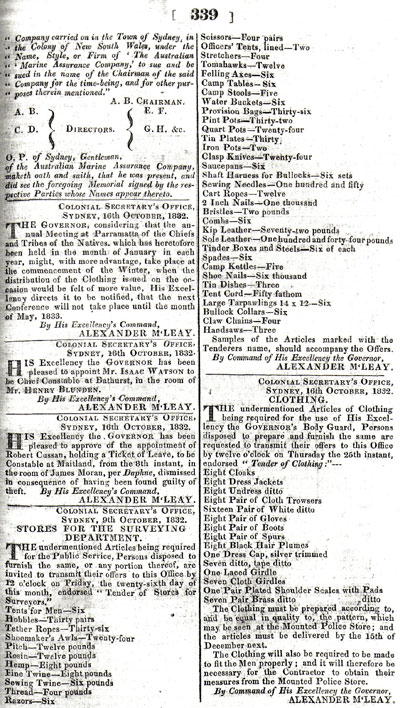
Sydney Gazette, 16th October, 1832, Governor's Order forbidding the Tribes to meet until May 1833
"A Mission to the Aboriginal Inhabitants of New Holland"
10 July 1832.
1833
Annual meeting of the Chiefs and Tribes of the Natives
26th March, 1833; Sydney Gazette
Colonial Secretary's Office, Sydney
His Excellency the GOVERNOR is pleased to direct it be notified, with reference to the Government Order of the 16th of October, that the ANNUAL MEETING of the CHIEFS and TRIBES of the NATIVES will take place at Parramatta on Wednesday the next, at one o'clock.
The GOVERNOR also takes this opportunity of notifying, that the Blankets which are to be given this Winter to the Aborigines will be distributed at several Stations in, the Interior about the 10th of May; and His Excellency requests that the Magistrates and Settlers will have the goodness to make this known to the Natives, in order that such of them as may attend the feast at Parramatta may he induced to return immediately to their Districts.
By His Excellency's Command,
ALEXANDER McLEAY.
Blankets and Clothing
26th March, 1833 Colonial Secretary's Office, Sydney
The following articles being required for the Public Service, Persons disposed to furnish the same, or any part thereof, are requested to transmit their offers to this Office by twelve o'clock on Thursday the 4th of April next, endorsed "Tender of Blankets, &c.," and accompanied by samples of the articles tendered.
Coarse Blankets, 800 - For distribution to the Natives of the Interior.
Coarse Serge Jackets, 200 - For distribution to the Natives at the Feast to be given at Parramatta, in May next
Ditto Trowsers, 200
Ditto Petticoats, 100
Ditto Bed Gowns, 100.
The Blankets will be required to be delivered immediately, and the other articles must all be supplied by the 20th of April.
By Command of His Excellency the Governor
ALEXANDER McLEAY
The
Wellington Missionaries report on the violence
of
the settlers towards the Aborigines
14th December, 1833
REPORT
of the Mission to
the Aborigines of New Holland. Station, Wellington Valley.
The
Missionaries, Rev. Messrs. Watson and Handt, with their wives, arrived at
Wellington Valley on the 3rd October, 1832, accompanied by eight Natives who had
joined them on the road. A sew days aster their arrival they were visited by
more than sixty Natives, many of whom, were wild, and had come from 50 to 70
miles distance. They were supplied with food, a small quantity of tobacco, and a
sew pipes. They were then interrogated as to their knowledge of who had made
them, the sun, trees, &c. of this they appeared . to be entirely ignorant;
nor hail they the least idea of a Supreme Being, of the immortality of the soul,
or of a suture state of existence; they were then; informed that the
Missionaries had been sent by the King of England to teach them the great truths
of religion, and to make them. acquainted with arts and civilization; they
answered to these things, ".budgery, budgery" (good, good.)' They did
nut remain many days, but have since paid several visits to (Mission.) The
Missionaries very speedily discovered that the Natives had been prejudiced
against them, by the stockmen in the neighbourhood, who told them that the men
would be yoked and made to work as bullocks, and the children would be sent to
Sydney and put in prison. A school was established at the commencement of the
Mission, and has been continued. Here from twelve to twenty children have been
under instruction at one time ; some have occasionally lest, and others have
supplied their place. These have been taught to read and spell, and have been
regularly instructed in the principles of the Christian religion. ' It has not.
been discovered that these children and youths are in any degree inferior in
intellect, or ability to learn, than those of civilized countries. They
learn their lessons, hymns, prayers, &c, as readily as children in general
in an English school. That some moral reformation has been produced by the
labors of the Missionaries among these degraded and unlettered Tribes, is
evident from this one circumstance, viz:—That swearing in the English
language, which is generally prevalent, is never practised in the hearing of the
Missionaries by any Native who has occasionally been at the station. Instances
have occurred of the Mission boys correcting adult Natives for swearing, even at
the excuse of a good beating for their friendly admonition. Some time ago a
Native youth, who was so deeply diseased as to render his recovery exceedingly
doubtful, came to Mr. Watson for medical aid ; he was at the time a notorious
swearer ; after being at the Establishment for some time he recovered, and
returned to his brethren forty miles distant. Shortly aster his return, an
English stockman swore at an unruly cow, in the hearing of the Native youth, who
reproved him, and said it was " no good to swear." He was asked why ?
He replied, " because you will not go to Heaven is you swear." He was
then asked who told him so ? He answered, " good deal Mr. Watson talk that
way, and good many books he have too, which talk that way all about." The
Englishman acknowledged that it was very wrong to swear, and he would try to do
so no more.
The
demoralization and degradation of the women have perhaps no parallel among
savage nations ;for sad as is the state of the female generally under such
circumstances, these seem degraded below the lowest of the low. They are
commonly betrothed in their earliest infancy, and are not unfrequently taken
soon aster by their husbands. Then, too often, all moral restraint and honorable
affection are cast away, and adultery in the most frightful latitude is
permitted, both with the Aboriginal youths and European adults ; and in the huts
of the latter they are very commonly compelled to reside for a considerable time
; but when with their husbands they usually have to hunt for their own food, and
even for their husbands, and in their journeys they have to carry what they may
desire to take from one place to another, and even the weapons of the husband.
And it may be added, that they are often made the unwilling victims of
their husbands' indolence, and the licentiousness of the Europeans. Indeed the
idleness of both sexes, and their willingness to receive either food or other
articles without any labor, has led to a dreadful increase of their native
habits of immorality, and the Europeans participate in them, who are ready to
use threats, or even violence, when they find opposition to their vicious
inclinations. The cruelty of some of these stockmen to the Natives of both sexes
it is to be greatly feared will ultimately lead to revenge on the part of
the natives, and the result may be the murder of any or of every white man they
meet with. Common as female
prostitution is here, the Missionaries are happy to say, that one female who has
been under religious instruction at the Mission House, has since that been known
repeatedly to repel the solicitations of white men, and. has told them as a
reason for her conduct, that ‘God would see them,’ and that. ‘God who sit
down in Heaven would be angry.’ That the children instructed at the Mission
House believe the fundamental doctrines o| the Christian religion, is evident
from the very interesting questions which they are constantly in the practice of
asking. In the month of April, 1813, Mrs. Watson rescued a. half-caste infant
from immediate death. Its unnatural mother had so treated it as to impress her
own mind that it was already dead, and her female companion was preparing its
grave, when Mrs. Watson discovered them. By the attention paid to it it revived
and lived for three weeks, when the effects of its parents unnatural conduct at
its birth produced a disease which terminated its earthly existence. On this
occasion the Native children at the Mission House were deeply affected, and
asked is baby in Heaven now ? Has
Jesus Christ taken it ? Is it a little angel?" There is abundant proof that
some of the children who have lest the Establishment, and gone into the bush for
a season, have both related their prayers at night and said grace before they
partook of the opossum or wild
cabbage.
Besides
those who are under regular
instructions, there are generally
several others, youths and adults, at the Mission House. Their
number is very fluctuating, and
their stay very variable ;
sometimes twenty or thirty will
remain for a fortnight, and then
take their departure. In a day or two some of them, perhaps all, will
return, and remain for a short
The
expenditure of the Mission, has during this, its first year, been unavoidably
heavy , and indeed it must continue to be so, is as has been the case during the
past year, all the supplies needed for the Establishment in suture, have to be
procured in Sydney, or at Bathurst, or indeed, is they will have to be purchased
at all. The Missionaries, aware of this, have availed themselves of the
facilities afforded them by the generous act of His Excellency the Governor, in
assigning a certain portion of land at Wellington Valley for the use of the
Mission. Accordingly, in the month of July last, twenty acres of wheat were
sown, which, however, from the unparalleled dryness of the season has all
perished. About ten acres of maize corn has since been planted, and is in a
promising state. When there has been raised at Wellington Valley a sufficient
number of stock, and grain enough to warrant such a procedure, the Missionaries
think it highly desirable to form a station amongst the wild black Natives,
where they have not been corrupted by intercourse with Europeans. Such a station
might be very conveniently supplied from Wellington Valley, where Missionary
efforts will still be in operation, and as diligently attended to, as at
present.
A
Vocabulary of the language is in a state of preparation.
(Signed)
WILLIAM WATSON,
J.C.S.HANDT
Mission
House, Wellington Valley,
14th
December, 1833.
E.
DEAS THOMSON, Clerk of the Council.
[17]
1833
– Appellate jurisdiction of Privy Council extended to Colony; civilian juries
in criminal cases
Annual meeting of the Chiefs and Tribes of the Natives at Parramatta
25th March, 1834; Sydney Gazette
His Excellency the GOVERNOR is pleased to direct that the ANNUAL MEETING of the CHIEFS and TRIBES of the NATIVES will take place at Parramatta on Thursday the 1st of may next, at one o'clock. The GOVERNOR also takes this opportunity of notifying that the Blankets which are to be given this winter to the Aborigines will be distributed at the several stations in the interior, about the 10th of May; and His Excellency requests that the Magistrates and Settlers will have the goodness to make this known to the Natives, in order that such of them as may attend the Feast at Parramatta, may be induced to return immediately to their districts.
By His Excellency's Command,
ALEXANDER McLEAY.
Colonial Secretary's Office,
Sydney, 25th March, 1834.
is hereby given, that TENDERS will be received at this Office, on Wednesday the 2nd of April, for furnishing such quantities of the under-mentioned Articles of CLOTHING as may be required, from time to time, during the present year, for the Colonial Service.
BLANKETS, DITTO, coarse, for the Native Blacks, HAMMOCKS, TROUSERS, PETTICOATS, BED GOWNS For distribution to the natives, at the feast to be given at Parramatta, in May next. The conditions to be those specified in the Government Notice of the 29th October, 1833. Information respecting the quantity of articles required, and the description of those for the Aborigines will be afforded on application at this Office.
By Command of his Excellency the Governor, ALEXANDER McLEAY.
Temporary Reserve for the Mission to Aborigines
3rd June, 1834; Sydney Gazette
Colonial Secretary's Office, Sydney
NOTICE is hereby given, that the undermentioned tract of Land, in the neighbourhood of Wellington Valley, has been temporarily set apart for the use of the Mission to the Aborigines; viz. -
"Commencing at the confluence of the Rivers Bell and Macquarie; and bounded on the north and east by the River Macquarie, until it turns to the east at a point about two miles south-east of Wellington Station; on the south-east by the hills to Welbong Caves; and on the west by the hills about a mile west of the Bell to the confluence aforesaid." By Command of His Excellency the Governor, ALEXANDER McLEAY
Forty Pounds Reward
November 17th, 1834
Colonial Secretary's Office, Sydney
WHEREAS the undermentioned BLACK NATIVES stand charged on oath with having committed RAPE and ROBBERY at the Farm of John Lynch, at Sugar-Loaf Creek, in the Hunter River District, on Wednesday the 5th instant; - Notice is hereby given, that any person who shall apprehend, or cause to be apprehended, and lodged in any of His Majesty's Gaols the whole or either of the said offenders, shall receive a REWARD of TEN POUNDS for each of them who shall be so secured: YOUNG PRICE: CHARCOAL'S BROTHER; or DICKEY CHARCOAL; BILL or MISERABLE BILLY; and MICKEY.
By His Excellency's Command, ALEXANDER McLEAY
One Hundred and Eighty Pounds Reward
December 15th, 1834; Sydney Gazette
WHEREAS the undermentioned BLACK NATIVES have been reported to the Government as Ringleaders in various Robberies and other Outrages which have been recently committed in the District of Brisbane Water; Notice is hereby given, that any person who shall apprehend or cause to be apprehended, and lodged in any of His Majesty's Gaols, the whole or either of the said Offenders shall receive a REWARD of TEN POUNDS for each of them who shall be so secured: -
MOLLY MORGAN, HOBBY, LITTLE JACK, Brothers, and very bad characters, JACK JONES, TOM JONES, JUGO, Brothers, and ditto. ABRAHAM, PADDY, Brothers, and ditto. YOUNG DICK, always carries a gun, BIG JIMMY, speared a white man. WHIPUNUP, ditto. KORUNBONG JIMMY, EMU, MONKEY, NIMBO, BIG HARRY, Bad characters. LITTLE DICK, Principal agent and messenger. LITTLE JOHN, Bad character, and father to Abraham and Paddy.
By His Excellency's Command, ALEXANDER McLEAY
The
Missionaries Report on the Aborigines
of
New Holland.
"...STATION—WELLINGTON
VALLEY.
The
Missionaries, in presenting a Second Annual Report of their labors among the
Aboriginal Natives of New Holland, are happy in being able to state, that their prospects of being useful to these so deeply degraded, and so long neglected Tribes, are more cheering than when the former Report was drawn up. The prejudices which formerly were so strong against the Missionaries are in a great measure removed, and many of them have acknowledged that the design of the Mission is a very good one, and they believe that " by and bye blackfellow make a light." The native men have left their wives at the Mission House in large numbers for months successively, when they have gone on their expeditions into the bush. The Natives in general have come to the Establishment in larger numbers than in. the preceding year, occasionally to the amount of eighty and one hundred. They have also remained longer there and evidently with more confidence. Many have been induced to work in the Mission garden, in the paddock, &c. In the spring, one youth was engaged in driving bullocks at plough, and occasionally ploughing. During the harvest, eight Natives were daily employed in reaping. Several have planted maize, corn, melons and pumpkins, and sown tobacco seed for themselves. Some of the children have each a small plot of ground in the Mission garden which they respectively cultivate for themselves. The Missionaries have itinerated on several occasions to the distance off from forty to seventy miles in each direction. On these journeys when they have met with Natives who had seen them at Wellington Valley, the most friendly disposition has been invariably manifested. They have also given sufficient evidence that they had not forgotten the daily custom at the Mission House, of presenting prayer and praise to the Great God and Saviour of mankind, by readily kneeling down and uniting with their Christian Teacher in this sacred duly. In the month of February, 1834, one of the Missionaries and his Wife, with an European servant, and a Native Girl, commenced a journey into the interior. A Native youth who had generally been at the Mission House since October, 1832, expressed his desire of going ; but it was thought advisable for several reasons to leave him on the Establishment. However, he felt the disappointment so keenly, that he went before, and having cut down and gathered a number of large boughs, he laid them across the road to impede the progress of the cart, for the distance of two miles. This youth, aster his return, of his own accord, removed them all, saying be had done wrong to place them there. When the company had proceeded about three miles, the youth came up and begged to be allowed to go. which was agreed to, for however improperly he had acted, it cannot be forgotten that he was Heathen. On their journey several Natives joined and proceeded with them. Every evening, all the Natives who were present, united with the Missionary in family worship, and afterwards repeated their prayers in a very solemn manner. This was indeed an interesting scene to behold. A number of Heathen savages in the open wilderness, upon their knees, observing the greatest decorum, addressing the august Majesty of Heaven and Earth. Goon-peen, a Native youth, always took the lead, and acted as prompter in these devotional exercises. It was intended to proceed to Gingin, but having been joined by so many Natives, the stock of provisions became exhausted, and after travelling about eighty miles in a north-west direction, it was sound necessary on this account to return. About one hundred Natives were seen during this tour, and were conversed with on the subject of religion, &.C. The Native Girl who accompanied the Missionary from Wellington Valley, was of great service, acting as an interpreter in cases where the Missionary could not make himself understood ; and it was remarkable how strongly she sometimes argued with the Natives on religious subjects. Medicine was administered to about thirty who were sick, and several came with the Missionary to Wellington Valley. Tho weather was sometimes very unfavorable, the lightning was so vivid, and the rain descended in such torrents, that it was with difficulty the horses could proceed.
The Missionaries by holding frequent intercourse with the Natives, have obtained more accurate views of their opinions on various subjects. It is now proved beyond dispute, that they believe in the existence of a spirit distinct from the body, and surviving its dissolution. Though there are amongst them, as indeed amongst all nations, some professed unbelievers on this subject, who frequently say, " blackfellow die altogether, " but like the infidel in the storm, from this position they are easily driven by reference being made to their constant fear of death, and their dread of going near a grave, or a hut where a person lately dead formerly resided.. They say that " Byamy, who sits down long way off, over the great waters near to England, " made every thing, and every body first time. " It may eventually appear that they do believe in a first cause. Conversations are frequently hold with the Natives respecting "Byamy," but their accounts are so mysterious, that it is very difficult to understand them; and when they are asked questions which they cannot answer, they conclude the subject by saying, " don't like to talk about him, ho will be very angry." Several months ago there was a general opinion among them, which emanated from some one eminent Native living a great way off, that in a short time there would be a general inundation, but previously to its occurring they would receive a warning, where they should erect a very large hut, in which, they were all to dwell, and that animals eaten by them as food, would voluntarily proceed to the hut, and remain therefore their consumption; when time passed on, and the great flood came not, on being interrogated on the subject, they replied, " Oh ! that happened long time since. " Whether this is a fragment of the tradition respecting the deluge, it is not easy to determine.
In October, 1833, Goongeen, a Native youth, accompanied one of the Missionaries, on a visit to Sydney. In many respects it appears desirable that persons in his situation should have the opportunity of witnessing the comforts and advantages of civilised life. But it must be confessed, that in a moral And religious point of view, such a circumstance is replete with danger, from that pravity of morals which so generally disgraces our cities and towns. As the youth was anxious to see Sydney, it was deemed more prudent for him to accompany the Missionary than others, who would encourage him in the indulgence of his evil propensities, and who would probably introduce him to scenes of vice, to which he had before been a stranger of all the strange things he beheld there, nothing seemed to surprise him so much, or to make so deep an impression on his memory, as Saint James's Church full of persons assembled together for divine worship, and the sound of the organ. Many times since his return, he remarked, " Sydney, hye, hye; every body goes to Church at Sydney—great music there. "'What for not make Church here like Church at Sydney. " He seemed much astonished at the sine furniture which he saw in some respectable houses, and asked, " who made all them things." To him this was quite a novel scene, as the seats of the Mission house consist principally of benches, boxes, and broken chairs. At Sydney, Goongeen saw some of the New Zealanders, and being told that very many of their countrymen were converted to Christianity, and several were engaged in preaching the gospel, he has frequently made this a subject of conversation with his Native brethren. The Missionary does not at present, see any reason to regret his taking the youth with him, as there is ground to hope be thereby rather profited than otherwise. The return of Goongeen to Wellington Valley was hailed with delight by many of the Natives, who had been made to believe that he would never return. Great pains had been taken to dissuade him, as well as King Bobby, (who was very anxious to see His Excellency the Governor) from going, being told that tho Missionary would put them in chains, and send them to England. Several instances have occurred, in which some of the Natives have evidenced solicitude for tho safety of the Missionaries in times of apparent danger. On one occasion, when one of the Missionaries, in company with several Natives, was returning from a journey into the interior, when several miles from home, and late in tho night, they were overtaken by a violent storm of thunder, lightning, and rain; indeed, so tremendous was the hurricane, that the Missionary lost his horse, cloak, hat, and all his travelling apparatus. Tho night was so dark that not an object could be discerned, except by the slashes of lightning. To prevent the Missionary from falling over any stumps of trees, or in passing through creeks, two of the Natives voluntarily took him between them, each taking holdof his arm. On another occasion, when the land at Wellington Valley was flooded, as one of the Missionaries was riding through a paddock, in company with a Native, his horse stumbled, and aster making several plunges, laid himself down in the water; in a moment the Native dismounted, had the Missionary in his arms, placing him upon his (the Native's) horse.
There have been at different times on the establishment, during the past year, thirty children to whom instruction has been given; some have remained but a short time, others longer, and some have continued with the Missionaries. It has been remarked, that the Native children might be taught to imitate certain sounds, or to remember those imitations, and no more; but the Missionaries are happy to say it is far otherwise. The gate to knowledge is in a great measure secured against their admission, and they manifest no curiosity to know what is contained within. Learning to read appears to them a work of impossibility ; and therefore they have no heart to it. But when they have once become able to read, and their minds being thereby expanded, they become inquisitive; learning is no longer looked on as a task, but esteemed as a privilege, as well as & of delight. Several months age, two boys refused to grind their wheat, and went to the river. In the evening they returned and came up to the window as the children were at prayers; when they came to that petition in tho Lord's Prayer, " Give us this day, &c., " the boys outside repeated in an emphatic tone. " Give us this day our daily bread ; give us daily broad ; bread for all day ; and forgive us our trespasses. "
The following will tend to show the simple, yet pleasing manner, in which the Heathen children often converse. Tho conversation took place in the garden, after tho departure of a gentleman :—
Geanil—Who is that gentleman ? Is he an Englishman ?
Missionary—No.
Geanil—Oh ! an Irishman.
Missionary—No. He is a Scotch Gentleman.
Geanil—Oh ! Scotch Gentleman—does land where be lives belong to your King ?
Missionary—Yes.
Geanil—Oh ! all white masters belong to your King. King William—Sovereign Lord King William. You pray for your King every Sunday. Is he a good man ?
Missionary—Oh yes. He prays to God, and goes to Church.
Geanil—Gracious Queen Adelaide. Who is Queen Adelaide ?
Missionary— The wise to King William.
Geanil—Is she a good Woman ?
Missionary—She always reads the Bible, prays to God, and goes to Church.
One of tho little boys then started the following conversation :—
Oomby—Sheep-mutton sit down at Sargeants
Missionary—Yes, the flesh of sheep is called mutton.
Oomby—Who makes mutton ?
Missionary—God makes sheep, the flesh of which is called mutton.
Oomby—First time I believe, (that is, God made sheep at first.)
Goanil—God always makes it to be sure. God makes all about. First man Cod made was Adam—then be eat of the tree of knowledge of good and evil.
Missionary—Yes, Satan tempted him, and he did eat of it, although God had told him not to eat it.
Geanil—No woods in garden then. Did Adam die then? . Missionary—No.
Dicky Marshall—No. God came down from Heaven, and turned him ou tof the garden with a sword, which went this way. (Waving an old shingle about with his hand.)
Geanil—Is Adam in Heaven now ?
Missionary—Yes. God told him that Jesus Christ, his Son, would in process of time come down from Heaven, and die for him and all men: He believed God, and was very sorry for his sins, then God forgave him.
Geanil—Then he went to Heaven when he died.
Missionary—Yes.
Geanil—Eve too ?
Missionary—Yes.
Dicky Marshall — Enoch too went to Heaven?
Geanil—Enoch not die.
Dicky Marshall—Abel too went to Heaven, not Cain?
Geanil—Why did not Cain go to Heaven?
Dicky Marshall—Because ho was wicked, he killed his brother Abel:
In this manner the children often converse among themselves. Many quick and promising boys have been enticed away from the Mission House by European servants in the neighbourhood ; and when it is remembered that elsewhere they are under no moral restraint, but rather encouraged in all kinds of vice, instead of its being a matter of surprise that so few remain at the Mission House, where they are necessarily subject to control, and under discipline, it is rather remarkable that any will remain, where everything is so uncongenial with their habits and disposition. The migratory habits of the Natives prevent them from receiving that degree of Christian instruction which is desirable, but as they are always conversed with on religious subjects, and attend the Church when at the Mission House, it is hoped that some good, some real spiritual benefit will be the result—and when it will please the Almighty to convert any of them to the Christian faith, their predilection for wandering about, should it remain with them, will doubtless be a great facility for extending the glad tidings of salvation far and wide, as the Establishment is occasionally visited by Natives from a distance of one hundred miles. But it must be acknowledged, that until the Missionaries are able to address the Natives familiarly in the Aboriginal language, no considerable success can be expected from their labors. During the past year constant attention has been given to collecting words and sentences, analyzing them, forming a vocabulary, and arranging matter for a grammar. The following portions have been translated into tho Aboriginal language.
1.—Tho Lord's Prayer. Apostle's Creed. And the Ten Commandments.
2.—1st, 2nd, and 3rd. chapters of Genesis.
3.—1st, 2nd, 3rd, 4th, part of 5th, 8th, 20th, 27th, and 28th chapters of Saint Matthew's Gospel.
4. —Some of the Miracles of our Lord.
It was thought more eligible to translate an account of tho Creation of the World, the introduction of moral evil; the decalogue ; the birth of Jesus Christ, his baptism, and temptation the wilderness ; some of his miracles ; his accusation, trial, death, and resurrection, as forming the leading subjects of converse with the Natives, than to proceed regularly with one book; it may have have been expected, that ere this, something in the form of a translation would have appeared as the result of Missionary labor. It is true indeed, tho Missionaries could some months ago have presented sur publication some of the result of their labors in the language; but they were well aware that such translations would eventually be proved very inaccurate, and as such, any expense incurred by its publication, would have been employed to no useful purpose- It will be acknowledged by all, that tho attainment of an unwritten language, spoken by savages, unacquainted with the manners and customs of civilized life, is at all times a work of intense study, and of incessant application. In the present instance it is rendered more difficult by the constant use of words by the Natives, which are altogether spurious, being neither English nor Aboriginal. Moreover, as ideas cannot be intelligibly communicated but through the medium of words known both to the speaker and hearer, the Missionary has first to teach the. English language to the person from whom he would learn the Aboriginal. But aster all possible attention has been devoted to the language, the Missionaries apprehend that no translation of the scriptures, sufficiently correct for publication, will be produced, until some of the Natives are converted to Christianity. So it has been sound in other Missions, and so it may be in this. As this is a matter of opinion,—when the Missionaries have done their utmost, it will be left for others to decide on this point; from the great interest which, the Natives take in repeating their prayers, and in hearing portions of Scripture read in their native tongue, the Missionaries cannot but infer, that as their knowledge of the language advances, a door of usefulness will be gradually opening wider and wider. . On one occasion, when a portion of the Scriptures in the Aboriginal language was being read, tho Natives who were round the hut, on hearing it, came in and sat round the Missionary of their own accord. When he had finished, onoof them almost in an ecstasy, jumped up and exclaimed, "kurrenderung myengoo —kurrenderuny myenyoo," (book for blackfellows—book for blackfellows.) Their conduct at Church is remarkably correct; the most indecorous behaviour of which they are guilty, is occasionally falling asleep.
It is not in the power of the Missionaries to record in a report, all the pleasing features of their Mission, or all the trying scenes through which they have to pass. It will never to a reflecting mind appear, that the path of a Christian Missionary, amongst savages, is bestrewed with flowers, or that his mind is the seat of calmness and tranquillity. In this Mission, where Natives of both sexes are under instruction on the same spot of ground, the Missionary is called to witness painful, yea, heart-rending circumstances, which can never be recorded for tho perusal of an enlightened and Christian public. Cradled in prostitution as it were, and fostered in licentiousness, the female children brought under instruction in the families of the Missionaries, do not lose their propensity to vice, as with a charm. Nothing but Divine grace can eradicate those propensities, by the regeneration of the soul; and until that glorious change can be effected, the minds of the Missionaries will be constantly exercised with anxiety.
The entire failure of the crops of wheat in 1832, and maize in 1834, at Wellington Valley, and the high price of flour, together with the increase of Natives on the Establishment has greatly augmented the expenditure of the past year. But; while the Missionaries were careful to distribute to the Natives a moderate supply of provisions, they were equally anxious to observe the greatest economy from sixteen acres of wheat, a very fair crop has been reaped and gathered in, which it is presumed will be sufficient for the consumption of the ensuing year. A few acres of maize corn have been planted, bat owing to the dryness of the season, it is apprehended there will be no crop.
In conclusion, the Missionaries desire to present their grateful acknowledgement to His Excellency the Governor for defining the boundaries of the land reserved for the service of the Mission. It has been considered advisable to bring the Report down to the close of the year, so as to make it more regular, and as it will include the state of crops it will afford means of estimating more accurately the probable expenditure of the succeeding year
(Signed)
WILLIAM
WATSON
J.C.S.
HANDT
Mission
House, Wellington valley
31st December, 1834"
"The
duty of
acting upon principles
of
justice and humanity"
"There is no part of the British Empire in which so conscientious a care was taken of the lives and rights of the natives during the process of colonisation as in the contiguous districts of Victoria and South Australia. They were first colonised in 1837, at a time when the prolonged agitation of the emancipation party had just secured the freedom of the negro; and the treatment of the aboriginal inhabitants of colonies had come prominently before the public. The atrocious evils of the past were brought out in all their horror, and the savagery shown by well-armed white men in dealing with comparatively defenceless savages was depicted from many a platform ... Vastly different was the tone of men's minds in the days when Victoria was colonised. In 1834 there would be no doubt as to the temper of the English nation. In the address which the House of Commons presented to King William lV. in reply to his speech on opening Parliament in the July of that year, there occurs this notable passage:-"Your faithful Commons in Parliament assembled are deeply impressed with the duty of acting upon principles of justice and humanity in the intercourse and relations of this country with the native inhabitants of the colonial settlements," and they humbly pray His Majesty that the would be pleased to take such steps as will secure a kindly treatment of the natives and the spread of civilization among them ... such an expression of opinion compelled the cabinet then in Office to take the most extreme care in dealing with this difficult question, and for six or eight years afterwards it was a prominent matter in the policy of the Colonial Office , all the more so because the general seeling in England was so intense ... Those who maintained a general theory that the white men had no right to invade the territory of the inferior race, were expending their rhetoric in trying to convince practical men of a proposition to which they did not well know how to reply, but of which their common sense made them suspect the fallacy ... what could the oratorical party urge as the reason why each adult black man in Victoria should remain in perpetuity the sole and indefeasible owner of three hundred and sixty square miles to support himself, his wise, and an average of two children? Is the white man could without difficulty contrive to make these three hundred and sixty square miles support ten persons to the square mile, there would be 3500 persons resident thereon, and it would amply repay so numerous a community to maintain the naked savage, his wise, and two children, in a state of comfort utterly unobtainable when he had to hunt over so wide an area for their scanty subsistence. That, in principle, was the policy adopted in the early colonisation of Victoria ..."
[Source: Whitworth. Mr R.P.; The Treatment of the Aboriginals-1838 to 1847in Victoria and Its Metropolis (Melbourne, 1888) Page 229]
"Good free land"
" ... a great proportion of the capital which flooded in from 1834 was borrowed so that the pastoralist speculators could buy land within the boundaries, offered at auction by the Crown .. a substantial part of the 18 million acres of the 'twenty counties' still unalienated was good land ... graziers who had well established freehold stations found it abundantly worth while to send flocks out far beyond their accustomed pastures, to graze on good free land ..."
[Fitzpatrick, Brian: The British Empire in Australia, An Economic History, Foreword By Geoffrey Blainey Macmillan 1969) (Page 36-37) ]
1835
Proclamation of Governor Bourke, 10 October 1835
Although many people at the time also recognised that the Aboriginal occupants had rights in the lands (and this was confirmed in a House of Commons report on Aboriginal relations in 1837), the law followed and almost always applied the principles expressed in Bourke's proclamation. This would not change until the Australian High Court's decision in the Mabo Case in 1992. This document implemented the doctrine of terra nullius upon which British settlement was based, reinforcing the notion that the land belonged to no one prior the British Crown taking possession of it. Aboriginal people therefore could not sell or assign the land, nor could an individual person acquire it, other than through distribution by the Crown. When John Batman, one of the pioneers in the founding of Victoria, first settled at Port Phillip, he made an attempt to buy the land from the Aboriginal people through a 'treaty'. New South Wales Governor, Sir Richard Bourke, effectively quashed the treaty with this Proclamation issued by the Colonial Office and sent to the Governor with Despatch 99 of 10 October 1835. Its publication in the Colony meant that from then, people found in possession of land without the authority of the government would be considered trespassers.
"By His Excellency Major General Sir Richard Bourke, K.C.B. Commanding His Majesty’s Forces, Captain General and Governor in Chief of the Territory of New South Wales and its Dependencies, and Vice Admiral of the same &c. &c. &c.
Whereas, it has been represented to me, that divers of His Majesty’s Subjects have taken possession of vacant Lands of the Crown, within the limits of this Colony, under the pretence of a treaty, bargain, or contract, for the purchase thereof, with the Aboriginal Natives; Now therefore, I, the Governor, in virtue and in exercise of the power and authority in me vested, do hereby proclaim and notify to all His Majesty’s Subjects, and others whom it may concern, that every such treaty, bargain, and contract with the Aboriginal Natives, as aforesaid, for the possession, title, or claim to any Lands lying and being within the limits of the Government of the Colony of New South Wales, as the same are laid down and defined by His Majesty’s Commission; that is to say, extending from the Northern Cape, or extremity of the Coast called Cape York, in the latitude of ten degrees thirty seven minutes South, to the Southern extremity of the said Territory of New South Wales, or Wilson’s Promontory, in the latitude of thirty nine degrees twelve minutes South, and embracing all the Country inland to the Westward, as far as the one hundred and twenty ninth degree of east longitude, reckoning from the meridian of Greenwich, including all the Islands adjacent, in the Pacific Ocean within the latitude aforesaid, and including also Norfolk Island, is void and of no effect against the rights of the Crown; and that all Persons who shall be found in possession of any such Lands as aforesaid, without the license or authority of His Majesty’s Government, for such purpose, first had and obtained, will be considered as trespassers, and liable to be dealt with in like manner as other intruders upon the vacant Lands of the Crown within the said Colony. Given under my Hand and Seal, at Government House, Sydney, this (L.S) twenty sixth Day of August, One thousand eight hundred and thirty five.
(Signed) "Richard Bourke"
By His Excellency’s Command
(Signed) Alexander McLeay
God Save the King!
True Copy
Deas Thomson Clk Co
[Source: Proclamation of Governor Bourke, 10 October 1835, Provenance: Colonial Office of the British Government, Features: A document not available in Australia, Location: National Archives of the United Kingdom, http://www.foundingdocs.gov.au]
Annual Meeting of Aborigines discontinued
28th March, 1835.
Colonial Secretary's Office, Sydney
THE Governor is pleased to direct it to be notified, that as it has been found productive of some disorder and much inconvenience, to withdraw the Chiefs and Tribes of the Natives from their Districts to assemble them at Parramatta, His Excellency proposes this year to omit the meeting heretofore annually held at that place, and to cause the Blankets usually provided for them in the winter season, to be distributed at the several stations on or about the 1st of May by the local Magistracy, who will thus have an opportunity of obtaining an influence with the Natives, which properly directed, may tend to their permanent advantage, whilst it will promote the convenience and security of the settlers and their property.
By His Excellency's Command, ALEXANDER McLEAY.
YEARLY LEASES OF LAND.
March 30, 1835; Sydney Gazette
Colonial Secretary's Office, Sydney
Go to: Auctions: 1835, Yearly Leases of land
Crown Land (Claims) [Acts 1833-1835]
4 William IV., No. 9. An Act for appointing and empowering commissioners to hear and determine upon claims to grants of land, under the Great Seal of the Colony of New South, Wales. [28th August, 1833.]
5 William IV., No. 6. An Act to amend an Act, intituled, An Act for appointing and empowering commissioners to hear and determine upon claims to grants of land, under the Great Seal of the Colony of New South Wales. [18th July, 1834.]
5 William IV., No. 21. An Act for appointing and empowering commissioners to examine and report upon claims to grants of land, under the Great Seal of the Colony of New South Wales. [2nd June, 1835.]
Whereas a certain Act was passed by His Excellency the Governor, with the advice of the Legislative Council of New South Wales, in the fourth year of the reign of His present Majesty, intituled, An Act for appointing and empowering Commissioners to hear and determine upon claims to grants of land, under the Great Seal of the Colony of New South Wales, which Act is no longer in full operation, by reason of certain of the provisions thereof having been limited to a particular time; and the said Act having been found highly beneficial in settling disputed claims to grants of land, it is expedient to renew the same, with certain alterations and amendments : Be it therefore enacted by His Excellency the Governor of New South Wales, with the advice of the Legislative Council thereof, That it shall and may be lawful for the Governor of this Colony, to issue !'. one or more commission or commissions, under the Great Seal of this Colony, as the same may become necessary ..."
New South Wales Attorney General Saxe Bannister and the value in recognising customary law.
"... at least one former New South Wales Attorney General saw the value in recognising customary law in 1835. In his evidence to a Committee of the House of Commons, Saxe Bannister stated 'we ought forthwith to begin, at least, to reduce the laws and usages of the Aboriginal tribes to language, print them, and direct our courts of justice to respect those laws in proper cases."
[Aboriginal customary law, in Strengthening Community Justice, Some issues in the recognition of Aboriginal Customary Law in New South Wales. (Aboriginal Justice Advisory Council) Page 5]
Annual
Report of
the Mission to the Aborigines,
for
the Year 1835
28 June, 1836
MISSION TO THE ABORIGINES.
Annual Report of the Aboriginal Mission at Lake Macquarie, New South
Wales, 1835.
To the Honorable the Colonial Secretary, Alexander McLeay, Esq., &c, &c, &c.
Ebenezer, Lake Macquarie,
December 2nd, 1835.
Sir,
In the absence of the Venerable the Archdeacon, it becomes my duty, and I have the honor to forward the Annual Report of this .Mission to you, in order to its being submitted to His Excellency the Governor.
In the month of February last several Aboriginal Natives were tried, convicted, and sentenced for transportation for life : one was left for execution for a rape, whilst the others had their sentences commuted for a shorter period of confinement to labor on Goat Island, where they are being taught to read English.
Mickey, the individual to be executed, was attended to during his confinement in the condemned cell until his execution took place, and every exertion was used by me to instruct him in the knowledge of God our Saviour. At the first he stoutly denied being at the place when the crime was committed, and appealed to a person in proof thereof; but on enquiry it was most satisfactorily proved, that he had not been in the employ of that party to whom he referred. He afterwards adopted a threatening tone, and assured me that, "Is the White Men hung him, all the Blacks belonging to his, and the surrounding tribes up the Country would come, encompass and burn Sydney, together with the gaol in which he was confined." Conversation, however, softened down his mind, and he wept. In a subsequent visit he assumed a more bold aspect, and in. an undaunted manner declared, " That the Blacks had a much more powerful Being than the Whites had," who, he assured me, with English oaths, "would, is he were executed, put out the eyes of all the Whites, and smite them with total blindness!" This led to a conversation on the power of the True God, and of his Son Jesus Christ, to which he apparently paid attention, and henceforth ceased to make threatenings. On the morning of his execution, he was asked is be had prayed to Jesus in the night, and for the first time replied, that he had. Suitable passages of Scripture were read to him, whilst the irons were being removed, and he repeated prayers, which were also composed in his own language, as we walked to the place of execution ; he there knelt down joining in prayer, and then ascended the platform. Whilst the rope was being adjusted round his neck, he uttered a deep expression of sorrow, and with a becoming demeanour, was launched into the presence of the "Judge of All."
Hitherto, the Blacks under confinement had not been permitted to be present at the executions, in consequence of a general order respecting all prisoners in the gaol to that effect; but, at my suggestion, the Aborigines under confinement were allowed to behold the sentence carried into effect. Their pale visages, their trembling muscles, indicated the nervous excitement under which they laboured at the melancholy sight. Some, who were about to be brought to trial, urged me to speak for them to the Judge, and all requested that I would ask the Gaoler not to hang them during my absence. To use the. expression of McGill, who was present with me, he said that, " he thought when the drop fell, that he should have shed his skin !" .
Previously to this, it was a matter of joke amongst the Blacks, their being sent to any gaol. This painful task, together with attendance at the Courts of Justice, occupied nearly six weeks at Sydney.
It is pleasing to be able to report, that no further outrages have been committed in the neighbourhood whence these Blacks were taken ; and also, that when I visited Goat Island, where the Aboriginal Culprits are confined under the Superintendence of Mr. Langhorne, they were improving fast in their English Reading. This Gentleman informed me, that on asking the Blacks, " Who made all things ?" one of them, to his surprise, immediately answered " God;" and on being further questioned as to his source of knowledge he replied, " it was at Lake Macquarie." In August last, I was again subpoenaed to the Supreme Court, in consequence of outrages having been committed by the Aborigines in the vicinity of William's River; when another Black, named Charley, was sound guilty of murder, which he did not deny, even when arraigned, but pleaded in justification, the custom of his nation, justifying himself on the ground that, a Talisman, named Mura-mai* (*Note: see Grammar, Page 89) was taken from him by the Englishman, who with others were keeping a Black Woman amongst them, was pulled to pieces by him, and shewn to the Black Woman, which, according to their superstitious notions, subjects all the parties to the punishment of death ; and further, that he was deputed with others, by his tribe, to enforce the penalty, which he too faithfully performed.
It was deemed necessary, for the tranquillity of those disturbed Districts, that Charley should be executed at a place called Dungog, nigh to the scene of violence, and my duty was to attend him whilst under confinement in the Gaol of Sydney, and also to the place of execution. In this painful part of my Office , much satisfaction was derived from the great attention, and, submissive behaviour of the unhappy culprit. His dialect was a little different; he, like the former one, was a perfect stranger to me, but when my dialect differed from his, he would enquire minutely, and correct my language to accord with theirs. From him no murmur arose, no threat of vengeance escaped his lips, but only an expression of sorrow that he had listened to his tribe, and of lamentation that he knew no better, his tribe had deceived him. When urged to believe in, and pray to the Lord Jesus Christ, he asked, how was he to address him ; on being taught what we deemed suitable prayers, in-his own tongue, he repeated them; and subsequently, when asked, is he had prayed in the night, his reply was that, " he had asked Jesus to cast away all his evil deeds, and to receive his spirit when the Whites kill his body." Owing to some little confusion in the arrangement of the concern when we landed at the Green Hills, he appeared angry, and with a louring aspect, took from his cap bread and biscuit, and threw them, with much displeasure, to the dogs. Seeing him agitated, I informed him this was not the place of execution, nor the day on which he was to suffer, he then gave me a slip of paper from those with which I had furnished him, to know the days he had to live, and sound he had but three lest; he then resumed his usual appearance.
On the morning of his execution at Dungog, aster reading and praying with him, he said, " when I am dead, shall I make good houses, and be like the Whites in the other world;" this led to reference to the " House not made with hands; Eternal in the Heavens" and to the fashioning of our mortal Bodies to " the Glorious Body of Christ;" the executioner then arrived, and we walked to the fatal drop through an escort of military; he kneeled and prayed, we ascended the gallows, he stood firmly, saying, " I am now cast away for death he repeated the prayer, " Lord Jesus receive my spirit " the drop fell, and eternity must develop the triumphs of the Cross.
Six weeks were thus occupied before I could return home, making with the former execution, a period of three months out of the present year, employed in a useful, though unpleasant part of my Missionary duties. My first detention in Sydney afforded me a more favourable opportunity of hastening through the press " The Australian Grammar," than could have been had I remained at the Lake, and I have much pleasure in announcing its completion; copies of which have been forwarded to the Colonial Secretary. Owing to the arrangement, by His Excellency the Governor, that part of the expense of printing should be defrayed by Government, being made subsequent to the printing, precluded the acknowledgment with thanks in the work itself.
The following subjects have occupied, and still occupy my attention in the Aboriginal language and Mission, viz : —
1. An Australian Grammar. Printed.
2. The Gospel of Saint Luke .
3. A Selection of Prayers for Public Worship..........Under revisal.
4. A Spelling Book........ In manuscript,
5. Reading Lessons, Selected from the Sacred Scriptures .... In progress.
6. The Instruction of Two Native Youths, in Writing and Reading their own Tongue ........
During the present year the Measles have been very prevalent amongst the Aborigines, and have carried off many of the Natives, from whom Mrs. Threlkeld and our nine children caught the complaint, and were laid up at one time. Providentially, the disease has now subsided.
Several of the Blacks belonging to this District, headed by M'Gill, are travelling to Windsor, Parramatta, and Sydney, in order to teach other tribes a new Song and Dance, which have lately been brought from the regions far beyond Liverpool Plains, where my Son has ascertained that the Song exists, though the dialect is different to that used in these parts on. the Sea Coast, it is not discouraging to reflect that when " Knowledge shall increase amongst these tribes then, the same custom which promulgates the new Song, will convey throughout Australia " The glad tidings of " A Saviour, Christ the Lord."
Having thus stated the progress of, and circumstances connected with the Mission at Lake Macquarie, it only remains for me to mention that my intention in the ensuing year is, to endeavour to complete the elementary works for the Aborigines, and also to introduce their use, when printed, amongst them ; humbly depending on the powerful influence of that Holy Spirit, to cause these very dry bones in the wilderness to arise, and become an exceeding great army to the praise of Him who can excite " Kings to be nursing Fathers, and Queens to be nursing Mothers," to these miserable objects, for whom " The Messiah died."
Trusting that the progressive state of this Mission will not disappoint the expectation of His Excellency the Governor, of the Venerable the Archdeacon, during his protracted detention in Europe, or of His Majesty's Government, in England,
I have the honor to remain, Sir,
Your most obedient and humble Servant,
(Signed)
L.E. THRELKELD
1836
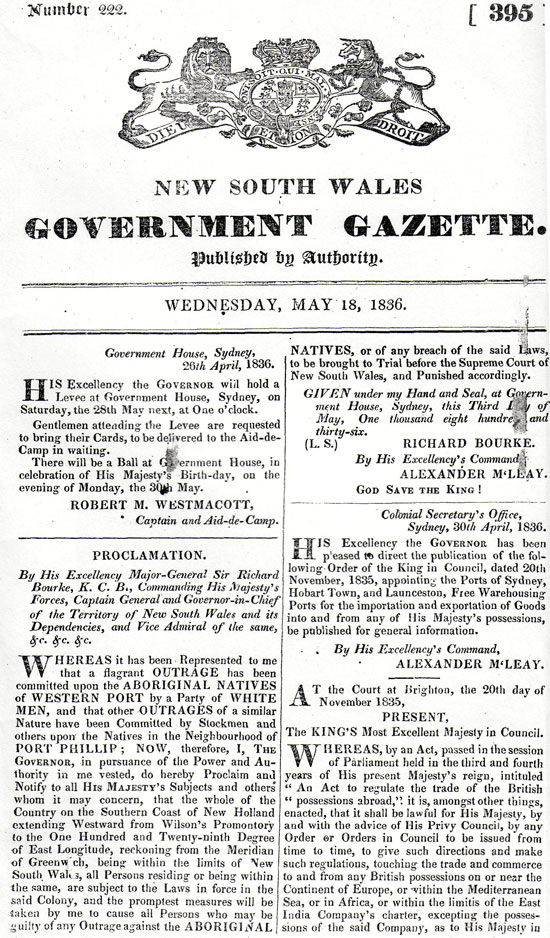
The Act for the Prevention of Vagrancy: the first New South Wales Act to refer to Aborigines
The Governor, Major-General Sir Richard Bourke KCB, (3/1/1831 - 5/12/1837), and his administration, were responsible, in 1836, for the first statutory Act against the rights of Aboriginal people; the Act for the Prevention of Vagrancy and for the punishment of Idle and Disorderly Rogues and Vagabonds and incorrigible Rogues in the Colony of New South Wales (6 Geo. IV. No.6) 25 August 1836 (repealed by 15 Vic. No. 4, 1851
The Public General Statutes of
" .....Whereas it is expedient to make provisions for the prevention of Vagrancy and for the punishment of idle and disorderly persons and rogues and vagabonds in the Colony ... and every person not being a black native or the child of any black native who being found wandering in company with any of the black natives of this Colony shall not being thereto required by any Justice of the Peace give a good account to the satisfaction of such Justice that he or she hath a lawful means of support and that such lodging or wandering hath been for some temporary and lawful occasion only and hath not continued beyond such occasion ... and every person wandering abroad or placing himself or herself in any public place street highway court or passage to beg or gather alms or causing or procuring or encouraging any child or children to do so shall be deemed an idle and disorderly person within the true intent and meaning of this Act and it shall be lawful for any Justice of the Peace to commit such offender (being thereof convicted before him by his own view or by the confession of such offender or by the evidence on oath of one or more credible witness or witnesses) to His Majesty's nearest gaol or house of correction there to be kept to hard labour for any time not exceeding three calendar months ..
In 1836, the Legislative Council passed the first Act to legalize and regulate squatting. Within the boundaries, the system continued as before, save that punitive sanctions were introduced; outside, the territory was divided into districts, over each being a Government official known as the Commissioner of Crown Lands. His duties were to safeguard the Government's interests and to prosecute intruders. Each squatter was allowed to occupy as much land as he could obtain for a yearly payment of £10, the amount being the same if the stockman had one acre or ten thousand. The Act went no further and even the Commissioners were an afterthought. The sole object was to allow stockmen to occupy Crown lands without breaking the law; and this the Act accomplished.
6 William IV., No. 16. An Act to remove doubts concerning the validity of grants of land in New South Wales.
9th June, 1836.
Whereas the Governors, Lieutenant-Governors, and persons administering the government of New South Wales, have from time to time, been authorised and red by His present Majesty, and His Majesty's two last Royal predecessors by commission under the Great Seal, to grant and dispose of the waste lands of New South Wales ; and whereas, in exercise of the power and authority in them vested as aforesaid, the respective Governors, Lieutenant-Governors, or persons administering the government of New South Wales, have from time to time made and issued grants, or conveyances of lands, situated in the said Colony, to divers of His Majesty's subjects; but such grants or conveyances, have been in the names of the said Governors, Lieutenant-Governors, or persons administering the government for the time being, and not in the name of His Majesty, or either of His Majesty's Royal predecessors ; and whereas doubts have been entertained whether such grants or conveyances, made and issued as aforesaid, by reason of the informality thereof, are valid in the law, or binding upon His Majesty, His Heirs and Successors ; and whereas to remove such doubts, and to quiet the titles of His Majesty's subjects holding or entitled to hold any lands in New South Wales, so granted or conveyed as aforesaid, His Majesty hath, though the Right Honorable Charles Viscount Glenelg, one of His Majesty's Principal Secretaries of State, graciously signified His Royal will and pleasure, that all grants or conveyances of lands, made by any such Governor, Lieutenant Governor, or person lawfully administering the government for the time being in the exercise, or supposed exercise, of the powers and authorities in them as vested as aforesaid, should be declared to be valid in the law, and binding upon His Majesty, His Heirs, and Successors: Be it therefore enacted, by His Excellency the Governor of New South Wales, with the advice and consent of the Legislative Council thereof, That all grants, deeds, or conveyances, at any time heretofore made and issued, by or in the name of any Governor, Lieutenant Governor, or person lawfully administering the government of New South Wales of any lands situated in the said Colony, and notwithstanding such grants, deeds, or conveyances, shall not be in the name of His Majesty, or of either of his Majesty's two last Royal predecessors, shall be, and shall be deemed, taken and held to be, and to have been, from the respective dates thereof, as valid and effectual in the law to grant and convey such lands, and shall be as binding upon His said Majesty, His Heirs and Successors, to all intents and purposes, as if such grant, deeds, or conveyances, had been made and issued in the name of His Majesty, or of either of His Majesty's two last Royal predecessors, passed and been executed under the Public Seal of the said Colony, been recorded, in the most regular form of law, anything in any Act, law, custom, or usage, to the contrary in anywise notwithstanding.
RICHARD BOURKE, GOVERNOR
1837
"The duty of acting upon the principles of justice and humanity"
"That His Majesty's faithful Commons in Parliament assembled, are deeply impressed with the duty of acting upon the principles of justice and humanity in the intercourse and relations of this country with the native inhabitants of its colonial settlements, of affording them protection in the enjoyment of their civil rights, and of imparting to them that degree of civilization, and that religion, with which Providence has blessed this nation, and humbly prays that His Majesty will take such measures, and give such directions to the governors and officers of His Majesty's colonies, settlements and plantations, as shall secure to the natives the due observance of justice and the protection of their rights, promote the spread of civilization amongst them, and lead them to the peaceful and voluntary reception of the Christian religion."
[Source: Report from the Select Committee on Aborigines (British Settlements) 1837,B.P.P., (425), Vol.VII, p.75; in Woolmington J, Aborigines in Colonial Society, (Cassell Australia, 1973) p. 9]
The
document series (above) in Chapter 1 is still incomplete
Here ends Chapter 1, (a work in progress), commentary last updated 19/04/2006
Go to next chapter, 1838 - 1846: Chapter 2
Go to central reference page: Index of Acts by Year