Chapter 2
February 1838 – July 1846
"Queen Victoria Proclaims Aboriginal Rights, and the Evidence Act is Disallowed"
Work in progress. Updated 17/04/2006
Note: This web page is part of a research blog, and will expand.
Commentary on the documents
Chapter 2 covers the period February 1838 until July 1846. It examines the behaviour of, and attitudes of Sir George Gipps and his administration towards the Aborigines; and the three Acts, the Imperial Ordinance, and the Standing Orders to the Border Police; all referring to Aborigines, which were generated during this period.
The first document, in 1838, the Colonial Secretary refers to Copies of Minutes and Memoranda Received, [AONSW ref: 4/1013]. Just a tantalising glimpse of the records waiting out there to be brought to light.
Also
in 1838, in "Major
Mitchell's attacks on the Black Natives" [HRA 18th
April, 1838]
Sir George Gipps
wrote to
Lord Glenelg, (Despatch No. 63, per H.M. Ship Buffalo.) that with reference to the attack made on the Black Natives by the exploring party under
Major Mitchell on the 27th May, 1836, and Lord Glenelg's desire that
the case be should be laid before the Law
Officers of the Colony, who should report whether they find any cause to doubt
the lawfulness of Major Mitchell's proceedings, or regard a further enquiry
necessary for vindicating the authority of the Law: Geo. Gipps had the honour to inform
his Lordship that the same has been done, and that he has enclosed a Copy of the Report
which has in consequence been made by the Attorney General.
The documents, 1838 - 1846.
1837
Major Nunn, and a massacre by the Mounted Police under his command
" ...there were rumours to the effect that the mounted police did not always deal thus with the blacks. One of the better documented episodes of this latter kind occurred in early 1838. On 19 December 1837 Major Nunn, Commandant of the Mounted Police, was summoned to Government House where he spoke to Mr Thomson, the Colonial Secretary, and Colonel Snodgrass. They had received a report from the Commissioner of Crown Lands for the Liverpool district in the far north-west and from this it appeared that blacks to the number of 1000 had gathered for the purpose, it seemed, of challenging the invasion of their territory. Already there had been outrages on the Namoi, Gwydir and Big rivers, including the murder of five workmen. It was said that some white men were with the blacks, and, according to one account, 250 fires had been counted in one camp alone. Major Nunn was ordered to the north-west with all the police that could be spared.
After some preliminary sweeps through the troubled country in which the stockmen in many cases were afraid to leave their huts, Major Nunn and Lieutenant Cobban of the 50th Regiment, commander of the First Division of the mounted police, with a number of non-commissioned officers and about twenty troopers and some stockmen, were riding in fairly thick scrub in January 1838 when a black suddenly started up in front of Corporal Patrick Hannan and speared him in the leg. The same black was about to have a second go but was shot down by Senior-Sergeant John Lee. Hannan broke off part of the spear and rode to the rear whereupon the troopers took up the cry, 'Damn them. They have speared Hannan', and rode into the blacks, who by now faced them in considerable numbers. Because of the scrubby nature of the country the police soon scattered, and the commandant found it impossible for a time to maintain discipline. After the action a station superintendent, Lamb, was able to identify stolen property abandoned by the blacks, while Sergeant Dean collected over 300 spears. It is difficult to determine how many blacks were killed but Sergeant Lee believed it to have been between thirty and forty. Critics of the police said many more had fallen. Indeed, it was alleged that Major Nunn had boasted of 'popping off with holster pistol at the blacks whenever they appeared from behind a tree'. For good measure it was also alleged that in a side action Sergeant Temple had disposed of eighty. In after years it was said that a place called Gravesend, a mountain near Cobb's Station, where white men had been murdered at this time, used to be pointed out as a place where about 200 blacks had been killed.
One reason why the truth of this action was never discovered was that the officers neglected to take proper records of evidence at the time. Moreover the attention of the authorities was distracted by the Aboriginal massacre of a party of overlanders in what is now Victoria. This necessitated the dispatch of some of the police to the south while a massacre of blacks by stockmen near the scene of Nunn's action also diverted attention from the Nunn affair. In the end the Executive Council decided that the police had been justified in the use of force, though it deplored the number of Aborigines who fell. There was some irony in the fact that the police helped in arresting the stockmen later hanged for the Myall massacre ..."
[Source: O'Sullivan, John; Mounted Police in N.S.W. A history of heroism and duty since 1821. Rigby (1979) pp. 24-27)]
1838
Colonial Secretary: Copies of Minutes and Memoranda Received, 1838
(AONSW
ref: 4/1013). This bundle also contains policy drafts, Minutes, and
correspondence relating to land rights sovereignty, and conflict between British
settlers and Aboriginal people. Copies of the Bill are also in the New South
Wales Parliamentary Archives.
"Major Mitchell
18th April, 1838
Government House Sir George Gipps to Lord Glenelg, (Despatch No. 63, per H.M. Ship Buffalo.)
"With reference to
that part of Your Lordship's Despatch of the 26th July, 1837 .. which
directs that the proceedings of the Executive Council of New South Wales,
relative to the attack made on the Black Natives by the exploring party under
Major Mitchell on the 27th May, 1836, should be laid before the Law
Officers of the Colony, who should report whether they find any cause to doubt
the lawfulness of Major Mitchell's proceedings, or regard a further enquiry
necessary for vindicating the authority of the Law, I have the honour to inform
your Lordship that the same has been done, and to enclose a Copy of the Report
which has in consequence been made by the Attorney General.
I have, &c., Geo. Gipps.
[Enclosure]
[A copy of this Report will be
found in a volume in series V.] "
(HRA)
On the subject
of the treatment of the Aboriginal inhabitants of this Country
25 April 1838
(HRA)
Sir George Gipps to Lord Glenelg ".. on the subject of the treatment of the
Aboriginal inhabitants of this Country, and the measures which are to be adopted
when any of them come to a violent death by the hands of the Queen's officers or
by people acting under their orders, I regret very much that I have to state to
your Lordship that a case has already occurred, in which I found it necessary to
act on your Lordship's instructions ... Your Lordship will perceive by the
accompanying report, made to me by Major Nunn of the Mounted Police, that,
previously to my arrival in the Colony, a rencontre had taken place between a
part of the Police under his orders and a Tribe of the Natives, in which there
is but too much reason to suppose that a number of the latter lost their lives.
On the receipt of Major Nunn's Report, I deemed it my duty to lay it before the
Executive Council ... and also a copy of the Report of the Committee of the
House of Commons, which was appointed ... to enquire into the condition of the
Aborigines in the British Possessions; [find the Copy of the Minutes referred
to]
I had previously consulted the Attorney
General on the same subject, and as the advice (note 81) of the Council was
entirely in occurrence with the opinion expressed by him, I have since given
orders for an investigation into all the circumstances of the case to take place
before the Police Magistrate and Bench of Justices ... at Invermein in the
County of Brisbane, that Bench being the nearest to the scene of action ...
As your Lordship expressed an opinion
... that an investigation in cases of this nature might be held ... I could not
have made a selection of any particular Magistrates, without exposing myself to
the charge of partiality and of deviating without sufficient reason from the
course of proceedings, adopted in the Colony in cases of a similar nature, where
the lives of white men are concerned. As the affair took place far beyond the
boundaries of location, and in a Country which has rarely, if ever, been visited
by Europeans, it is impossible to ascertain with any great deal of correctness
the exact scene of it, or of the particular Tribe which Major Nunn fell in with
... the Surveyor General is inclined to suppose that that the affair happened ..
300 miles to the North and 70 to the West of Sydney.
I have, &c.,
Geo. Gipps.
HRA
Notice re
inquests on aborigines
27th April, 1838.
Sir George Gipps to Lord Glenelg "In my Despatch ... I detailed to your
Lordship the measures which I thought it right to adopt in consequence of a
recent collision between a party of Mounted Police and a Tribe of Native Blacks,
and I have now the honor to acquaint you that I have further deemed it
necessary, with the advice of my Executive Council, to issue a Government Notice
declaring that, in all cases where any of the Aboriginal Inhabitants of this
Territory shall lose their lives in consequence of a quarrel or collision with
white men, an Inquest or Inquiry shall be held, precisely similar to that which
is held in located parts of the Territory when a white man comes to a violent or
sudden death, and also declaring that the Commissioners of Crown Lands, beyond
the Boundaries of Location, shall act as Protectors of Aborigines. ... Your
Lordship is, I am sure, well aware of the extreme difficulty of devising any
measure that shall effectually check the outrages, which, I regret to say, are
now of frequent occurrence beyond the boundaries of location ... I have also
deemed it necessary to republish a Notice, which appeared in the Government
Gazette on the 16th Septt. (sic)
1837, on the subject of the forcible retention by white men of women
belonging to the Aboriginal Tribes, which there is reason to fear is often the
immediate cause of these outrages.
May 2nd, 1838 P.S..- Since the above Despatch was written, I lament to say that that information has been received .. which, being calculated to exasperate the public mind against the Blacks, renders it in my opinion desirable to defer the publication of these Notices for a few weeks. To the North, and in the neighbourhood of Major Nunn's late operations, a man in charge of a Cattle Station .. has been found barbarously murdered, and also two other men ... From the South, we have accounts of a large Convoy of Sheep and Cattle ... having been attacked ... and eight men killed out of eighteen ... the particulars of this last occurrence I have not yet received; but I have directed a Civil Stipendiary Magistrate and a party of the Mounted Police to proceed .. to the spot, and have given them particular instructions for their guidance. The Blacks, who are supposed to have murdered the two men ... will be tried before the Supreme Court."
[Gipps to Glenelg, 27 April, 1838, HRA]
An apprehension .. of the mischief that might ensue,
if any offence were given to the Officers and Men of the Mounted Police
27th April, 1838
Sir George Gipps to Lord Glenelg (HRA)
(page 399) "...the measures which I have thought it right to adopt, in
consequence of the late unfortunate Collision between a party of Mounted Police
and a party of the native Blacks ... I have reported to your Lordship that a
Government Notice is on the point of being issued, declaring the Commissioners
of Crown Lands beyond the boundaries of location to be charged with the duty of
protecting the Native Blacks. Your Lordship must be, I am sure, aware that these
matters are calculated to produce a considerable sensation in the Colony, and
that therefore much management is required in the treatment of them. In the
Executive Council, an apprehension arose of the mischief that might ensue, if
any offence were given to the Officers and Men of the Mounted Police .... Major
Nunn has stated to me that he thinks the party of Natives, he fell in with, must
have consisted of not far short of 1,000 persons, including women and children;
that they consisted of tribes but little accustomed to intercourse with white
men; and that they are particularly dexterous with their spears as well as a
peculiar instrument called a Boomering which they hurl with great effect. Your
Lordship will observe that Major Nunn does not state in his report the number of
men that were killed; but ... I should not think they were less than ten or
twelve, beside a number wounded ...I lament to say that we have since heard of
some outrages, which have the appearance of being retaliatory on the part of the
Blacks ....."
[Letter
from the Colonial Secretary of Van Diemen’s Land to the Colonial Secretary
of New South Wales, 22 August 1838 (HRA?)
Gipps to Glenelg
27 April 1838
1 lament to say that we have since heard of some outrages, which have the appearance of being retaliatory on the part of the Blacks. One white man at a distant Cattle station, belonging to a Mr. Fitzgerald, on the river Gwyder, has been most barbarously murdered, and some Cattle belonging to the same person slaughtered in a way that seems also to indicate its having been an act of revenge, rather than one of ordinary rapine, though I am not without hope that they may prove unfounded.
I have, &c, Geo. Gipps
P.S., May 2nd, 1838.—I regret very much to have to state that the rumours, alluded to in the concluding paragraph of the above Despatch, have proved but too true; two men belonging to a Surveying party having been found murdered in a part of the Country, not very distant from the scene of Major Nunn's operations.
The parties however, who committed these murders, have all been taken, and, as there seems no reason to doubt their identity, they will all be tried at the next Sittings of the Supreme Court.
Atrocities of a still more serious character have also, I regret to say, been reported, since the above Despatch was written, from quite another part of the Country. A party consisting of no less than eighteen men, who were driving a large herd of Cattle and a considerable number of sheep from the County of Murray to Port Phillip, were attacked on the 13th ulto. by a party of 300 Blacks and eight of them killed. I have as yet no particulars of the occurrence; but I have directed a Civil Stipendiary Magistrate and a party of the Mounted Police to proceed with all possible despatch to the spot. G. Gipps.
Sir George Gipps to Lord Glenelg.
"The influx of Capitalists ... the subject of Immigration from India ..."
Gipps to Glenelg. (Despatch marked "Confidential," per H.M. ship Buffalo; acknowledged by lord Glenelg 16th November, 1838.)
My Lord, Government House,
1st May, 1838.
"So long as the demand for labour, created by the influx of Capitalists, continues at its present rate, the supply afforded by means of Immigration alone must 1 think be found deficient ... I am very happy that I have received your Lordship's instructions on the subject of Immigration from India, as this means of supplying labor would, if carried to any extent, lie fraught in my opinion with evils of the highest magnitude."
Go to: The influx of Capitalists for more of document
Legal opinion
awaited re attack on aborigines by expedition under Mitchell
May 1838 (HRA)
Sir
George Gipps to Lord Glenelg
The Mounted Police are appointed
Loud Glenelg to Sir George Gipps.
(Despatch No. 104, per ship Portsea.)
Sir, Downing Street,
21 July, 1838.
I have received Colonel Snodgrass's dispatch No. — of the 23d February last, and I have to convey to you the sanction of Her Majesty's Government to the appointment of a Sergeant and six Rank and file of the Mounted Police of New South Wales for the service of the Settlement at Port Philip and also an addition of one Assistant and a Clerk to the Survey Department in that Province. I have, &c, Glenelg.
"A rencontre with a party of the Mounted Police under the command of Major Nunn ..."
Sir George Gipps to Lord Glenelg. (Despatch No. 113, per ship Superb; acknowledged by Lord Glenelg, 21st December, 1838.) My Lord, Government House,
21st July, 1838.
In my Despatches of the 25th and 27th April last, Nos. 67 and (58, I informed your Lordship of various outrages, which had taken place in the remote districts of this Colony beyond what are called the boundaries of Location, and of the measures which it was then my intention to adopt. In the Despatch of the 25th April, I stated that an enquiry was about to be instituted at Invermein into the circumstances, under which a number of the Aborigines lost their lives in a rencontre with a party of the Mounted Police under the command of Major Nunn, and, in that of the 27th, I informed your Lordship of my intention to issue a Government Notice on the subject, though in a Postscript to the same I stated that, in consequence of events which had come to my knowledge since the Notice was prepared, I had been induced to suspend the issue of it for a few weeks.
I lament now to have to state to your Lordship that, in consequence of the continuance of similar outrages, the calls for the services of the Mounted Police have been so constant that I have not been able to spare the men, who would have been required as witnesses in the proposed investigation at Invermein, also that, under the advice of the Executive Council, I have refrained from issuing the proposed Notice on account of the degree to which the Public mind continues to be exasperated against the Blacks.
On the 18th ulto., a Memorial was transmitted to me by a number of gentlemen interested in the opening of the Country near Port Phillip, of which I enclose a Copy; but, in so doing, as well as in transmitting to your Lordship a copy of my answer to it, it is necessary that I should explain to your Lordship that some of the gentlemen, who signed this Memorial, had previously waited upon me and requested that I would either myself levy war against the Blacks, or sanction the enrolment of a Militia for that purpose and allow them to be supplied with Arms and Munitions of War from Her Majesty's stores; and that it was (as I presume) in consequence of my declining to do either, that their subsequent Memorial was, contrary to usual practice, addressed to the Governor and the Executive Council instead of the Governor alone.
I have the honor to enclose a short abstract of the principal outrages between Blacks and Whites which have been reported in the last three months. Your Lordship will observe that a large proportion of these acts of violence occurred in the neighbourhood of Port Phillip, or on the road between the settled parts of the Colony and that place; the reason of which is that large herds of Cattle and flocks of sheep have been recently driven through these extensive tracts of Country, with a very insufficient number of people to guard them, often not more than in the proportion of one man to several hundred sheep; That, under these circumstances, predatory attacks should have been made on them by the Natives, does not I must say appear to me in the least degree to lie wondered at.
Your Lordship must be aware that it is quite out of the power of this Government to give to the proprietors or their Flocks the protection they desire; even if we were restrained by no sense of humanity towards the Blacks, the resources of the Government would be quite insufficient to keep Military parties always in advance of persons, who are migrating in search of pasturage, advancing often 50 miles in a single season, and in the ease of Port Phillip having stretched to a distance beyond our former limits of between three and four hundred miles in the last three years.
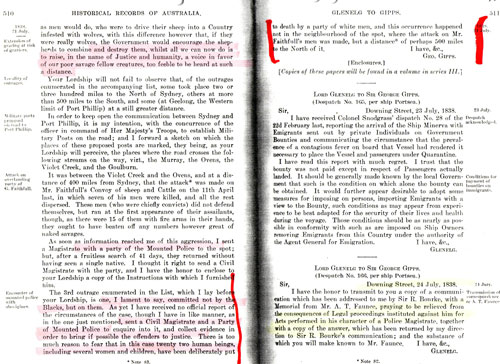
If Proprietors, for the sake of obtaining better pasturage for their increasing flocks, will venture with them to such a distance from protection, they must be considered to run the same risk as men would do, who were to drive their sheep into a Country infested with wolves, with this difference however that, if they were really wolves, the Government would encourage the shepherds to combine and destroy them, whilst all we can now do is to raise, in the name of Justice and humanity, a voice in favor of our poor savage fellow creatures, too feeble to be heard at such a distance.
Your Lordship will not fail to observe that, of the outrages enumerated in the accompanying list, some took place two or three hundred miles to the North of Sydney, others at more than 500 miles to the South, and some (at Geelong, the Western limit of Port Phillip) at a still greater distance.
In order to keep open the communication between Sydney and Port Phillip, it is my intention, with the concurrence of the officer in command of Her Majesty's Troops, to establish Military Posts on the road; and 1 forward a sketch on which the places of these proposed posts are marked, they being, as your Lordship will perceive, the places where the road crosses the following streams on the way, viz., the Murray, the Ovens, the Violet Creek, and the Goulburn.
It was between the Violet Creek and the Ovens, and at a distance of 400 miles from Sydney, that the attack was made on Mr. Faithfull's Convoy of sheep and Cattle on the 11th April last, in which seven of his men were killed, and all the rest dispersed. These men (who were chiefly convicts) did not defend themselves, but ran at the first appearance of their assailants, though, as there were 15 of them with fire arms in their hands, they ought to have beaten off any numbers however great of naked savages.
As soon as information reached me of this aggression, I sent a Magistrate with a party of the Mounted Police to the spot; but, after a fruitless search of 41 days, they returned without having seen a single native. I thought it right to send a Civil Magistrate with the party, and I have the honor to enclose your Lordship a copy of the Instructions with which I furnished him.
The 3rd outrage enumerated in the List, which I lay before your Lordship, is one, I lament to say, committed not by the Blacks, but on them. As yet I have received no official report of the circumstances of the case, though I have in like manner, as I in the one just mentioned, sent a Civil Magistrate and a Party I of Mounted Police to enquire into it, and collect evidence in order to bring if possible the offenders to justice. There is too much reason to fear that in this case twenty two human beings, including several women and children, have been deliberately put to death by a party of white men, and this occurrence happened not in the neighbourhood of the spot, where the attack on Mr. Faithfull's men was made, but a distance of perhaps 500 miles to the North of it. I have, &c,
Geo. Gipps. [Enclosures.] [Copies of these papers will be found in a volume in series ///.]
Above: Historical Records of Australia document, Sir George Gipps to Lord Glenelg. (Despatch No. 113, per ship Superb; acknowledged by Lord Glenelg, 21st December, 1838.)
21st July, 1838.
Prevalence of a contagious fever on board a Vessel.
Lord Glenelg to Sir George Gipps. (Despatch No. 165, per ship Portsea.)
Sir, Downing Street, 23 July, 1838.
"I have received Colonel Snodgrass' dispatch No. 28 of the 22d February last, reporting the arrival of the Ship Minerva with Emigrants sent out by private Individuals on Government Bounties and communicating the circumstance that the prevalence of a contagious fever on board that Vessel had rendered it necessary to place the Vessel and passengers under Quarantine ...."
Votes
and Proceedings of the Legislative Council
Friday, 10 August, 1838
“ ... His Excellency the GOVERNOR
took the Chair, and laid upon the Table,
(1) The Report of a Select Committee of
the House of Commons, appointed (20 February 1837) ‘to consider what Measures
ought to be adopted with regard to the Native Inhabitants of Countries where
British Settlements are made, and to the Neighbouring Tribes, in order to secure
to them the due observance of Justice, and the protection of their Rights, to
promote the spread of Civilization among them, and to lead them to the peaceful
and voluntary reception of the ‘Christian Religion.’ Printed by order of the
House, 26 June 1837, with the Minutes of Evidence and Appendix.
(2) A Despatch from the Right Honorable
Lord Glenelg, No. 72, dated 31 January 1838, referring to former communications
on the subject of the better Protection and Civilization of the Native Tribes
within the Limits of the Government of this Colony, and intimating that with a
view towards the accomplishment of those objects, Mr. G.A. Robinson, who has
been for some time past in charge of the Aboriginal establishment at Flinders
Island, has been appointed to fill the Office of the Chief Protector of
Aborigines; whose principal station is proposed at Port Phillip, with the aid of
four Assistant Protectors ...”
Go to 1838 New South Wales Government Select Committee Report on the Aborigines Question further documents
1838
NEW SOUTH WALES.
ABORIGINES QUESTION
REPORT FROM THE
ON
THE ABORIGINES QUESTION
WITH
THE MINUTES OF EVIDENCE.
ORDERED BT THE COUNCIL TO BE PRINTED,
12th October,
1838,
SYDNEY
PRINTED BY J. SPILSBURY
LOWER GEORGE ST
“The present state
of the Aborigines”
EXTRACT FROM THE VOTES AND PROCEEDINGS OF THE LEGISLATIVE COUNCIL,
No. 23
Tuesday, 14th
August, 1838
Aborigines
Question: Motion made, and Question put, That a Committee be appointed to inquire into the present state of the
Aborigines,
and to take Evidence,
particularly as to
the consequence of their intercourse with the Colonists, and the results of
the efforts that have been made to introduce Civilization, Education, and
Christianity amongst them; and to inquire into the state, progress, and effects
of the several Missions now employed amongst the Aboriginal tribes.
Passed. , Moved, that the various documents relative to the
subject of the intercourse with the Aborigines, laid by the Governor before the
Council, on Friday last, be referred to the Committee." .
'
.
.
.
COMMITTEE APPOINTED:—
THE
RIGHT REV. THE LORD BISHOP OF AUSTRALIA
THE
COLLECTOR OF CUSTOMS.
MR. BLAXLAND
THE
AUDITOR GENERAL.
MR. MACARTHUR.
ABORIGINES
QUESTION.
REPORT
FROM THE
COMMITTEE
Appointed
to inquire into the present state of the Aborigines, and to take Evidence,
particularly at to the consequence of their intercourse with the Colonists, and
the results of the efforts that have been made to introduce Civilization,
Education, and Christianity amongst them; and to inquire into the state,
progress, and effects of the several Missions now employed amongst the
Aboriginal tribes.
.
.
YOUR
Committee have proceeded, so far as their opportunities have enabled them, to
examine evidence for the purpose of ascertaining the existing condition of the
Aborigines of this colony; and have the honour to lay before the Council, the
information which they have collected.
Within the time which it has been in the power of the Committee to
allot to the discharge of the duty entrusted to them, it has not been possible
to obtain the testimony, of so many witnesses as it might be desirable to
interrogate, upon a subject so interesting to humanity, and so vitally connected
with the welfare of the colony. Neither
have they been enabled to direct their own attention so closely to the different
points requiring examination, or to be able conscientiously to pronounce an
opinion, or to recommend the adoption of any particular course.
Upon one subject only, have they after full consultation arrived at any
agreement; and that subject is, the proposition which has been made for the
removal to this colony of those natives of Van Diemen's Land, who are now located
on Flinders' Island. It is
not desirable, in the opinion of your Committee, that this suggestion should be
complied with. Not to enter
into a detail of all the reasons which have impelled them to form this
conclusion, your Committee deem it enough to state that the measure in question
would entail an
[Source: New South Wales Legislative Council, Report from the Committee of the Aboriginal Question October 12, 183 ]
Go to 1838 New South Wales Government Select Committee Report on the Aborigines Question, further documents
SADLEIR, RICHARD (1794-1889)
(Witness to the Select Committee)
“ .... In 1825 Sadleir went to New South Wales and ... undertook an official tour to investigate the condition of the Aboriginals and their relationship with the settlers. Sadleir’s study was long and thorough, and his concern for the natives remained active. He gave evidence on the subject before a Legislative Council Committee in 1838, and, late in life, published a short book on the Aborigines of Australia (Sydney, 1883).”
Pike, Douglas (General
Editor) (Section Editors, Shaw AGL and Clark CMH) Australian
Dictionary of Biography Vol. 2, 1788-1850 (Page 414)
"Protectors of aborigines"
22nd August, 1838.
PROTECTORS OF ABORIGINES.
Letter from the Colonial Secretary of Van Diemen's Land, to the Colonial Secretary of Sew South Wales, stating that Mr. G. A. Robinson is empowered to make arrangements for the removal to New Holland, of the Aboriginal Natives at Flinders Island, and that Sir John Franklin is prepared to meet in a liberal manner the question of the expense of their future support and to cooperate in every measure for their welfare.
Van Diemen's Land, Colonial Secretary's Office,
Sir,
I have the honor by direction of Sir John Franklin, to acknowledge the receipt of your letter of the l5th ultimo transmitting copy of a Despatch, dated 31st January last, from the Right Honorable the Secretary of State for the Colonies, addressed to His Excellency Sir George Gipps, relative to the adoption of some plan for the better protection and civilization of the native tribes -within the limits of the Government of New South Wales.
I am to inform you that the Lieutenant Governor had been honored, on the 28th June last, by a copy of the Despatch above alluded to, in a communication addressed to him by Lord Glenelg, in which His Lordship intimated his desire that the situation of Chief Protector of Aborigines should be offered to Mr. G. A. Robinson, at present in charge of the Aborigines Establishment at Flinder's Island; this instruction was immediately complied with, hut owing to the severe gales in the Straits, Mr. Robinson's decision in this matter, could not be ascertained until the 18th instant, when he arrived at Hobart Town,—and I have now to notify his acceptance of the office tendered him by the Secretary of State, and that he proceeds to Sydney in the vessel which conveys this.
As to
supplying Liquors to Aboriginal Natives
[26th Sept 1838.]
"Acts and Ordinances of the
Governor and Council of New South Wales and Acts of Parliament enacted for, and
applied to, the Colony. Aboriginal Natives. s 2 Victoria, No. 18, sec. 49. An
Act for Consolidating and amending the Laws relating to the Licensing of
Public-houses, and for further regulating the Sale and Consumption of Fermented
and Spirituous Liquors in New South (see
Gazette 23 Dec 1849). XLIX. And whereas, the introduction of intoxicating
liquors among the aboriginal natives of New South Wales and New Holland, is
productive of serious evil to the said aboriginal natives and others: Be it
enacted, that if any person whosoever, whether licensed or unlicensed, under
this Act, shall sell, or supply, or give any spirituous liquor, or mixed liquor,
part whereof is fermented, in any quantity which shall produce intoxication, to
ant aboriginal native of New South Wales or New Holland, he or she shall for
every such offence forfeit and pay (over and above any penalty which may be
incurred for the sale of such liquor without a license) a penalty of five
pounds, to be recovered before any one or more Justices of the Peace.
George Gipps, Governor. s See post,
Licensed Publican."
No 8. Statement
of Expenditure on Account of the Aborigines of New South Wales, For the Year
1838.
"Port Phillip: Salaries of the Chief, and four Assistant Protectors of Aborigines, Eight Tents, Four Carts, Harness and Equipments, Passages, and allowances for outfits, Stationary and Medicines; Mission Institution under Mr Landhorne, Salaries, Provisions, Clothing, Tools, Stores and Utensils, Stationary and Incidental Expenses, Arrears-Provisions, Fuel and Light, from 23 Sept. 1836, to 31st Dec., 1837; In aid of the Wesleyan Mission to the Aborigines, a larger amount having been raised by Private Subscription; In aid of the Mission to the Aborigines, under the Church Missionary Society, at Wellington Valley; Salary and Allowance, to the Rev. LE Threlkeld, employed in the civilization of the Aborigines, at Lake Macquarie; In aid of the German Mission to the Aborigines, at Moreton Bay, an equal sum having been raised by private subscription; Cost of Blankets distributed to the Aborigines in the various districts, cost of Medicine [Five pounds 18 shillings] Carriage of Blankets 1836 and 1838: Total expenses of Aborigines ... Four thousand, six hundred and forty eight pounds and seven pence."
Roberts, John (Widjabul Elder) "All the Aborigines got was the
blankets."
No.9. Statement
of the Expenses of the Colonial Government Establishments, at Port Phillip. For
the Year 1838.
"... Native Police. Salary of
Superintendent, Provisions, Clothing and Equipments ... Total,
£2,209
7
shillings and a penny/ ha'penny ..." LOCATE
7 whites hanged for murder of Aborigines
Sir George Gipps to Lord Glenelg.
(Despatch No. 200. per ship Florentia; acknowledged by marquess of Normanby. 17th July, 1839.)
My Lord, Government House, 19th Decr., 1838.
In my Despatch of the 21st July last, No. 115, I brought under your Lordship's notice a long list of atrocities, committal both by and on the Aborigines of this Country; and I then stated that I had despatched a party of Mounted Police in search of some white men, who were supposed to have put to death in cold blood not less than twenty two helpless and unoffending Blacks; it is now my painful duty to inform your Lordship that seven of the perpetrators of this atrocious deed, having been convicted on the clearest evidence, suffered yesterday morning the extreme penalty which the law awards for the crime of murder.
The act, for which these men have paid the forfeit of their lives, took place on the evening' of Sunday, the 10th June last, at or near a Cattle station, belonging to a person of the name of Henry Dangar, distant perhaps 350 miles from Sydney in a direction due North, on the banks of the Myall Creek. This Creek is a branch of the Big River, which is supposed to fall into the sea at Shoal Bay, in about Lat. 29° S.; but your Lordship is aware that this part of the Country is so little known, that it is impossible to fix the spot with any degree of precision. On the banks of the Big River, there are several Cattle stations besides that of Mr. Dangar; and it appeared on the trial that, for some weeks previous to the 10th June, not less than fifty Blacks of all ages and sexes had been living at these different stations (but mostly at Mr. Dangar's) in perfect tranquillity, neither molesting the Whites nor being themselves molested by them. In consequence of some old quarrels, however, or possibly from accounts having reached the place of occurrences in other quarters, determination seems to have been formed by the white men to put the whole of the Blacks to death. On the afternoon of Sunday, the 10th June, a number of them suddenly surrounded the place, where more than thirty of the Blacks were assembled; they tied them all to a rope in the way that Convicts are sometimes tied, in order to be taken from place to place in the Colony, marched them to a convenient spot about a quarter of a mile off, and put them all, with the exception of one woman and four or five children, deliberately to death. The following day, Monday, the 11th June, the same white men scoured the Country on horseback, endeavoring to find ten or twelve of the Blacks, who, having left Danger's station on the morning of the 10th, had survived the massacre. These ten or twelve persons have never been seen or heard of since, and it is doubtful to this day whether they were not overtaken and murdered also. The first account of these deeds of blood reached Sydney about the end of the month of June. I despatched, with as little delay as possible, a Stipendiary Magistrate (Mr. Day), on whose activity and devotion I could rely, and a party of Mounted Police, in search of the Murderers; and Mr. Day, after an absence of 53 days, reported to me in person that, having come unexpectedly to the Cattle station of Mr. Dangar, he had succeeded in capturing no less than eleven out of the twelve persons, who were known to have taken part in the massacre. When Mr. Day arrived at the spot, some few scattered human bones only were visible, great pains having been taken to destroy the whole remains of the slaughtered Blacks by fire; but undeniable evidence was procured of more than twenty human heads having been counted on the spot within a few days after the day of the massacre; and the best accounts lead me to suppose that the number of persona murdered of all ages and both sexes was not less than 28. The eleven persons apprehended by Mr. Day, all arrived in this Country as Convicts, though, of some of them, the sentences have expired. The twelfth man or the one who has escaped is a free man, a native of the Colony, named John Fleming. The eleven men were all brought to trial on the 15th November on the information lodged against them by the Attorney General containing nine Counts. The first four Counts charged them in various ways with the murder of an Aboriginal Black named Daddy, the only adult male who could be identified as one of the murdered party; the five other Counts charged them (also in various ways) with the murder of an Aboriginal male Black, name unknown. The Jury on this occasion acquitted the whole of the Prisoners.
The Attorney General immediately applied to have them detained on the further charge of murdering the women and children, none of whom had been comprehended in the first Indictment ; and, this being done, seven of these men on the 27th of the same month (November) were again brought before the Supreme Court tin the charge of murdering a child. On this occasion, the first five Counts charged them simply with the murder of an Aboriginal Black Child; other Counts described the Aboriginal Child by the name of Charley. The Attorney General laid this information only against Seven of the Prisoners instead of the whole -eleven, in order that they might have the opportunity of calling the other four, if they chose to do so, as witnesses in their favor, but which they did not do. On being brought this second time before the Court, the Prisoners, who were defended by three of the ablest Counsel at the Bar entered: on the first five Counts a Demurrer, to the effect that there was not sufficient certainty in the description of the Aboriginal Child, neither the name, nor the sex being mentioned; and, against the other Counts of the Indictment, which charged them with the murder of a Boy called Charley, they entered the Plea of " Autre fois acquit," saying that it was the same offence, for which they had been already acquitted. The presiding Judge (Mr. Justice Burton) overruled their Demurrer, declaring that there was sufficient certainty in the description of the child, though neither the sex nor name was mentioned; and, upon their Plea of "Autre fois acquit," issue being joined by the Attorney General, a Jury was empanelled to try whether the Offence, with which they then stood charged, was or was not the same as that for which they had already been acquitted. This Jury found that it was not the same offence. The seven men were consequently two days afterwards, on the 29th Nbvr., put on their trial for the murder, of the child, and found Guilty on the first five Counts, which described the Child merely as a Black Aboriginal; but were acquitted upon the Counts, which charged them with the murder of a Child named Charley, sufficient proof of the name of the child not being adduced.
The seven men were brought up for judgment on the 5th inst., upon which occasion their Demurrer, as well as their Plea of Autre fois acquit," was brought under the solemn consideration of the three Judges of the Supreme Court, and sentence of death was not passed upon them, until after the three Judges had unanimously expressed their opinion, against the validity of their Demurrer, and their satisfaction with the verdict of the Jury, which had been empanelled on their plea of "Autre fois acquit."
The Report of the Judge (Mr. Justice Burton), who presided at the trial, was received by myself and the Executive Council on Friday, the 7th instt., when, no mitigating circumstances appearing in favor of any of them, and nothing to shew that any one of them was less guilty than the rest, the Council unanimously advised that the sentence of the law should take effect on them; they were accordingly ordered by me for Execution and suffered yesterday morning at 9 o'clock.
I enclose for your Lordship's information copies of the following documents:—
1. Copy of the Notes of the Chief Justice, taken on the 5th Novr., at the trial of the eleven men for the murder of the Aboriginal named Daddy, which ended in an acquittal;
2. Report of Mr. Justice Burton of the proceedings on the 27th Novr. on the Demurrer of the seven prisoners, and on the trial of their Plea of " Autre fois acquit ";
3. Minute of the Proceedings of the Executive Council on the 7th inst., to which is appended a Copy of the report made to the Council by Mr. Justice Burton of the trial at which the seven men who have been executed, were found guilty.
It will be satisfactory to your Lordship to hear, that the smallest doubt does not exist of the guilt of the men who have been executed, or of their all having been actively engaged in the massacre. The whole eleven would indeed, I have reason to believe, have pleaded guilty at the first trial, if not otherwise advised by their Counsel. After condemnation, none of the seven attempted to deny their crime, though they all stated that they thought it extremely hard that white men should be put to death for killing Blacks. Until after their first trial, they never I believe thought that their lives were even in jeopardy.
Three Petitions were presented to me in their favor, though not very numerously signed, one from Sydney, another from Parramatta, and the third from Windsor, bull did not feel that I could consistently with my public duty pay regard to them.
I have, &c., Geo. Gipps (Enclosures: Copies of these papers will be found in a volume in series IV.)
Magistrate
Scott
makes himself a party to the defence of the Myall Creek murderers
20 December, 1838
Sir George Gipps to Lord Glenelg. (Despatch No. 201, per ship Florentia; acknowledged by Marquess of Normanby, 17th July, 1839.)
My Lord, Government House, 20th Decr., 1838.
Connected with the trial of the men whose execution for murder I have reported in my Despatch of yesterday's date No. 200, there are some circumstances which I think it right; to bring separately to your Lordship's knowledge. The apprehension of so many as eleven men for the murder of the Blacks, and the determination of tho Government to bring them to trial, created an unusual sensation in the Colony, and a Meeting was held at Patrick's Plains, a place on. the Hunter River about 30 miles above Maitland, at which the sum of, I believe, about £800 was subscribed to defray the expences of defence.
The person who presided at this Meeting was Mr Robert Scott, a Magistrate of the Territory, who, from his property, family connections, and the prominent part usually taken by him public affairs, may be considered a person of note in the community. At this same Meeting, a Petition or Memorial was adopted, which was subsequently presented to me by a Deputation, of which Mr. Scott was the leader. In all this, I saw nothing to find fault with. I could not be displeased that the Accused should have Counsel employed for their defence. The meeting at Patrick's Plains was held before the whole atrocity, which marked the murders, was known to the Public. The persons, who attended it, might reasonably have supposed that the accused had only acted in defence of their Master's property against the aggressions of the Blacks, and the Memorial addressed to myself asked for nothing more than equal justice to both parties. I cautiously therefore avoided expressing in any way disapproprobation of Mr. Scott's proceedings. The case however was altered, when a few days afterwards the Attorney General reported to me that Mr. Scott had visited the eleven men in prison and, in the presence of the Gaoler, advised them not to split among themselves, saying that there was no direct evidence against them, and that, if they were only true to each other, they could not be convicted. Mr. Scott happening to call upon me so soon after this occurrence, I thought it right to inform him of the report which had been made to me by the Attorney General, telling him, however, that, until the trial of the men should be over, I was determined to say or do nothing more in the matter. this occasion, Mr. Scott fully, acknowledged that he had visited the men in prison, and spoken to them the words which been reported to me; he said, however, that, when he did so, he did not know the full extent of the case against them, not having then read the Depositions taken before Mr. Day; and that, after reading the Depositions, he was sorry for what he had done. From that moment, I supposed that Mr. Scott would at least have ceased to take any personal part in the defence of the men, and it was therefore with the greatest surprise I subsequently learned that he was seated in Court at their trial, close to the Bar, and by the side of their Attorney, thus making himself a party to their defence to the very last.
A New Commission of the Peace was at this time on the point M being issued, having been rendered necessary by the lapse of nearly eighteen months from the death of the late King. I thought I could not, consistently with my duty, continue Mr. Scott's name in it, and immediately after the trial was over I told him it would be omitted.
The Commission was issued on the 8th Inst., and I have to report to your Lordship that Mr. Robert Scott's name does not appear in it. '
I will only further express to your Lordship my opinion that the proceedings of Mr. Scott did materially interfere with, and have in part prevented the due administration of Justice. His appearance at the first trial contributed, I have no doubt, to a verdict from the Jury directly against the evidence; it was in consequence of the Attorney General's knowledge of the advice given by Mr. Scott to the men in Gaol, that no ipt was made on the part of the Crown to get an approver."
HRA
Sir George Gipps to Lord Glenelg.
(Despatch No. 65. per ship Caroline; acknowledged by Lord John Russell, 20th October, 1839.) My Lord, Government House, 6th April, 1839.
With my Despatch of the 20th Feby. last, No. 32, I had the honor to forward to your Lordship a Copy of the address with which I opened, on the 14th of the same month, an extraordinary Session of the Legislative Council of this Colony, and also a Draft of the Bill which I then laid before the Council for the establishment of a Police Force beyond the limits of location. I have now the honor to submit to your Lordship the Act as it has passed the Council, and to express a hope that it may, on your Lordship's recommendation, receive the approval of Her Majesty.
With respect to former Acts which have been passed to regulate the occupation of Crown Lands beyond the Borders of Location, I beg to refer your Lordship to Sir Richard Bourke's Despatch of the 14th Sept., 1836, No. 100, and to my own Despatch of the 7th Novr., 1838, No. 180, and a separate Despatch of the same date. The Act, now submitted for Her Majesty's approval, proceeds upon the same principle us these prior ones, but goes beyond them in the powers which are given to the Commissioners, and also authorises the levying of a tax or assessment on Cattle depastured beyond the Boundaries to defray in part the expence, which must be incurred for the maintenance of the Police. This assessment, which is fixed at Id. per annum for every sheep, 3d. for every head of horned cattle, and 6d. for every horse, depastured on the lands beyond the Boundaries, is expected to produce about £7,000 a year, whilst the Licences at £10 each, which are to be granted as heretofore for the occupation of the land, will produce probably from £5,000 to £6,000 a year; and though these two sums together form but a small amount for the protection of the immense tract of Country extending from Port Phillip almost to Moreton Bay, I could not as a first experiment propose the raising of a larger sum.
I trust it will appear, to your Lordship that the rights of the Crown to the wildlands of the Colony are sufficiently protected in this act, proceeding as it does on the principle explained in the Despatch of Sir Richard Bourke to which I have alluded. The price of the Licence, which is analogous to rent, is still to be determined, as it formerly was by the Crown, the amount of the assessment only being fixed, and the produce of it appropriated by the Act; and the temporary occupancy of the land under the Licence is expressly declared to give no permanent right over it whatever. The country being entirely unsurveyed, and indeed very imperfectly explored, except on the Banks of a few of the principal Rivers, it would have been impossible to define the limits, which are to be occupied by the Flocks or Herds of any individual. The Licence gives only a general right to depasture Cattle or Sheep on the Crown Lands, in the same way as a right of Common is enjoyed in England or as Licences to cut Timber are granted in Canada.
The Commissioners have powers under the 10th Clause to adjudicate in cases of encroachment by any New Comer, on what is called the established Run of the first occupant; but this is only granted to preserve order, and gives no more protection to any occupant than that which he might seek in a Court of Law, it having been decided in the Supreme Court of the Colony that a right of occupancy is good against everybody but the Crown; and I may here remark that, in a very recent case (Scott v. Dight), tried on the 22d ulto., damages to the amount of £200 were given for a intrusion by the Defendant on the established Run of the Plaintiff, though the Plaintiff held only a general Licence from the Crown. The difficulty in such cases is to decide what constitutes occupancy, and this in the first instance the Act leaves to the decision of the Commissioner.
Your Lordship may probably observe that no mention is made in the act of the protection of the Aborigines, although, as stated [\ in my opening address to the Council, it was principally introduced for the purpose of putting a stop to the atrocities which have been committed both on them and by them, and which I have reported in various Despatches to your Lordship. The Law however, as it respects the Aborigines, required neither improvement nor alteration, the means only were required of putting the Law in execution; these it is hoped will be supplied by the Police to be established under the Act, and it will be of course for the Executive Government to direct the application of them.
It may possibly be objected that, by facilitating the occupation of these distant lands, and giving security to the Flocks and Herds which are depastured there, we encourage the dispersion of our Population, and lessen the inducement to purchase lands within the limits of location; but, in anticipation of such objections, I would crave permission to remark that it is too late to calculate the evils of dispersion in New South Wales. All the : power of Government, aided even by a Military force ten times greater than that which is maintained in the Colony, would not suffice to bring back within the limits of our twenty counties the Flocks and Herds, which now stray hundreds of miles beyond them; and therefore the only question is whether we will abandon all control over these distant regions, and leave the occupiers of them unrestrained in their lawless aggressions upon each other and upon the Aborigines, or make such efforts, as are in our power, to preserve order amongst all classes.
In conclusion, I have only to state that the details of the act were very carefully arranged by a Committee of the Council, who examined a number of persons most conversant with the state of the country beyond the limits of location, which Committee made a report* to the Council, of which I enclose a copy
I have, &c,
Geo. Gipps.
P.S.—A Bill of Lading is enclosed of the Box, which contains the engrossed copy of the act on Parchment. G.G.
"Humanity
towards the Blacks"
21st December 1838
(HRA) " .. even if we were
restrained by no sense of humanity towards the Blacks ..." gipps?
"The
venturesome settlers whose philosophy was that the only good Aboriginal was a
dead one"
"Gipp's policy towards the Aboriginals was humane, practical, and courageous. Over the years settlers had constantly pressed the Aboriginals back into the interior .... Officially, the Aboriginal was considered a British subject, sheltered by British law and justice. The best expression of official policy was set out in the report of the Aborigines committee to the House of Commons in 1837: its special suggestions for Australia were the reservation of lands so that Aborigines could continue as huntsmen until tilling the soil ceased to be 'distasteful' to them, education of their children, increased expenditure for missionaries and for protectors, and, if necessary, the prosecution of the whites. In January 1838 Glenelg sent Gipps this report and an elaborate plan for ... a chief protector, GA Robinson, and four assistants, who were to be part-time missionaries and school-teachers and full-time defenders against the land-greed and vindictiveness of the less responsible settlers. The scheme was known as the 'Protectorate', and its officers were paid from local revenue ... In Sydney a select committee of the Legislative Council ... was appointed to study the Aboriginal question ... Weakened by inadequate finance, the official policy collapsed in the face of the explosive dangers inherent in frontier contact. How could the government control the venturesome settlers whose philosophy was that the only good Aboriginal was a dead one ... on the frontier an atmosphere of force and fear prevailed. The Aboriginals did not combine, and most incidents were small in size ..."
[Source: Shaw AGL and Clark CMH (eds.) Australian
Dictionary of Biography 1788-1850 (Vol 1, MUP 1966) Page 451
"The
nomadic food gathering tribes in the 'full enjoyment of their possessions'"
" .. How could the nomadic food-gathering tribes be protected in the 'full enjoyment of their possessions', when they had no land but all the land, and every new arrival was likely to impinge upon some ancient hunting ground? The land was seized by the Crown and redistributed among the settlers; none was reserved for the natives, 'driven back into the interior as if they were dogs or kangaroos'. The totemic shrines were not protected; ceremonial gatherings became impossible. Hunting and food gathering became trespass, often stealing. There would be bloodshed and retaliation. Then the natives had 'to be taught a lesson', and the punitive expedition followed ... White violence in NSW was virtually unchecked and unpunished until the infamous Myall Creek massacre in 1838; then seven men were hanged for the murder of twenty-eight friendly natives of both sexes and various ages, in retaliation for an alleged 'outrage'. 'We were not aware that in killing the blacks we were violating the law ... as it has so frequently done before,' argued the defence. Certainly it was frequently done again, and the aborigines were soon driven from the more fertile parts of the continent. They were not likely to hamper white settlement." (Page 246) " .. By 1938 the 300,000 blacks who had been estimated to be living in Australia had been reduced to some 50,000 fullbloods ... and 25,000 half-castes, chiefly in NSW and Queensland."
[Source: Shaw, AGL: The Story of Australia (Sydney
University, Faber 1954) (Page 23)
"The treatment of the indigenous populations of the ... British
colonies"
" ...The Aborigines Protection Society was founded in England in 1838 in England as a result of a royal commission appointed at the instance of Sir T Fowell Buxton to inquire into the treatment of the indigenous populations of the various British colonies."
[Aborigines, Encyclopaedia Britannica (Vol 1, Encyclopaedia Britannica Ltd 1957) Page 57]
Forcible removal of Aboriginal people
".... From the early days of European invasion, from 1788 onwards, Aboriginal people were forcibly removed from their lands. This practice included the removal of Indigenous children for virtual slave labour and more seriously to eradicate the Aboriginal race ... These children have come to be known as the Stolen Generations ... With British invasion came massacres and atrocities. When reports of this brutality were passed on to the British Government they responded by establishing a Select Committee to inquire unto the conditions of Aboriginal Australians ... One of the key findings of the committee was the plain and sacred rights of indigenous people to land. This was the first recognition of native title by a formal Government Inquiry ... "
[Source:
Colin Markham MP; NSW Parliamentary Secretary for Aboriginal Affairs; Native
Title and the Impact of the Stolen Generations -25 August 1999,
Commonwealth Parliamentary Association, 25th Australian and
Pacific Regional Conference. Port Moresby, Papua New Guinea, 23-25 August
1999
"It was
well known that the British Government was resolved to protect them"
"The second of the causes mentioned (the first being disease) as having led to the extinction of the blacks was the shooting of the men in affrays that arose in various ways. But with only one notable exception the aboriginals who were thus shot met their death in fights in which, whatever the original source of contention, the first blow was struck by themselves. When Victoria was settled it was well known that a change had taken place in the views of the public as to the indiscriminate shooting of the aboriginal races; it was well known that the British Government was resolved to protect them, and the fact that early in 1838 eleven men were put on their trial for shooting blacks on the Gwydir River, and that, of these, seven had been hanged, made the convict servants and others understand that the killing of a black man, save for self-defence, would thenceforth be treated and punished as murder ... But all the same, the black men were slowly exterminated in the war of races. If they drove off a flock of sheep from some station, the squatter pursued them; they turned to defend the stolen property; the squatter, aware of the state of the law, would endeavour by pacific means to obtain possession of his sheep; the blacks would throw a spear or two; the conflict would begin, and a crowd of blacks be left who could not be considered as murdered, though they were none the less dead. The most notable case ... resulted in the death of thirty-six blacks, none of the (5) white men being seriously wounded. The Whytes duly reported the circumstances to the authorities. The matter was put into the hands of Mr. Croke, the Crown Prosecutor, but after due inquiry he came to the conclusion that there was no case. For it had been settled in the law courts that if the Crown issued to anyone a license to depasture his flocks in a certain district he had a perfect right to defend them against robbers who came in arms to remove them. There was, therefore, no trial, although it was with some show of justice maintained that several of the blacks had been shot when the conflict was really over and the sheep recovered. This, indeed, was often the case in these skirmishes. However, it is not easy when sitting in comfort, with the blood stirred by none of that strong throbbing which attends a sense of danger, to say exactly where we would ourselves have drawn the line had we been involved in such a conflict ... "
[Source: Whitworth. Mr R.P.; The Treatment of the Aboriginals-1838 to 1847in Victoria and Its Metropolis (Melbourne, 1888) Page 233]
Sir Thomas
Livingstone Mitchell, surveyor-general
"Mitchell, Sir Thomas Livingstone.. surveyor-general, ... second lieutenant, Peninsular war ... Mitchell in 1928 started on the necessary but seemingly impossible task of making a general survey (of NSW) ... In February 1832 (Gwydir/ Barwon expedition) after Aboriginals had killed two of his party and plundered the stores Mitchell returned to Sydney ... on 9 July 1835, the vicinity of Menindee ... the Darling Aboriginals had been 'implacably hostile and shamelessly dishonest' and, after an affray in which shots were fired and several Aboriginals killed and wounded, Mitchell decided to return home ... on 24 May (Mitchell) encountered a large body of Aboriginals who were at once recognised ... as their old enemies from the Darling. Three days later near Mt Dispersion, fearing that his party might be subject to continual attacks ... Mitchell set an ambush ... Firing broke out and, according to an Aboriginal with Mitchell's party, seven natives were killed; the remainder fled ... In December 1836 the Executive Council conducted an inquiry into the killing of Aboriginals near Mt Dispersion. It regretted that Mitchell had not made sufficient efforts to conciliate the natives, but in view of their numbers and threatening aspect the council could not severely blame 'a want of coolness and presence of mind which is the lot of few men to possess'. ... In April 1844 Mitchell was elected to the Legislative Council ... Mitchell (was known for) ... fostering of those things peculiarly Australian ... the retention of Aboriginal place names ..."
[Source:
Shaw
AGL and Clark CMH, Australian
Dictionary of Biography 1788-1850 MUP 1967) Pages 238-241]
"All land
in the settled districts was put up to auction"
"Free grants of land were also abolished at this time. All land in the settled districts was put up to auction at an upset price of 5s. per acre, except in the Port Phillip district, where 1 pound per acre was fixed at the lowest price ... Beyond the settled district the runs of the squatters, whose boundaries had hitherto been undefined, were marked out, and a small rent charged, in return for a partial fixity of tenure, the squatters having previously been liable to be turned out at any time. The famous expeditions of Sir Thomas Mitchell, who succeeded Oxley as Surveyor-General, were undertaken during Bourke's tenure of office ..."
[
Coghlan, T.A., A.M., Inst. C.E., Government Statistician; The
Wealth and Progress of New South Wales 1887-88 (Sydney: Charles Potter,
Government Printer, Phillip-Street. George Robinson and Co., 361
George-Street. 1888) Page 22
1839
Crown Lands unauthorised Occupation Act, 2 Vict 27 1839
" ... no significant move was made to enrol the squatters as such in the NSW taxpaying community was made until, in March 1839, a border police under the Crown Lands Commissioners was authorized to be formed by the Act 2 Vict., No. 27 1839 ..."
[Source:
Fitzpatrick,
Brian: The British Empire
in Australia, An Economic History, Foreword By Geoffrey Blainey
Macmillan 1969) (Page 138)
"an Act further to restrain the unauthorized Occupation of Crown Lands and to provide the means of defraying the Expense of the Border Police
[22nd March, 1839 ... or offence committed upon or against any aboriginal native or other person or of any other offence"
(Full text of Act) The Public General Statutes of New South Wales from 1
Victoriae to 10 Victoriae, inclusive
(1836-1846) (Sydney, Thomas
Richards, Government Printer, 1861)
Legislative
Council Proceedings and Proceedings, 1838-1839:
Major Nunn and massacres of Aborigines - anatomy of an official cover-up
Enclosure Al to Minute No. 20
Police Office, Muswell Brook,
24th January, 1839
Sir, In
reference to your letter of the 9th of this Month, directing me to proceed with
the enquiry ordered in June last into the circumstances attending the death of
certain Aboriginal Natives, I beg leave to inform you that 1 have to attend the
Supreme Court in Sydney on the 11th of next month, being subpoenaed as a
Witness, and, as 1 consider that the investigation cannot be brought to a close
before that time, it may perhaps be advisable to inform Major Nunn that it will
not be necessary for him to proceed to Invermein until my return to the District.
It would perhaps save much unnecessary delay if Major Nunn were directed to send me a list of the Witnesses he may require, at least of such of them as are in this neighbourhood, who can then be collected by a certain day ...
E Day,
Police Magistrate. The Honourable
The Colonial Secretary,
etc., etc.
1st
February, 1839
[Enclosure
A 2 to Minute No. 20 of 1839]
Colonial
Secretary's office. Sydney,
Sir, Referring to my letter of the 8th Ultimo, relative to the the Inquiry ordered to be instituted into the circumstances attending the death of certain Aboriginal Natives, 1 am directed by His Excellency the Governor to request that you will send in a list of the Witnesses, whose attendance will be required, with a statement of where they are to be to be found.
I am also instructed by His Excellency to inform you that Mr. Day, the Police I Magistrate of Muswell Brook, before whom the Inquiry is to take place, will be in Sydney by the 11th Instant to attend the Supreme Court; and that the inquiry may s take place here, if the witnesses can be collected. I am, &c,
The Commandant of the Mounted Police. [ Unsigned. ]
[Enclosure A3 to Minute No. 20 of 1830.]
Colonial Secretary's Ofilee, Sydney, 1st February, 1889.
Sir, In acknowledging the receipt of your letter of the 24th Ultimo, I do myself I the honor to inform you the Commandant of the Mounted Police bus been called on t for a list of the Witnesses who will be required on the investigation, ordered to be made into the circumstances attending the death of certain Aboriginal Natives, with a statement of where the Witnesses are to he found.
I am at the same time instructed by His Excellency to inform you that, as you are required to attend the Supreme Court on the 11th Instant, the Investigation may take place in Sydney, if the Witnesses can be collected, of which Major Nunn has been apprised. I have, &c.
The Police Magistrate, Muswell Brook. [ Unsigned. ]
[Enclosure A 4 to Minute No. 20 of 1839.1
Police Office, Muswell Brook, 28th February, 1830.
Sir, In reference to your letter of the 7th Instant, I beg to inform you that I have received from Major Nunn a list of the Witnesses required by him to attend at the investigation, ordered to be made into the circumstances attending the death of certain Aboriginal Natives near the Gwyder. Four of those Witnesses belong to the Mounted Police, and are at present attached to Mr. Mayne's party at the Big river; two more are Stockmen residing in the same neighbourhood ; I therefore wrote yesterday to Mr. Mayne to request him to order these people to attend here with the least possible delay; but, as many days must elapse before they can possibly reach this, and as His Excellency the Governor is most anxious that the investigation should be commenced at once, and is also of opinion that it is not necessary that Major Nunn's examination should be postponed until all the Witnesses can be assembled, I wrote to Major Nunn by this post to request that he may attend at Merton, as soon as may be convenient to him, for the purpose of being examined.
Doctor Little is the only Magistrate at present in the Invermein District, and he has, I am informed, declined to act until he shall have taken the necessary Oaths under the new Commission.
I therefore suggest that it would be advisable that the investigation should take I place at Merton, and that Messrs. Ogilvle and Bettington and Captain Pike, the Magistrate of that District, should be requested by letter to assist in it.
I have, &c.,
Edw. D. Day, Police Magistrate.
The Honourable The Colonial Secretary, etc., etc., etc.
[Enclosure A 5 to Minute No. 20 of 1839]
Court House, Merton, 9th April. 1839.
Sir, In compliance with the desire of His Excellency the Governor, communicated to us in the letters we had the honor to receive from you, that we should inquire into the circumstances relative to the collision between the Mounted Police uinder the command of Major Nunn and the BIack Natives on the Namoi and Gwyder rivers, wherein some of the latter were unfortunately killed in the Month of January, 183S. We attended at the Court House for that purpose on Thursday, the 4th Instant, and took depositions and examinations of all the parties presented to us for that purpose, namely, Major Nunn, Sergeant Lee, and Corporal Haunou of the Mounted Police and Major Fitton, a Stockman of Mr. Hall's, Copies of which we have now the honor to enclose. We have. &c.,
Edw. D. Day, J.P., Police Magistrate. W. Ogilvie. J.P. The Honble. The Colonial Secretary, J. Pike, J.P.
[Source: Enclosure, Gipps to Glenelg HRA 22 July 1839]
"The
outrages which have been committed on the Aborigines, as well as by them
..."
Thursday, 14 February, 1839.
No 1. Votes and Proceedings of the Legislative Council.
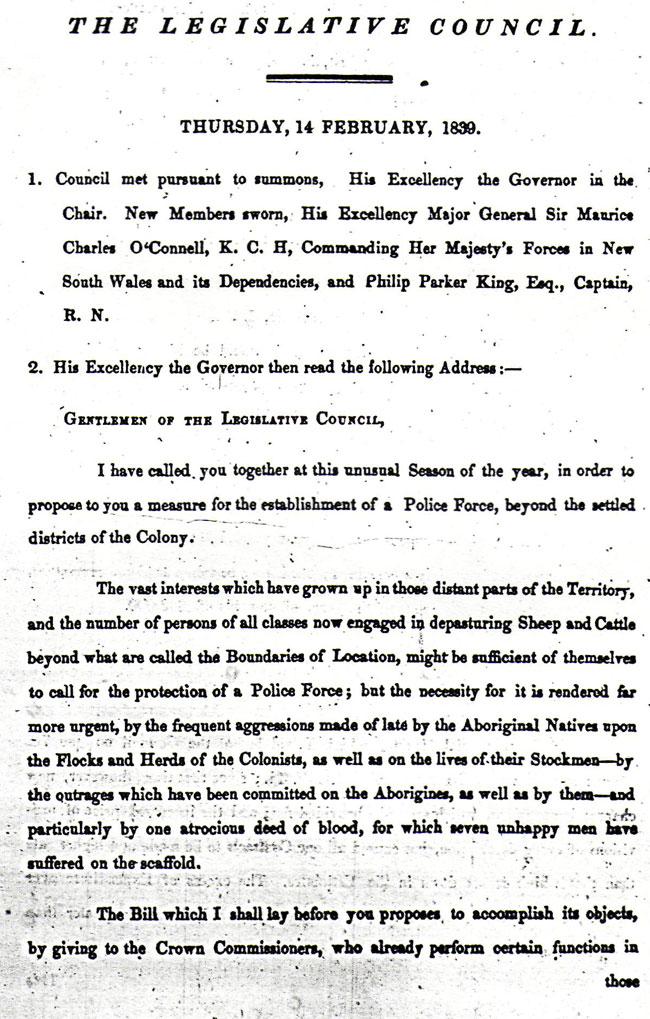
"1. Council met pursuant to
summons, His Excellency the Governor in his Chair. New Members sworn, His
Excellency Major General Sir Maurice Charles O'Connell, KCH, Commanding Her
Majesty's Forces in New South Wales and its Dependencies, and Phillip Parker
King, Esq., Captain, RN. 2. His Excellency then read the following Address:- I
have called you together at this unusual Session of the year, in order to
propose to you a measure for the establishment of a Police Force, beyond the
settled districts of the Colony ...
The vast interests which have grown up in those distant parts of the Territory, and the number of people of all classes now engaged in depasturing Sheep and Cattle beyond what are called the Boundaries of Location, might be sufficient of themselves to call for the protection of a Police Force; but the necessity for it is rendered far more urgent, by the frequent aggressions made of late by the Aboriginal Natives upon the Flocks and Herds of the Colonists, as well as on the lives of their stockmen-by the outrages which have been committed on the Aborigines, as well as by them-and particularly by one atrocious deed of blood, for which seven unhappy men have suffered on the scaffold.
The Bill I shall lay before you
proposes to accomplish its objects, by giving to the Crown Commissioners, who
already perform certain functions in those districts, far more ample powers than
they now possess; and by providing that each Commissioner shall be accompanied
by a moving Police Force, sufficient to repress the predatory attacks of the
Natives, and keep order amongst all classes.
As it appears to me perfectly just,
that the persons who are to be protected by this Force, should bear the expense
of maintaining it, the Bill provides for this object, by means of an assessment
on Cattle and other stock ...
George Gipps ...
3. His Excellency the Governor laid
upon the table, "A Bill to amend an
Act intituled, 'An Act to continue and amend an Act, intituled, "An
Act to restrain the unauthorised occupation of Crown Lands." Bill read
a first time, to be printed."
Minutes of
Evidence Taken Before the Committee on the Crown Lands Bill
MINUTES
OF EVIDENCE.
SATURDAY,
16 FEBRUARY, 1839.
LIEUTENANT-COLONEL
J. G. N. GIBBES, IN THE CHAIR.
William
Ogilvie, of Merton, Esq.,
J,
P.; called in and examined.
I
have read
the Bill to amend the Act to restrain the unauthorised occupation of Crown
Lands; I think that some amendment of that Act is necessary, as the Bill proposed
for that purpose requires modification; I think the the powers intended to be
granted to the Commissioners are too great in certain cases; they are, in fact,
more than should be vested in any individual
…I conceive that the hitherto unprevented
grazing on Crown Lands has been
one
principal cause of the prosperity of as at present customarily practiced, is
essential to the welfare of the Settlers
… It
appears to me to be necessary, that protection should be afforded to
parties occupying unlocated lands beyond the Boundaries …
I
think that the present force or establishment with the Commissioner in the
Liverpool Plains District, is sufficient for the purpose required; I am of
opinion, that if such an establishment had been in advance, to mediate between
the Blacks and the Whites, all the unfortunate events which have occurred, might
have been prevented; so much bad feeling has arisen out of those occurrences,
that much more difficulty will now be experienced in establishing a good
feeling; but I think by judicious management it may still be effected; with
just, kind, and considerate treatment, the Blacks are easily conciliated, which
I can say from personal experience.
SATURDAY, 16 FEBRUARY, 1839.
Terence Aubrey Hurray, of Lake George, Esq, J. P.;
called in and examined.
I
have read the Bill to amend the Act to restrain the unauthorised occupation of
Crown Lands, and I consider that some amendment of that Act is desirable; but 1
think that the Bill. as it now stands, proposes to vest too much power in the
hands of the Commissioners
… I am of opinion that, so far as the Blacks
are concerned, there it nothing to apprehend in the Maneroo country, and Banks
of the Murrumbidgee as far as they are occupied; but I look upon the
establishment of a Police force as likely to be of the greatest service in the
Colony, in keeping order amongst the lower classes of Whites in those distant
parts …
Wednesday 20 February, 1839
Votes and Proceedings of the
Legislative Council, Crown Lands Bill Committee Minutes
of Evidence Taken Before the Committee, "Report from the Committee
Appointed to consider, and Report their Opinion upon, the Provisions of a
"Bill to amend an Act, intituled 'An Act to restrain the unauthorised
'Occupation of Crown Lands,' (page 16-17) "... with leave to examine
Evidence, if necessary ... In reading over the Minutes of Evidence annexed to
this report, it will be perceived that it is only in the Northern, or Liverpool
Plains District, and in the Country between the Hume and Port Phillip, that any
force is considered necessary for the protection of the Settlers against the
aggression of the Aborigines. Nevertheless, all parties agree that a Border
Police will prove of the greatest service in keeping peace and good order, and
in protecting property in those distant parts of the territory, where many
Europeans of the most abandoned character have taken up their abode ..."
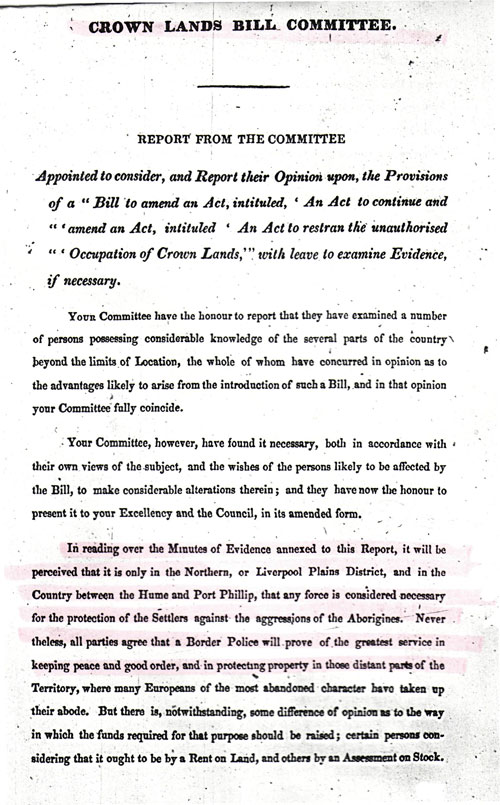
Document: Votes and Proceedings of the Legislative Council, Crown Lands Bill Committee
Minutes of Evidence Taken Before the Committee
Wednesday 20 February, 1839
Sir
Terence Aubrey Murray Esq., called in and examined. " ... I am of the opinion that, so far as the
Blacks are concerned, there is nothing to apprehend in the Maneroo country, and
Banks of the Murrumbidgee as far as they are occupied; but I look upon the
establishment of a Police force as likely to be of greatest service in the
Colony, in keeping order amongst the lower classes of Whites in those distant
parts ..."
R.V. Dalhunty,
Esq. " ... four Policemen, and a scourger"
Monday, 18 February,
1839. (HRA)
R.V.
Dalhunty, Esq., JP.; called in and
examined. " ... I think a Commissioner, four Policemen, and a Scourger,
would be sufficient for every purpose in the Wellington district ... I do not
think that, under the present circumstances, any force is required in the
Wellington district to keep the Blacks in order; I have never heard of a single
outrage being committed by them ..."
WC Wentworth,
Esq. and the water rent
Monday, 18 February,
1839
WC Wentworth. Esq.; called in and
examined. "... I have read the Bill, and approve of the general principles
of it, with the exception of taxation part ... because the objects of the bill
might be obtained by a rent of sections ... the frontage of every section on the
banks of a river, creek, or chain of posts sufficiently watered, is sufficient
rent ...."
"I can
assign no satisfactory reason for the hostility of the Blacks"
Monday, 18 February,
1839. (HRA)
James
Glennie, of the Gwydir, Esq;
called in and examined. " ... I have heard that from four to five hundred
of the native Blacks (unaccompanied by females) have been seen in one body in
that district; I have, however, never myself seen more than one hundred Blacks
together; but I have not been on the Gwydir, where they are most numerous ... I
consider them as hostile to the Whites, and I know of fifteen or sixteen murders
committed on white men within two years and a half. ... They also commit
outrages on stock; I was the first person who had a station on the Gwydir, and
have suffered severely from their depredations. I have missed two hundred head
of cattle, of which seventy-three were found speared or killed by the Blacks ...
At first, they consumed the flesh; but lately, they have destroyed it taking
away the fat only; they also speared fourteen of my sheep; but my neighbour, Mr
Cobb, has lost upwards of nine hundred sheep by their acts ... The Commissioner
and Seven Mounted Men would nevertheless be sufficient to keep these people at a
distance, and to preserve the peace of the district ... I can assign no
satisfactory reason for the hostility of the Blacks, for they were, to my
knowledge, well treated at Mr Bowman's and Mr Cobb's stations; having been
supplied with brass plates, tomahawks, and food; notwithstanding which, they
watched an opportunity, and murdered the hut-keepers at both stations ..."
H Fyshe
Gisbourne ... commissioner of crown lands
Tuesday, 19 February, 1839.
H Fyshe Gisborne, Esq., JP;
called in and examined. " ... I disapprove of the Fifth Clause; (Note:
i.e.,
Clause 5, Crown Lands Unauthorised
Occupation Act, 2 Vict 27 1839).
I should object to leaving it in the power of one Magistrate, who, I suppose
would, in most cases, be the Commissioner, to declare a license null and void,
without any appeal being allowed; and what I think more advisable, would to be
to require the Commissioner to prosecute any parties for a breach of this clause
at the nearest Petty Sessions ..."
"They were distressed for food from the scarcity of kangaroos"
Wednesday, 20 February, 1839.
William Faithfull, Esq.;
The Reverend David Mackenzie and the troublesome blacks
WEDNESDAY, 20 FEBRUARY, 1839.
The Reverend David Mackenzie, of
Sydney;
called in and examined.
“
… I have lately returned from the
Gwydir, where Mr. Mayne, the Commissioner, formed a party of five Mounted
Policemen, and six Gentlemen, besides himself, to go in pursuit of the Blacks,
who were reported as being troublesome in that neighbourhood; . he returned,
however, without coming in contact with any; and in the meantime, a man of the
name of Kelly, stockman to Mr. Bell, having gone out in search of cattle, fell
in with six or seven Blacks, whom he induced to accompany him to my station,
when Kelly and I agreed to go with them, unarmed, as guides to conduct us to
their camp which was situated at the distance of four or five miles from my hut;
when we arrived at the camp, those six or seven Blacks having given the signal,
called out about eighteen or twenty of their tribe, the greater part of whom we
conducted to our hut, where we entertained them with a good dinner; one of those
Blacks I carried naked behind myself on horseback to Mr. Mayne, who made him
some -presents; after which, we had "no difficulty in getting them to come
to us in large
Their
vicinity, however, was plainly marked by their spearing of cattle, and their
places of encampment. I found them very serviceable to me in cutting bark for my
nut, and in peeling the rafters; and have had as many as fifty about me at one
time; several of them slept in my hut for several successive nights, and were on
the most friendly terms; notwithstanding which I should be afraid to trust them,
from their known treachery; and I have warned my servants to be always on their
guard against them.
I
accompanied Mr Mayne to the place where
four or five hundred of Mr.Cobb's sheep had been wantonly slaughtered, no part
of them having been carried away by the Blacks; affording a clear sign that
they were not instigated to that act by
hunger. This was on the banks
of what they call the Big
River. I
also accompanied Mr. Mayne to see many cattle which had been speared by the
Blacks, who had left the carcases untouched, except that they had eaten off the
fat from the kidneys; which is an additional proof that they were not in want of
sustenance when they committed such acts.
I
am of opinion that if Mr. Mayne's district is to be confined to within fifty
miles each way from his station, the force he now has will be amply sufficient;
but if it is to extend from Liverpool Range to
where he now is (a distance of fully one
Mr. Mayne's station is not above ten miles distant from where the massacre of the Blacks took place; about five miles from where Mr. Cobb's sheep were speared; and about twelve from where his men were murdered … I think that if one or two Black Natives were attached to the Commissioner's Party, they would be very serviceable, as they would be a check upon the aggressions of their own tribes, and be able to trace them where no White Man could see the least appearance of any footsteps.
[Source:
Votes and Proceedings of the Legislative Council, Crown Lands Bill Committee
Minutes of Evidence Taken Before the Committee, Wednesday 20
February, 1839 (page 16-17) ]
The Reverend David Mackenzie’s investment
The Reverend David Mackenzie, "author, lecturer and landowner ... Mackenzie was clearly trying to fill his purse by investing in livestock, taking up runs on the Namoi and Murray Rivers, and using Aboriginals to do his sheep-washing and shearing ..."
[Source:
Mackenzie, David, in Pike, Douglas et al.
(Eds)
Australian Dictionary of
Biography 1788-1850 (MUP 1967) Page 172
Captain GW Smyth, of the Mounted Police:
Minutes
of Evidence ... On the Crown Lands Bill
“Sydney,
25th
February,
1839.
Captain
George W. Smyth, of the Mounted Police, in Reply to a Letter from a Member of
the Committee.
Sir,
In
obedience to your wishes, I beg leave to offer the following suggestions in
regard to the
appointment of the Mounted Police, so as to render that body,
alone, sufficient to protect the:
Districts of Port Phillip and Geelong from disturbances of every kind.
Stations on a liberal footing have already been directed lo be formed on
the
Hume, Ovens, Broken and Goulburn Rivers, and at Melbourne, and Geelong.
By this arrangement, when complete, the passage of settlers and stock
along the main roads will be fully protected, alike from the attacks of the
Aborigines, and the aggressions of convict runaways, and other bad characters.
In
the neighbourhood of Mount Macedon are
several of the largest stock-holders.
There a detachment of Infantry has been placed for
some months
past; but dismounted men
are but of little use, however
active they may be.
Of this, two instances came under
my notice, in which the Aborigines made an attack on
stations, and long ere military assistance could
arrive, the Tribe had, in both
instances,
decamped. Another Police Station at this spot would,
I conceive, complete' the arrangements for the security of the whole district.
The
eight stations posses the advantage of being nearly equi-distant from each other.
The
Goulburn River has already been fixed on as the head quarters of the district;
nor could a more central or better spot have been chosen.
So
much for the site of the stations.
As
the districts are so extensive, and a constant patrolling is necessary, the work
for the horses is arduous. It is therefore necessary to keep them in good
condition: The supply of forage for this purpose will, I am aware, entail a
great expense upon the Government. It is a subject consequently of importance,
to ascertain the most economical method of foraging the horses and rationing the
men.
I
am convinced that it can be done by a resident in Melbourne at a cheaper
rate than by any one else, as the supplies
there are obtained from
Launceston; and also that it can be done more cheaply by one person taking the
contract for the two districts, than by several individuals contracting for
the supply of the different stations.
Captain
George W Smyth
Mounted
Police”
"Edw. D.
Day, Police Magistrate ..."
28th February, 1839
(HRA, 22 July 1839, page 249) "Edw. D Day, Police Magistrate, Muswell
Brook, Witnesses proposed by JW Nunn, Inquiry proposed at Merton ... that
Messrs. Ogilvie and Bettington and Captain Pike ... "
28th
February. 1839
Police
Office, Muswellbrook,
Sir,
In
reference to your letter of the 7th Instant, I beg to inform you that 1 have
received from Major Nunn a list of the Witnesses required by him to attend at
the investigation, ordered to be made into the circumstances attending the death
of certain Aboriginal Natives near the Gwyder. Four of those Witnesses belong to
the Mounted Police, and are at present attached to Mr. Mayne's party at the Big
river; two more are Stockmen residing in the same neighbourhood ; I therefore
wrote yesterday to Mr. Mayne to request him to order these people to attend here
with the least possible delay: but, as many days must elapse before they can
possibly reach this, and as His Excellency the Governor is most anxious that the
investigation should be commenced at once, and is also of opinion that it is not
necessary that Major Nunn's examination should be postponed until all the
Witnesses can be assembled, I wrote to Major Nunn by this post to request that
he may attend at Merton, as soon a« may be convenient to him, for the purpose
of being examined.
Doctor
Little is the only Magistrate at present in the lnvermain district, and he has,
I am informed, declined to act until he shall have taken the necessary Oaths
under the new Commission.
I
therefore suggest that it would be advisable that the investigation should take
place at Merton, and that Messrs. Ogilvie and Bettington and Captain Pike, the
Magistrate of that District, should be requested by letter to assist
in it.
I
have, &c,
Edw.
D. Day, Police
Magistrate.
The Honourable The Colonial Secretary, etc., etc., etc.”
HRA
page 249
Report from the
Crown Lands Bill Committee
5th March, 1839
CROWN
LANDS BILL. COMMITTEE.
REPORT
FROM THE COMMITTEE
Appointed
to consider, and Report their Opinion upon, the Provisions of a Bill to amend an
Act, intituled, An Act to continue and amend an Act, intituled
' An Act to restrain the unauthorised
Occupation
of Crown Lands, with leave to examine Evidence, if necessary.
Your
Committee have the honour to report that
they have examined a number of persons possessing considerable knowledge of the
several parts of the country beyond
the limits of Location, the whole of whom have concurred in opinion as to the
advantages likely to arise from the introduction of such a Bill, and in that
opinion your Committee fully coincide …
In reading over the Minutes of Evidence annexed to this Report, it will be perceived that it is only in the Northern, or Liverpool Plains District, and in the Country between the Hume and Port Phillip, that any force is considered necessary for the protection of the Settlers against the aggressions of the Aborigines. Nevertheless, all parties agree that a Border Police will prove of the greatest service in keeping peace and good order, and in protecting property in those distant parts of the Territory, where many Europeans of the most abandoned character have taken op their abode …”
[Report from the Crown
Lands Bill Committee 5th March, 1839
The
unauthorised occupation of Crown Lands, and the Border Police.
Monday, 18 March, 1839
(HRA)
"No. 6, Votes and Proceedings of
the Legislative Council
Council met pursuant to adjournment;
His Excellency the Governor in the Chair. Crown Lands Occupation Act Amendment
Bill; further considered, and amended, and the title altered to the following,
viz:-"An Act further to restrain the unauthorised occupation of Crown
Lands, and to provide the means for defraying the expense of a Border
Police;" to be fairly transcribed and presented to the Governor, by the
Collector of Customs, and Captain King. Council adjourned at four o'clock, until
Friday next, 22 March, at twelve o'clock. Wm. Macpherson, Clerk of Councils
."
"... they were not in any case to fire on the
blacks, unless it was necessary for their own defence ..."
| Enclosure A 6 to Minute No. 20 of 1839.]
Court House, Merton, 4th April, 1839.
Depositions taken before Edward Denny Day, Police. Magistrate, and William Ogilvie and John Pike Esquires, of the District of Merton, in an investigation ordered to be instituted into the circumstances attending the death of certain Aboriginal Natives in a collision with the Mounted Police under the command of Major Nunn.
Major W. Nunn, Commandant of the Mounted Police, being duly sworn, deposes: About the 19th of December, 1837, Colonel Snodgrass, the Acting Governor, sent for me to £o to Government House. On arriving there 1 found Mr. Thomson, the Colonial Secretary, with Colonel Snodgrass. The substance of a report made by Mr. Paterson, the Commissioner of Crown hands in the Liverpool Plains District, was made known to me. A Copy of this report, which was (riven to me then or afterwards, I now produce. It contains a statement of minders and other outrages committed by the Blacks on the Namoi, Gwyder and Big Rivers. Colonel Snodgrass ordered me to proceed in consequence of that report to the scene of these outrages with a party of Mounted Police. I asked Colonel Snodgrass, if he had any orders or instructions to give me. He said, "You must lose no time in proceeding; you are to act according to your own judgment, and use your utmost exertion to suppress these outrages. There are a thousand Blacks there, and, if they are not stopped, we may have them presently within the boundaries, or words to the same effect.
In consequence of these instructions, I gave immediate orders to assemble a party at Jerry's Plains, from which place I proceeded on or about the 20th of the same Month (December) with a detachment, consisting of one Subaltern, two Serjeants and twenty troopers. I marched direct for the Namoi. On my arrival there, I heard very distressing accounts from the Stockmen in the neighbourhood of the out-rapes committed by the Blacks. On the evening of my arrival, I sent Serjeant McNally to Mr. Baldwin's Station to ascertain of the people there if these reports were correct. He returned shortly after in a great hurry and informed me that the reports were quite correct; and that the Blacks were at that time assembled in great numbers at a place lower down the River Namoi. I immediately ordered the party to mount and, guided by Mr. Baldwin's Stockman, proceeded at once towards the place mentioned. After marching all night, we came upon a tribe of Blacks on the river bank. After disposing of my men so as to prevent the escape of the Blacks, and giving them orders not to fire at all, but, if necessary, to defend themselves with their swords, I succeeded in capturing; the whole tribe without any violence. With the assistance of a black boy who went with ns, I communicated to the tribe that they were charged with murder, spearing Cattle, and all manner of outrages, and demanded that the actual perpetrators of these acts of violence should be delivered up to me. On this, fifteen men of the tribe were pointed out to me by their comrades as the guilty parties; these were taken into custody, and the rest of (be tribe, amounting to about an hundred persons, were set at large, and treated kindly by me, so much so that they remained with the party until evening. Amongst the fifteen prisoners, two were pointed out to me by the tribe as the murderers of Mr. Hall's man some time before. About two hours before sunset, I returned to my former camp with the fifteen prisoners, the two men charged with murder were secured by handcuffs and placed in charge of two sentries; it was my intention to leave these two men under a guard until Mr. Hall could see them and identify them; but I regret to say that they succeeded in slipping their handcuffs after nightfall, and attempted to escape, in which one succeeded, but the other was shot by the sentry while in the act of running away ; it is however satisfactory to know that the tribe admitted that the man who was shot was the actual murderer of Mr. Hall's Servant; the other thirteen prisoners were subsequently liberated, all except one, who I retained with me as a guide; from this camp 1 proceeded to Mr. Bell's station on the Gwyder; Mr. Bell was at the station, and begged of me to remain a few days at the station for their protection, and was in a state of great alarm from the depredations the blacks had been committing. I remained there two days and then proceeded to Mr. Cobb's station, where I was very anxious to arrive in consequence of the reports I had received of the outrages of the black natives in that direction; on arriving there, I found every thing in the greatest confusion, the Shepherds and people all afraid to leave the vicinity of their tints, and the sheep all crowded round about, and not a man could be induced to take them out to pasture, until I had sent parties out to scour the country and ascertain that the Blacks were not in the neighbourhood. Lamb, the superintendent at the station, informed me of the particulars of the murder of the two men by the blacks at, this station, and told me that after the murder the blacks had taken off eight and twenty sheep and some articles from the station. On hearing this information, T considered it to be my duty to pursue the tribe, who had committed these outrages, and, having provisioned the party for fifteen days, 1 began my march. On the fourth day after leaving Marshall's station, which was then the lowest station on the Big river, I came upon a native black asleep under a tree, against which I saw four spears leaning. The black man got up the tree but we succeeded in getting him down. After explaining to him, through our black boy, that we did not intend to hurt him, he told us that his party consisted of four more black men, three women and some children; these blacks we found the same day. They were all brought to me to the camp. From these people I obtained all the information relative to the murder of Mr. Cobb's men. They confessed they had been present at it with the rest of their tribe, and had partaken of the Sheep that had been driven off. They offered to remain with us, and conduct us to the tribe. The next morning under the guidance of the blacks, the direction of our march was quite changed. We were led by them for two days. About noon of the second day, I was riding in the rear of the party, when I heard on a sudden the words " black fellows " in front. I was perhaps about fifty yards in the rear at the time. 1 rode up immediately, and the first thing I noticed was Corporal Hannan returning from the front speared through the leg; he appeared to be in very great agony, and cried out " I am speared, 1 am speared " ; at the same moment I heard several shots fired in rapid succession. Mr. Cobban was in the front at the time. The men charged and separated in such a manner that I was perfectly unable to collect them at the moment. I did so as soon as possible, and we succeeded in extracting, with the assistance of a black man, the spear from Hannan's leg; the wound was a very bad one, and I apprehend that mortification would ensue from the very great heat of the weather ut the time. I am quite satisfied Hannan was wounded before a shot was fired, and that, if-he had not been wounded, not a shot would have been fired. 1 certainly never gave my men any orders that could warrant their firing upon the blacks, unless in self defence. After the firing ceased, I rode through the wood and saw four or five dead bodies of the blacks; I am positive that I saw four. Lamb recognized a Tomahawk and knife, which were found in the blacks' camp, as some of the articles that were taken from his Master's station, when the two men were murdered there. From this and other circumstances, I have no doubt whatever of this tribe having been guilty of the outrages at Mr. Cobb's station. My guides remained with me after the collision, and showed me a more direct way back : on quitting me afterwards,. I rewarded them with presents I had taken with me from Sydney for the purpose. I explained to them that our intentions towards them were friendly, anil that the loss the tribe had suffered had not been intended; that our object in coming had been to take the parties, Who had been guilty of murders and other outrages against the whites. The Guides left me perfectly satisfied with my treatment of them. I am sure they perfectly understood the explanation I gave them of our motive in coming. J. W. Nunn Major, Comt. M. Police.
Sworn before us at Merton, this fourth day of April. 1S39.—Edward Day, J.P.;
Willm. Ogilvie, J.P.; J. Pike, J.P.
John Lee, Serjeant in the Mounted Police, being duly sworn, deposes:—I belonged to the party that went with Major Nunn to the Namoi and Big Rivers. I marched with them from Invermein (my station) on the 2nd January, 1838. I was present when the first prisoners were given up by their tribe to Major Nunn, as the persons who had been guilty of outrages against the whites ; there were fifteen of them; two were pointed out as the murderers of Mr. Hall's man. These two were handcuffed : they both attempted to escape that night; one of them who was called " Doherty " was shot by one of the sentries while in the act of escaping; we buried the body the following day by Major Nunn's orders.
I was present when Hannan was speared by the black. I was about a hundred yards from him. My attention was drawn towards him by his crying out. I looked at him and saw the spear sticking in his leg; it was quite through the calf of the left leg. I saw Hannan break the spear in two. I saw the black who wounded him ; he was in the act of throwing a second spear at myself, on which I fired at him and shot him; the spear was levelled at me at the time I fired; the first shot was fired by me ; it was fired in self defence and without orders. If I had not fired the instant I did, I must have been speared, as the blacks throw their spears with great precision, and I was not more than, nine yards from him when he aimed the spear at me. The firing was then taken up by the rent of the men and continued for some time; the blacks fled from their camp and we pursued them-; they were overtaken in about an hour, when some more were shot. Mr. Cobban was with the party when the last were shot. Major Nunn was not present with us at the time. I did not see Major Nunn until I returned to the place where Harman was wounded; the confusion was so great and the scrub so thick, that I had enough to do to take care of myself and my home. I could not see all that was done. It was impossible for the party to act in a body; every man had in fact to act for himself; the men had spread out so much that it was impossible for arty one person to put a stop to the firing at once; what I saw myself, I should say that from forty to fifty blacks were killed when the second firing took place. The troopers were very much exasperated when Hannan was speared; they scattered as soon as it was done, and after that it was quite impossible to restrain the firing. I do not think that a shot would have been but for that circumstance, I am certain the men would not have fired without orders, had it not taken place. In all our previous communications with the blacks, Major Nunn had been extremely kind to them. I was senior Serjeant of the party and the orders I received from Major Nunn and gave to the detachment, were that they were not in any case to fire upon the blacks, unless it was necessary tor their own defence. This was a standing order with the party. There was no remission of rhe pursuit from the time the firing began until it ceased altogether. We followed them about a mile and a half from where it began. Two iron bolts and a tin dish were found in the blacks camp, which I heard Lamb say were taken from Mr. Cobb's station when the men wore murdered. The black boy Jacky our interpreter told me the Guides, who were with us, undertook to lead us to the tribe that murdered Mr. Cobb's men. His John x Lee. mark.
Sworn before us at Merlon, this fourth day of April, 1830.—E. Day, J.P. ; Willm. Ogilvie, J.P. ; J. Pike, J.P.
Corporal Patrick Hannan of the Mounted Police, being duly sworn, deposes:—
I belonged to the party that went out with Major Nunn to the Gwyder and Namoi Rivers in the beginning of last year. After leaving Mr. Marshall's .station, we met with four blacks, who undertook to lead us to the tribe that murdered Mr. Cobb's men ; about two days after we came upon them near a Creek ; I rode through the scrub and attempted to apprehend the first black man I saw ; when I came near, before I could take hold of him, he turned suddenly round and thrust a spear through the calf of my leg; I was quite close to him at the time. I turned round and saw Serjeant Lee coming up. I called to him that t was speared, I heard a shot immediately after, but the pain of my wound was so great that I cannot speak of any thing that occurred. My horse sprang on one side when I received the wound, and the spear was hanging from my leg; it must have been seen by the other men; I saw that the black who wounded me had another spear. I could easily have shot him before he wounded me, but I wanted to capture him us our orders from Major Nunn were to take prisoners, but not to fire unless in self defence. I saw Major Nunn very soon after I was speared; he assisted me in getting the spear out of the wound. I heard firing after, which appeared retiring from me, as if the men were in pursuit. I am certain no shot was fired before I was speared,
Patrick Hannan.
Sworn before us at Merton, this fourth day of April, 1830.—P. Day, J.P, ; Willm. Ogilvie, J.P,
Major Fitton, being duly sworn, deposes:—
I am a Stockman in Mr. Hall's service. I have been employed at the Big River. I accompanied Major Nunn last January twelve month in pursuit of a tribe of blacks, who were stated to have murdered two men at Mr. Cobb's station. I was with the pack horses, when the troopers went after the blacks, after Hannan had been wounded; up to that time the blacks in that part of the Country had been very troublesome. Five stockmen and shepherds had been murdered by them about the same time, and a great many Cattle had been killed and speared, and' sheep also. These outrages caused a very hostile feeling against them, in fact no one considered it. safe to go about, spears and boomerings were constantly thrown at us. The black guides promised to take us to the tribe who had murdered Mr. Cobb's son, and I heard Major Nunn order the Police to take the tribe prisoner, but they were not to fire upon them. Some articles, taken from Mr. Cobb's station by the tribe that murdered Mr. Cobb's men, were found in the blacks' camp; among these was a tin dish and a Tomahawk and a knife, also pieces of shirts and half a blanket, and a bullock's tail was also found in their camp. Major Fitton.
Sworn before us al Merton, this fourth day of April, 1839.—Enwn. D. Day, J.P. ; Wm. Ogilvie, J.P. ; J. Pike, J.P.
Sir, Bell's Station, Manilla River, 6th December, 1837. I avail myself of the opportunity of a Stockman going from here to Invermein to state, for the information of His Excellency the Governor, that I proceeded on another survey of my District on the 28th of October last, ;and traced the Namoi down, taking returns of Inhabitants, Stock and fire arms, and I will immediately on my return forward to you in Duplicate my Itinerary and Census. On my route I heard of many outrages committed by the Natives on Stock at a number of the Stations, and also of their having murdered five men, and I made it my business to make every Inquiry to find out the cause of this increasing evil.
This evil is not confined to the Stock actually killed by the Blacks, but a herd of Cattle that has been harassed and speared by them wander away in all directions from their run, and altho' pasture is most luxuriant, the cattle are invariably in poor condition wherever this evil exists.
On the Namoi River, the stations below Sir John Jamison's run are more or less subject to their depredations, and at Oder's, which is the farthest down station, the Blacks are so numerous and daring that the men have all quitted the station from fear, and left the Cattle to their fate.
It was when on this River that I heard of the Blacks murdering two men belonging to Mr. Bowman, and two of Mr. Cobb's men. Mr. Bowman's station is situate on a Creek about 60 Miles from the Namoi, called Bowman's Creek, and Mr. Cobb's station 60 Miles from it, on a River called the Big River, into which the Gwyder empties itself.
Although this part does not belong to my District, still I thought that information, that could be depended on respecting these outrages and their probable cause, would be acceptable to His Excellency the Governor. I therefore proceeded there across the country and arrived at Bowman's at 10 o'clock at night of the day of the second day after leaving the Namoi. The whole of this Country is of the richest description, almost free from timber of any sort, abounding with wild carrot and thistle; in short, if it was better watered, it would be the finest grazing land in the world. It is however sadly deficient in this necessary article, as we travelled from 6 in the morning till 10 at night before we fell in with it, all the Creeks in the intermediate space being dry.
At Bowman's station, two out of the three men that were there had newly arrived, so they could give no account of the Natives. The other man staled that, previous to the Murder, the Natives had not been there for four Months, but before then they were frequently in the habit of coming to the hut, and that the men were always kind to them. The same account was given by Cobb's men, and they were seemingly on such friendly terms that they apprehended no danger even after the murder of Bowman's men.
When at Mr. Cobb's hut and while I was making these enquiries, and at the time one of the men was shewing me boomerings and spears he had picked up where the men were murdered, another man took up a musket saying "this is the sort of spear" and shot the other man through the breast. The ball entered the left breast and lodged in the back close to the back bone near the surface.
The harassing and killing of Cattle is even greater here than on the Namoi, and seems getting worse every day. The remains of six bullocks have been found at one of their encampments used at one feast. On another occasion when a party went in pursuit of them after they had murdered Mr. Cobb's men, they found the remains of 28 sheep at the place where they had encamped the first night after the murder. It was a black boy belonging to the tribe that traced them. They found 250 fires and the boy said there might be four at each fire. There is little doubt that it is most imprudent in the men to harbour and encourage the natives about the stations, and I have no doubt part of the present evils existing can be attributed to this cause.
The main cause, however, I imagine to arise from white men being with them urging them on to these outrages. The Black boy, who traced them, says that there are three white men with them painted like the Blacks, and this statement is corroborated by his taking the party to a hut in the mountains constructed evidently by white men. The wall plates were morticed and pegged down, the bark put on with green hide, the door hung with hide hinges, and berths for sleeping in put up.
If Government mean to take any steps to suppress these outrages it would be a material point to secure the black boy above alluded to. He is staying at a Mr. Fleming's station, the lowest but one on the Big River : he is intelligent and can make himself understood, and bays he has no wish to join his tribe again as they would kill him. I have, &c..
Alexr, Paterson.
[Enclosure AT to Minute No. 20 of 1830.1
Sir, Court House, Merton, 19th May, ISao,
We had the honor to receive your letter of the 4th Inst. communicating to us 1 (he desire of Ills Excellency the Governor that the examination of Lieutenant Cobban should be taken relative to the circumstances attending the death of certain aboriginal natives in collision with the Mounted Police.
We beg to state that Mr. Cobban attended at this Court House on the 17th Inst., when he made before us the deposition of which a Copy is enclosed.
We have, &c,
Enwin Day, J.P.
W, Ogilve. J.P.
The Honble. The Colonial Secretary.
[Enclosure A S to Minute No. 20 of 1S30.] t
Court House, Merton, 17th May, 1839. t
Lieutenant McKenzie of the 50th Regt., attached to the Mounted Police, being duly sworn, deposes:—In the Month of December, 1837, I was commanding the Mounted Police in this district and stationed at Jerry's Plains ; on the 29th of that Month, I left the station with a party of Mounted Police for the Big River under the command of Major Nunn. I understood that the object of our expedition was to drive away certain tribes of Blacks who were murdering some white people and committing outrages on their runs, spearing the Cattle and driving away Sheep in that part of the Country. On reaching the Namoi, we encamped there at a Station called Green hatches, where several .stockmen came riding in and reported to Major Nunn in my presence that some wild blacks had the day before crossed their runs, and Speared several Cattle, 1 think they said eight or nine head. They further said that they were the same blacks who had some time before murdered a man of Mr. Hull's and attacked the hut. Mr. Hall's Stockman, who had himself been wounded in that attack by the blacks, stated this information to Major Nunn, They also reported that they could guide the party to the place where the Wild blacks were encamped with a tame tribe, whom they had gone to visit. We marched from Green hatches that night about nine O'clock with the view surrounding the wild tribe at daylight on the next morning, before they dispersed in search of food. We saw the blacks' fire about daylight the next morning ; they were encamped on the banks of the River Namoi with a deep reach in front and a brush at some distance in the rear. We walked our horses quietly along by my orders (Major Nunn being then a little in the rear); my orders were to ride quietly on until we should be observed, and then to charge upon them so as to capture the whole tribe; some troopers had been before that sent across tile river to prevent their escape, if they should take to the water in front and swim across. Major Nunn had before that given orders to the party on no account to use fire arms, but if necessary in self defence to use their swords. The impression on my mind is that the men were to use fire arms, if absolutely necessary tor the protection of their lives, and also for the purpose of securing any prisoners they may be sent to apprehend, and for preventing the escape of any person who may have been captured.
This is the principle on which the Mounted Police have always acted as far as I am aware, when sent on duty ; the greater part of the blacks were surrounded and taken, but some few got into the water who were afterwards taken too. They came out by a great deal of persuasion and some were dragged out by one of the men who swam his horse in. There were one or two shots fired on this occasion but no life was lost, nor was any person wounded. The shots were fired to intimidate the blacks, who had got into the river and to frighten them out of it; after we got all the blacks together, one of the tame ones, who had been at Mr. Hall's station when the man was murdered there, pointed out one man who had been concerned in the murder. He also said that all the other wild blacks had been guilty of spearing Cattle, as the Stockmen had represented to us at Green hatches ; we took all those who were pointed out to us by the tame blacks as having committed depredations on the whites back to encamp at Green hatches the same night. The man, who was said to have murdered Mr. Hall's man, shewed great fear and uneasiness and made several attempts to escape on the way ; after the blacks were given over in charge to the sentries at the camp, they made an attempt to escape. The murderer was the first to rush; he ran past me towards the bed of the river, which was full of swamp oaks. I started after him, but, while pursuing him, two other prisoners, who were handcuffed together, ran nearer to me, and I turned after them; they fell in the flight and it being nearly dark I tumbled over them ; one of them immediately fastened his teeth in one of my arms; the other clung with all his force to one of my legs and caught my boot with his teeth. I kept hold of them however by their hair, until they were secured again. Major Nunn and myself first became aware of this attempt of escape by hearing the Sentries fire. After the two blacks, whom I caught, were secured, one of the men stumbled on the body of the man who was accused of Murder. He was lying dead in the bed of the river with a wound in his back, which he must have received in the act of running away. The Black boy, who acted as Interpreter, told me that one Black present knew the blacks of the Big River who had been committing the murders in that neighbourhood and their Country ; and I suggested to Major Nunn that it would be desirable to take one of them with us as a guide and let the others go, as the death of the man who had been shot may deter them from committing further outrages on the Whites. A guide was accordingly kept, and the others having first received some food and presents were let go.
We then proceeded towards the Big River; on making Mr. Hall's Cattle station, we received further complaints against the blacks ; we were told that they were continually spearing the Cattle and intimidating the Shepherds; one of the shepherds then told us that he had met the blacks the day before in his way from an out Station; That they stopped him and would have killed him if he had not told them that the Soldiers (as the blacks call the Mounted Police) were on their way up. They brandished their Tomahawks and spears about his head, and searched all his pockets. When they let him go, they said they did not care for the Soldiers, that they were not afraid of them. I was ordered out by Major Nunn to look for these blacks, and I searched all that night for their fires and all the next day, when I got upon their tracks and traced them to a Gully, where 1 found them perched upon ledges and rocks quite inaccessible to us. They shouted out defiance at us, as I understood ; but we could not get near them at all ; when all our efforts to take these people failed, I followed Major Nunn and the rest of the party according to his orders to Mr. Cobb's station on the Big River ; on arriving there I found all the people at the station in the greatest alarm from the blacks. The shepherds were afraid to move out of sight of the hut, and the sheep were in a wretched state for want of food. We refreshed our horses here for one or two days, and were made acquainted with all the particulars of the brutal murder of Mr. Cobb's two men at that Station some time before. The direction the blacks took after committing the murder was pointed out; and we found that the story of our black Guide was correct in this respect; we proceeded in the direction, and, after two or three days' Journey, we came on old traces where they had been. We followed up these marks for four or five days.
The marks were permanent from the nature of the Country and from some rain having fallen when the blacks passed over it; by this time, we came on fresh marks made a day or two before. I kept in front of the party with the black boy (our interpreter) and the Guide we brought from Green hatches. We followed up these marks until they led to a spot where the Guide pointed out some spears leaning against a tree. A black fellow had been lying asleep under the same tree; he ran up the tree on our coming up in great alarm; he was got down with great difficulty. This man was one of a small party of three or four, for whom I was ordered to search by Major Nunn; the old black man, who had been found with the Spears, and the black boy went with me, while looking out he told me through the interpreter that he could guide us to the rest of his party who were out getting honey. We got them one by one with much trouble. I took the four to Major Nunn, the same night; we questioned them about the tribe who committed the murder and asked them where they were. They pointed to a Creek at some distance, for which we started early the next morning and reached it the same night. There we found marks of the blacks having been lately encamped. These marks were quite fresh; the blacks were not found that night. We started next morning nt day break and followed the tracks of a very numerous tribe for some distance until we saw smoke ahead. I was then in front and passed the word to the men that we were close upon them, and ordered them to prepare. On reaching the smoke nearer, we found it to be from a burning log, and concluded from it that the blacks were still a day's Journey ahead of us. We were consequently thrown off our guard; but, on proceeding a few Hundred yards further and in turning an angle of the Creek, we came suddenly on a great number of blacks apparently encamped on opposite side from us, with a large body of water in between us and them, and a thick scrub close behind them, for which they made instantly on observing us. The five or six men who were In front with me were the best mounted in the party, and I ordered them to return a little distance with me to a crossing place, where we crossed ; on crossing we opened out and drew our Swords and Galloped into the scrub. We entered the Scrub in a direction to cut off the retreat of the blacks, and drive them back on the water, where they would be placed between my men and those on the opposite side who had not crossed. The scrub was extremely thick ; at this place we encountered the blacks face to face ; before we saw each other we were quite close. They had each two spears. I made an attempt to ride down one who was immediately in front of me; he stooped so low that I went over him and turned short to the right into a thick bush; while I was wheeling my horse round, I heard the many minutes. Major Nunn and myself rode round the scrub to see what number had been killed. I certainly did not see more than four or five, if so many ; after this some black gins were found in various hiding places; on questioning them through the interpreter, we found the party, we had fallen in with, was only a small detachment of the tribe..."
"The only question is whether we will abandon
all control over these distant regions, and leave the occupiers .. unrestrained
in their lawless aggression ... upon the Aborigines, or make such efforts, as
are in our power, to preserve order amongst all classes."
6 April 1839 (HRA) "Gipps to Glenelg; .. the establishment of a Police Force beyond the
limits of location .. With respect to former Acts which have been passed to
regulate the occupation of Crown Lands beyond the Borders of Location ... Your
Lordship may probably observe that no mention is made in the act of the
protection of the Aborigines, although, as stated in my opening address to the
Council, it was principally introduced for the purpose of putting a stop to the
atrocities which have been committed both on them and by them .. The Law
however, as it respects the Aborigines, required neither improvement nor
alteration, the means only were required of putting the Law in execution; these
it is hoped will be supplied by the Police to be established under the act, and
it will be of course for the Executive Government to direct the application of
them. .. and therefore the only question is whether we will abandon all control
over these distant regions, and leave the occupiers .. unrestrained in their
lawless aggression ... upon the Aborigines, or make such efforts, as are in our
power, to preserve order amongst all classes."
“Unfortunately
killed”
“[Enclosure A 5 to Minute No. 20 of 1839.
Sir,
Court
House. Merton, 9th
April. 1839
In
compliance with the desire of His
Excellency the Governor, communicated
to us in the letters we had the honor to receive from
you. that we should inquire
at court-house into the circumstances
relative to
the collision
between the
Mounted Police
under the command of Major
Nunn and the Black Natives on the Namoi and Gwyder rivers, wherein some of the
latter were unfortunately killed in the Month of January,
1838. We attended at the Court House for that purpose on Thursday, the
4th Instant, and took depositions and examinations of all the parties presented
to us for that purpose, namely. Major Nunn, Sergeant Lee, and Corpora!
Hannon of the Mounted Police and Major Fitton, a Stockman of
Mr. Hall's. Copies of which we have now the honor to enclose.
We
have, &c., Edw. D. Day, J.P., Police Magistrate, W. Ogilvie, J.P., J. Pike,
J.P.
The Honble. The Colonial Secretary."
" ... the unauthorised occupation of Crown
Lands."
17th May, 1839 (HRA) Deposition ... re collision between mounted police under J.W. Nunn and
aborigines. "... the object of our expedition was to drive away certain
tribes of blacks who were murdering some white people and committing outrages on
their runs, spearing the cattle and driving away sheep ... Major Nunn had before
that given orders to the party on no account to use fire arms, but if necessary
in self defence to use their swords ... After the two blacks, whom I caught,
were secured, one of the men stumbled upon the body of the man who was accused
of Murder. He was lying dead in the bed of the river with a wound in his back,
which he must have received in running away. ... (&c. &c.)"
HRA
"Asserting
Her Majesty's right to Alienate the Waste Lands of New South Wales"
17th May, 1839
(HRA) "Crown Lands. Despatch from the Most Noble the Marquess of Normanby,
to His Excellency Sir George Gipps, Knight, approving of the Crown Lands Act ...
and asserting Her Majesty's right to Alienate the Waste Lands of New South
Wales, and to direct the appropriation of the proceeds of the Sale of these to
the Public Service ... an Act passed by the Legislative Council of New South
Wales, on the 2nd October, 1838, intituled, "An Act to continue
and amend an Act to restrain the unauthorised occupation of Crown Lands:"
and I am to signify to you Her Majesty's gracious approval of that Act ..."
Queen Victoria's Government and His Excellency the Governor proclaim the subject and possessory rights of Aborigines of New South Wales
21st May, 1839
Colonial
Secretary’s Office, Sydney, 21st May, 1839.
(The
following notice was published at the time of its date.)
“His Excellency the Governor desires to draw attention of the owners of stock throughout the colony, and of the public in general, to the extensive powers which by an Act passed in a recent extraordinary session of the Legislative Council (2 Vict., No 27,) are now vested in the commissioners of lands acting beyond the boundaries of location, as well as to the fact that these commissioners are now magistrates of the territory; and as one of the principal objects which the Council had in view in passing the Act referred to, was to put a stop to the atrocities which have of late been so extensively committed beyond the boundaries, both by the aborigines and on them, His Excellency deems the present a proper occasion to notify to the public, that he has received distinct instructions from Her Majesty’s Government, to cause an inquest or enquiry to be instituted in every case wherein any of the aboriginal inhabitants may have come to a violent death in consequence of a collision with the white men; and that His Excellency is determined to make no distinction in such cases, whether the aggressors or parties injured be of one or the other race or colour, but to bring all, as far as may be in his power, to equal and indiscriminate justice.-As human beings partaking in our common nature-as the aboriginal possessors of the soil from which the wealth of the country has been principally derived - and as subjects of the Queen, whose authority extends over every part of New Holland-the natives of the Colony have an equal right with the people of European origin to the protection and assistance of the law of England. To allow either to injure or oppress the other, or to permit the stronger to regard the weaker party as aliens with whom a war can exist, and against whom they may exert belligerent rights, is not less inconsistent with the spirit of that law, than it is at variance with the dictates of justice and humanity. The duties of the commissioners of crown lands, in respect to the aborigines, will be to cultivate at all times an amicable intercourse with them, to assist them in obtaining redress for any wrong to which they may be exposed, and particularly to prevent any interference on the part of white men with their women. On the other hand, they will make known to them the penalties to which they become liable by any act of aggression on the persons or properties of the colonists. They will endeavour to induce the chiefs in their respective districts to make themselves responsible for the good conduct of their tribes, and they will use every means in their power to acquire such personal influence over them, as may either prevent aggression or ensure the immediate surrender of the parties who may be guilty of it.-His Excellency thinks it right further to inform the public, that each succeeding despatch from the Secretary of State, marks in increasing degree the importance which Her Majesty’s Government, and no less the Parliament and the people of Great Britain, attach to the just and humane treatment of the aborigines of this country, and to declare most earnestly and solemnly, his deep conviction that there is no subject or matter in which the interest as well as the honor of the colonists are more essentially concerned.”
[Source: Acts and Ordinances of NSW (ed. Callaghan) (1844-1852) 3v. in 4 46. Imperial Statutes in Force (ed. Bignold) [1913] 46. New South Wales Legislation in Force].
Deaths in
custody, 150 years on
"the circumstances of the homicide are unknown, (an Aboriginal death in custody) and no coronial enquiry was conducted. On this point, the Office of the Aboriginal and Torres Strait Islander Social Justice Commissioner in its Indigenous Deaths in Custody , 1989-1996 report (Commonwealth) expressed considerable concern. 'The decision by the Coroner not to carry out an inquest is disturbing ...' In this case, there were two breaches of RCIADIC recommendations, these being the recommendation that all deaths in custody be required by law to be the subject a coronial inquiry, culmination in a formal inquest (R11), and that such an enquiry investigate the quality of care, treatment and supervision of the deceased (R12)"
Indigenous Deaths in Custody, 1989-1996 (p. 399) in
Brooks, Marie: Aboriginal and Torres Strait Islander Female Custodial Deaths Post Royal
Commission into Aboriginal Deaths in Custody, Southern Cross University
Law Review, November 1999, (page 259)
Standing Orders for the Border Police
22nd
May, 1839 -
Orders read the Border
Police 22 May 1839 (HRA) [This
was a copy of the “Government Gazette” dated 22nd May, 1839.]
1. Every individual employed in the Border Police is
expected to pay implicit obedience to the orders of the Commissioner, in the
same way as troopers of the Mounted Police or soldiers in any regiment of the
Line are bound to obey the orders of their Commanding Officer.
2. Non-commissioned Officers and troopers of the Mounted
police are in an equal degree bound to pay implicit obedience to the Crown
Commissioner during the time they are placed under his orders.
3. The Commissioner of each District will keep a very
accurate register of the conduct of every man, who is attached to him, and will
report monthly the behaviour of each individual for the Governor’s
information.
4. The governor will consider good conduct of the Border
Police to constitute the greatest recommendation, which any man can have in this
country to His favourable notice; and He will be happy to grant the highest
rewards which is in His power to bestow, and at the earliest periods which He is
by law or regulation empowered to grant them.
5. On the other hand, the Governor desires it to be
perfectly understood that He will instantly remove from the Border Police any
man of whom he receives an unfavourable report; and that any person removed for
his misconduct will be retained in Hyde Park Barracks, or in Government
employment at some other station, for the whole of the time he may have to serve
in the Colony.
6. The means, by which every Border Policeman will have
it most in his power to obtain the approval and favourable consideration of the
Governor, will be by behaving in a kind and humane manner to the natives, and by
endeavouring to gain their confidence and esteem, as well as to civilise and
improve them.
7. The offences, on the other hand, which the Governor
will never overlook or forgive, are any harsh or unkind treatment or ill usage
of the natives, any attempt to teach them bad language, or to lead them into
vicious practices, or to mock or laugh at them.
8. Any person whatsoever giving or offering to give
spirits to a native, or encouraging in any way a native to drink spirits, will
be immediately dismissed.
9. Any person whatsoever having improper intercourse, or
attempting to have improper intercourse with a female native even with her own
consent or the consent of her friends, will in like manner be immediately
dismissed, and otherwise be punished to the extent of the Governor’s power.
10. The troopers of the Mounted Police attached to the
Border police will for the first three months act as non-commissioned officers.
11. The Commissioners will subsequently recommend the
best behaved men to succeed them, and, should there be none whom they can
recommend, they will report the circumstances in order that deserving men from
other districts may be sent to them.
12. These orders are to be read at least once a month to
every man in the Border Police by the Commissioner of the District.”
NOTE: chase up Report referred to.
(London?)
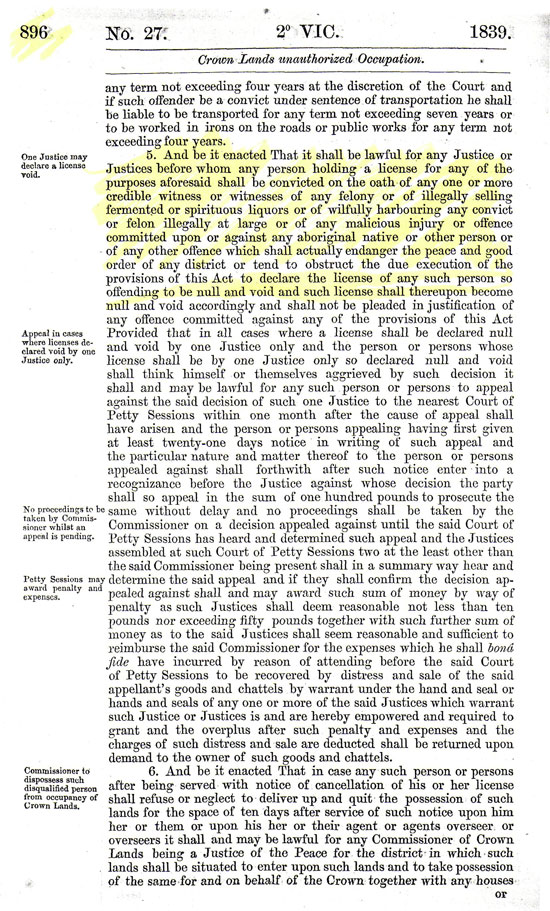
"... any
malicious injury or offence committed upon or against any aboriginal
native"
Crown
Lands Unauthorised Occupation Act, 2
Vict 27
1839;
"An Act further to restrain the
unauthorized Occupation of Crown Lands and to provide the means of defraying the
Expense of the Border Police [22nd
March, 1839.]
Whereas the unauthorized occupation of
the unalienated Lands of New South Wales is derogatory to the Rights of the
Crown and conducive to many illegal and dishonest practices and whereas an Act
was passed by the Governor and Council of New South Wales in the seventh year of
the reign of his late Majesty King William the Fourth intituled (sic)
"An Act to restrain the unauthorized occupation of Crown Lands" which
has been found beneficial in its operation and whereas another Act was passed in
the second year of Her Present Majesty intituled "An
Act to continue and amend an Act intituled 'An Act to restrain the unauthorized
occupation of Crown Lands' and it is expedient to repeal the same ...and to
provide the means of defraying the expense of a Border Police ...
5. And be it enacted That it shall be
lawful for any Justice or Justices before whom any person holding a license for
any of the purposes aforesaid shall be convicted on the oath of any one or more
credible witnesses of any felony or of illegally selling fermented or spirituous
liquors or of wilfully harbouring any convict or felon illegally at large or of
any malicious injury or offence
committed upon or against any aboriginal native
or other person or of any other offence which shall actually endanger the peace
and good order of any district or tend to obstruct the due provisions of this
Act to declare the license of any such person so offending to be null and void
..."
Aboriginal
deaths, the legal opinion of John H. Plunkett, Attorney General.
10th June, 1839 (HRA 22 July 1839, pages 256-7) Attorney General's Office. Opinion by JH Plunkett on papers re collision between mounted police under J.W. Nunn and aborigines. " ... relative to the circumstances attending to the death of some Aboriginal Natives in a collision with the Mounted Police on the rivers Namoi and Gwydir, and requesting my opinion whether any further proceedings are necessary in the case, and at the same time offering such remarks on the whole subject as I might deem proper; also stating you were directed to Explain to me that, the Inquiry in the case having been held in the express orders of the Government, the Proceedings were forwarded by the Magistrates to you, but that, as a Notice has been issued in the Govt Gazette of the 29th Inst. that, in every case in which an Aboriginal Native may meet with a violent death in consequence of a collision with white men, an Inquest or Inquiry is to be held in the same way as if the Deceased had been of European origin, the proceedings in similar cases will in future be forwarded to me by the Magistrates themselves ... Before I allude to this particular case now before me, I beg leave to observe that ... I infer that you cannot be aware that the practice has always been, since i have had the honor to hold office, in accordance with the terms of the Notice, which you state has been issued on the 29th Inst., and, in whatever part of the Colony within reach of a Magistrate, an Aboriginal Native met with a violent death, the same Inquiry was caused as if the Deceased were of European origin: and I have invariably in my official communications with the the Magistrates in the in different parts of the Colony impressed upon them the necessity of acting in all such cases without any distinction between Black and White; and, as far as I had an opportunity of judging, the Magistrates have invariably done so. Although there is too much reason to apprehend that many of the Aboriginal Natives have met with death from violent means, such instances I believe have only occurred beyond the Located limits of the Colony where no magistrate was within reach.
In the present case, it is much to be regretted that this practice was not followed by Major Nunn and Lieut. Cobban, who were both Magistrates of the Territory, and were I presume, at least ought to have been aware of it. If they had discharged their duty at the time, the proceedings would have come in the usual course to this, the proper office for them; and whatever other proceedings might have become necessary would have been taken without delay.
At this distance of time (it being according to the papers sent me One year and nearly five months since the unfortunate collision took place), I see the whole case surrounded with so many Embarrassing circumstances that it is difficult for me to determine what course should now be taken.
None of the documents transmitted to me are such as I could act upon as Public Prosecutor; there are no Original Depositions among them: there are only Copies of Depositions purporting to have been made before the Bench of Magistrates at Invermein by Major Nunn on 4 April, 1939; Serjeant Lee on the same day; Corporal Hannon ditto; Felton (Mr. Hall's stockman) ditto; Lieut. Cobban on the 16 May, 1839.
It appears from the Copy of Major Nunn's Deposition (which i presume to be a correct Copy) that his party consisted of 1 Subaltern, 2 Serjeants and 20 troopers, making on the whole (including Major Nunn himself) 24, besides some stockmen that accompanied them.
There being so many other persons to give an account of the transactions, if these Depositions had been taken in due time and forwarded to this office regularly, I could have immediately returned them to the magistrate, in order that the greater number, if not the entire party should be examined.
The Depositions taken could not be given in Evidence against the parties making them, and the law does not allow an admission made under the sanction of an oath in this way to be legal Evidence, neither do they mention the names of the other members of the party.
Before a correct legal opinion can be formed on the case, it would be necessary to Examine the rest of the party, and then the Bench of Magistrates should, as in all other cases, Exercise their discretion in it, and after that the whole proceedings should be forwarded to me, until then, it would be premature in me to form an opinion on the case.
As however His Excellency is desirous that I should offer such remarks on the whole subject as I might deem proper, I think it right to suggest that, in the present state of the case, it belongs rather to the Executive Council to advise His Excellency as to the policy and Expediency of instituting at this late period such an enquiry as that which in my opinion ought to have taken place in January, 1838. The Council taking into consideration the great excitement, which would undoubtedly be created by it in all parts of the Colony, and balancing against each other the evils which must obviously exist, whatever course may now be determined.
I have, &c.,
John
H. Plunkett, Attorney General."
The Protection
of the Aborigines
13th July, 1839 "Estimate of the Probable Expenses of the Establishments for the Protection of the Aborigines, and of Missions for their Civilization and Conversion to Christianity, for the Year 1840: Salary of Chief Protector ... Four Assistants ... Allowance to the Chief Protector ... For Donations, at the discretion of the Chief protector ... Donations of Provisions, Clothing and Blankets, for distribution by the several Police Magistrates, and Crown Commissioner ... Lake Macquarie: Salary of the Rev. LE Threlkeld ... Allowance for the maintenance of four convict servants ... Wellington Valley: In aid of the Mission, by the Church Missionary Society ... Moreton Bay: In aid of the German Mission at Moreton Bay on condition of an equal sum being raised by Private Contributions ... Port Phillip: In aid of Mission by the Wesleyan Missionary Society, on condition of an equal sum being raised by Private Contributions ... Estimated Charge of Donations and Missions to the Aborigines: 5,454 pounds, 12 shillings. E Deas Thomson, Colonial Secretary, Colonial Secretary's Office, 13th July,1839"
[Source: Votes and Proceedings of the Legislative Council 1840?]
Magistrate
Scott and the Myall Creek murderers
17th July 1839
(HRA) "The person who presided at this Meeting (in support of the accused
white men) was Mr Robert Scott,
a magistrate of the Territory ... a person of note ... he was seated in Court at
their trial, close to the Bar, and by the side of their Attorney, thus making
himself a party to their defence to the very last."
Atrocities
17 July 1839 (HRA) Gipps to Glenelg " a long list of atrocities, committed both by and
on the Aborigines of this Country.. I had despatched a party of Mounted Police
in search of some white men, who were supposed to have put to death in cold
blood not less that twenty two helpless and unoffending Blacks.. " [37]
The execution of the Myall Creek murderers
17 July 1839 (HRA) "Normanby to Gipps ... reporting the Conviction and subsequent
execution of Seven Men concerned in the Murder of Aborigines .. (and) .. the
removal of Mr R Scott's name from the Commission of the Peace. ... The whole of
these proceedings point out strongly the necessity of pursuing in the most firm
and decided manner such measures ... best calculated to check that system, which
has unfortunately arisen, of atrocities committed both by the Settlers and by
the Aborigines against each other... the fate of those men ... will serve to
check that feeling of recklessness in sacrificing the lives of the Natives ...
you would have failed in your duty, had you permitted the name of Mr Scott to
remain in the Commission of the Peace. The station, which he held in Society,
made it more necessary to mark the disapprobation of the Government
of his conduct ... The attention of HM's Government has recently been
called to the necessity of making provision for receiving the evidence of
Aboriginal Natives in Courts of Justice. This, however, is a question which I
consider it better to leave to you to bring before the local Legislature,
convinced that it will receive that consideration, which so important a question
demands."
"This Government has been in no way neglectful
of its duty to the Aborigines"
(Report referred to, Mitchell and massacres, to be located)
Minutes of executive council re
collision between mounted police and aborigines);
22 July, 1839
Sir George GipPs to Lord GLENELG
(Despatch
No. 100, per ship Palestine; acknowledged by lord John Russell, 21st December.
1839.)
Government
House.
My
Lord,
With
reference to the correspondence … on the subject of an encounter in Jany.,
1838, between a party of the Mounted Police under Major Nunn and a Tribe of the
Aborigines of this Country, as well as to other matters connected with the
treatment of the Aborigines, I have now the honor to forward to your Lordship
Extracts from the Minutes of the Proceedings of the Executive Council on the
7th ulto., and 9th inst., whereby the nature of the enquiry, which has been
instituted into
Major Nunn's case, will be explained to your Lordship, as well as the reasons
which have induced the Council to consider that no further proceedings in it are
necessary. The cause of the long delay, which has occurred in the disposal of
this case, is also 1 hope sufficiently explained in the Minutes now forwarded;
but 1 beg leave further to add that it was scarcely desirable for the
investigation at Merton to have taken place earlier, even if it had been
possible, on account of the excitement produced in the Colony by the
proceedings which terminated in the execution in Decr. last of seven men for a
massacre of the Aborigines, as reported m my Despatch of the l9th of that
month, No. 200.
I
beg further to report to your Lordship that the same causes, which prevented the
earlier disposal of Major Nunn's case, prevented also my publishing, until the
21st May last, the long contemplated notices on the subject of the Aborigines,
which was first mentioned in my Despatch, No. 68 of the 27th April, 1838. No
fitting opportunity for the publication of this notice presented itself, until
after the act (2 Vict. No. 27) for the establishment of a Border Police bad
passed the Legislative Council; indeed I am so fully persuaded that it, would
have been illtimed, had it appeared earlier, that 1 should scarcely think any explanation
on the subject necessary, were it not for an expression in respect to it. in
your Lordship's Despatch of the 16th Novr., 1838, No. 244, replying to mine of
the 27th April, 1838, already referred to.
I
trust that the proceedings, which ended in the execution of the seven men in
Decr. last, and the subsequent exertions made to establish
a Border
Police,
will
have satisfied your Lordship that
this Government has been in no way neglectful of its duty to the Aborigines, or of the respectful obedience which it
at all times
ought to pay to the expressed wishes of your Lordship and of Her
Majesty's Government, in regard to the treatment of them. In the
immediate case
under consideration (that of Major Nunn), I trust also your Lordship will agree
with myself and the Executive Council in thinking that no further proceedings
could with propriety be adopted; and that, if any of the parties were placed on
their trial, the result would inevitably be an acquittal.
It
appears to me that the worst feature in the case was the renewal of the pursuit
of the Blacks and of the firing, after a pause of about two hours (see Mr.
Cobban's evidence, Page 50 of the enclosed paper) ; when however it is borne in
mind that Major Nunn was a Military man, acting under Military orders, and that
he knew there was still assembled before him a large
I
further enclose for your Lordship's information a copy of the Notice which I
issued on the 21st May last, and also a Copy of the Standing Orders, which I
have desired may be read once a month at least by each Crown Commissioner to the
men of the Border Police under his orders.
(see 21st May 1839)
I have, &c., GEO. GIPPS
"A collision which took place in January. 1838, between a party of the Mounted Police under the command of Major Nunn and a Tribe of the Aboriginal Natives"
[Enclosure
No. 1]
27th
July,
1830
Extracts
from
the
Minutes of Proceedings of the Executive
Council, dated 7 June and
9th July 1839
respectively, relative to Depositions taken before
the Magistrates of the Bench
at Merton.
in reference to
a Collision which took place
in January,
1838, between a Party
of Mounted Police under Major Nunn and a Tribe of Aboriginal Natives.
Present:—His Excellency the Governor; His Excellency Major General Sir Maurice
Charles O'Connoll, K.C.H.: The Right Reverend the Lord Bishop of Australia : The
Honorable the Colonial Secretary.
His
Excellency the Governor, with reference to …
the subject of the measures which were to be adopted in consequence of a
collision which took place in January. 1838, between a party of the Mounted
Police under the command of Major Nunn and a Tribe of the Aboriginal Natives,
now laid before the Council certain Depositions which had been taken in this
Case by the Magistrates of the Bench at Merton, and also a letter from the
Attorney General to the Colonial Secretary commenting on the
same.
His
Excellency stated that this Investigation had been made in pursuance of the
recommendation of the Council by their Minute of 27th March, 1838, above
referred to; and. in laying the Papers in question before them, His Excellency
was anxious to make known to them the causes which had prevented that
Investigation from taking place at an earlier period.
Two
Officers and twenty two non-commissioned Officers and Privates of the Mounted
Police having been engaged in the Affair to be Inquired into, it was deemed
proper that a considerable portion. if not all, of those Individuals should
attend the Investigation. Scarcely however were the orders given for the Party
to proceed to Merton, when, in consequence of an outrageous attack by the Blacks
on a Convoy of Sheep and Cattle, the property of Mr. William Pitt
Faithfull,
proceeding towards Port Phillip, the services of every man. who could be spared
of the Mounted Police, were called for In that direction, being the directly
opposite one to that in which Merton is situated.
As
soon as this service terminated, an order was again given (on the 20th of June,
1838) for Major Nunn to repair to
Merton;
and
a letter was written to the Magistrates
instructing them to
commence the Investigation.
On
the 9th of July, however, and before any thing could be
done, it was necessary to send the Police
Magistrate of Merton (Mr. Day) with
us many of the Police as could be collected, in search of the
Parties who were then
reported to have
massacred between twenty and thirty helpless and unoffending
Blacks in the
neighbourhood of the River Bogy; the events, which followed, are sufficiently
known to
the Council and to the whole Colony.
During
the whole of these proceedings, which did not terminate until the middle of
December last, the Inquiry could not lie proceeded with; for not only was it
deemed inexpedient to hold it while the Public Mind remained in a very excited
state In respect to the blacks. but the Police Magistrate of the District, where
the Investigation was to lie held, was occupied during almost the whole of the
time in the pursuit, capture, and subsequent trials of the Offenders on the
River Bogy.
On
the 7th of February last, an order was again given for Major Nunn and as many of
his Party as could be collected to proceed to Merton.
It;
was only however on the fourth of April that he, accompanied by Sergeant John
Lee and Corporal Patrick Hannan out of the whole Party arrived there, and were
examined by the Bench: and the attendance of Mr. Cobban could not. be procured
before the seventeenth of the following month.
The
whole of the Evidence then taken has since been laid before the Attorney General
; and it is now submitted to the Council, with the Attorney General's Report.
The
further consideration of the subject was then deferred.
Major Nunn massacres the Aborigines under a persuasion that it was self-defence
Extract from Minute No. 22 of the year 1839,
dated 9th July.
Present
:—As on last occasion.
The
Council resumed the consideration of the Papers submitted to them by His Excellency the Governor.
relating to the encounter between the Aborigines and the Mounted Police under
command of Major Nunn at the River Bogy in January, 1838.
The
Council having attentively considered the Depositions taken in this important
Case, together with t lie letter of the Attorney General in reference to the
same, and having also carefully reviewed their own proceedings in connexion
with this Inquiry ... they are of opinion that no object either of Justice or
Humanity could he attained by making the transaction in question the subject
of further Judicial inquiry.
In
coming to tills conclusion, the Council are anxious to record the grounds upon
which it rests, and to shew that they have not failed to bestow the most earnest
consideration upon the
difficult and trying nature of the service upon which the Military were
employed, as well as upon the acknowledged claims of the Native Tribes to the
utmost degree of forbearance and protection which can be extended to them,
compatibly with the general safety.
It
does appear that whatever compassionate allowance may be made for the ignorance
of the Savage Tribes or for provocations which it is possible they may on other
occasions have received, they were unquestionably the Aggressors in the present
instance.
The
Council are compelled to admit that their acts of violence, rapine, and murder,
reported to this Government in December. 1837, were such as to authorise and
require the employment of an Armed force to repress them, and to secure the
lives and properties of the Settlers occupying Stations beyond the limits of
Location. and having Servants necessarily in a state of much exposure employed
in charge of the same.
The
first act of bloodshed, attendant on the employment of the Military in these
transactions, arose from the attempted escape of a Black Native who had been
identified as having been a leading accomplice in the murder of a White man, and
who was shot in endeavouring to escape from what must be regarded as Legal
Custody: the Officers, by whose directions he was arrested and under whose
charge he was detained, being also Magistrates of the Territory.
In
the main encounter in the month of January, 1838, the Council find the
strongest, reason to deplore the numbers of the Native Tribe, who, even
according to the lowest, estimate, fell under the fire of the Police. They have
most assiduously sought to arrive at an accurate view of these transactions,
derived from the Depositions of Major Nunn, Lieutenant Cobban, and the other
Parties who were examined before the Bench of Magistrates at Merton. These
statements appear to be sufficiently candid and consistent. and, from them,
the Council believe they may
safely deduce the conclusion that the firing on the part of the Soldiery commenced under a persuasion that it was necessary in self-defence.
Having
given the most attentive and Impartial consideration to the entire question
under every aspect in which they conceive ii can possibly be regarded, The
Council are now enabled to advise His Excellency that there are not sufficient
grounds for preferring a charge of wilful misconduct, against any of the Parties
engaged against the Natives in this lamentable casualty; and that accordingly
all proceedings connected with it should now be allowed to terminate.
The
Council, however in justice to themselves and to the Government, can not
forbear annexing the following observations upon a few collateral points.
First,
they are persuaded that no imputation can Justly lie against the Executive
Government of insensibility to the protection of the Native Tribes, or of dis-inclination
to avenge their injuries, when it is considered, how marked and severe an
example of Justice has been recently executed upon Offenders convicted of a
barbarous outrage against them. At the same time, the Council are sensible of a
duty incumbent on them to draw the widest distinction between the case of those
murderers of men. women, and children, without personal provocation and in cold
blood, and that of Officers and Men repelling an attack made upon them, while
acting under orders In execution of their duty.
Secondly,
The Council can not but advert to that paragraph in the Letter of the Attorney
General relating to these transactions in which surprise is apparently expressed
that no Inquiry in the nature of
an Inquest was held upon the bodies of the
Natives, who fell in a
skirmish with the Military, his
Officers who commanded on the
occasion both holding
the Commission of the Peace.
Entirely as the Council approve of the practice of holding an Inquest in every
case, wherein it may be practicable, of violent death befalling any
of the Aborigines, they are unable in the present instance, to discover
any mode in which such an Investigation could have been entered into with
consistency, the Officers, by whom it is presumed
the Inquest, might have been held,
being themselves the principals in the transaction upon which they would have
had to sit in Judgment. The
Military, having been the only persons present and
therefore alone capable of being examined as
Witnesses, were all
either principals
or accessories;
and it
appears to
be admitted by the Attorney
General that
any evidence, they might thus have furnished against themselves, would
have had no Legal effect, while, as a means of self-exculpation, it is plain
that their own testimony could have availed but little.
With
reference to the opinion, expressed or implied by the Attorney General, that a
different result might have ensued, if the Investigation had been, as it ought,
undertaken in January, 1838, the Council can not but observe that the
transaction itself occurred only in that month beyond the borders of Location;
and that official intelligence of it was not received until the 6th of March
next ensuing. Subsequently to this, the question as to what measures were
proper to be taken was brought before the Council by His Excellency the
Governor on as early a day within the same month, as the due order of the Public
business permitted: and their advice was at once given that precisely the same steps should be
taken for the attainment of Justice, if it should appear that aggression had
been committed against the Natives, as would according to Law have been
directed, upon the supposition that, a similar injury had been sustained by
persons of European Origin. The Council therefore are of opinion that the great distance of the
scenes of operation and investigation, coupled with the wide dispersion of the
Mounted Police on duty, and the consequent, difficulty of assembling at one
point those whose depositions were to be taken, sufficiently account for the
length of time which has been occupied in the Inquiry; and that no blame, so far
as they are aware, can justly be imputed to any individual on this account.
Wm.
Macpherson, Clerk of Councils.
Sydney, 27th July, 1830.
[39]
(HRA), xx, pp. 303-4
No blame for
Major Nunn and the Military
27th
July 1839
"The
rejection of the Evidence of these Natives"
"July 1839 .. Amongst various points which have engaged the attention of the Aborigines Protection Society as necessary to ensure the safety and elevation of the uncivilized Natives of those parts of the Globe, on which the British Colonies or Settlements are formed, the subject of their admission to give Evidence in our Courts of Law .. It is evident that the rejection of the Evidence of these Natives makes them virtually outlaws in their Native Land which they have never alienated or forfeited. It seems to be a moral impossibility that their existence can be maintained when in the state of weakness and degradation, which their want of civilization necessarily implies: they have to cope with some of the most cruel and atrocious of our species, who carry on their system of oppression with almost perfect impunity so long as the Evidence of Native Witnesses is excluded from Our Courts. ...
(dated 9 July 1839) (HRA) ...
"No blame,
so far as they are aware, can justly be imputed to any individual on this
account"
22nd July, 1839 PAGE MISSING (P245)
" ... On the 9th of July, however, and before any thing could be done, it was necessary to send the Police Magistrate of Merton (Mr. Day) with as many of the Police as could be collected, in search of the Parties who were then reported to have massacred between twenty and thirty helpless and unoffending Blacks in the neighbourhood of the River Bogy; the events, which followed, are sufficiently known to the Council and to the whole Colony.
Mr. Day, after an absence of Fifty three days, returned with eleven out of the twelve men, who had been concerned in this atrocious deed; and of them, seven, after a protracted course of Legal investigation, paid the forfeit of their lives upon the Scaffold.
During the whole of these proceedings, which did not terminate until the middle of December last, the Inquiry could not be proceeded with; for not only was it deemed inexpedient to hold it while the Public Mind remained in a very excited state in respect to the Blacks, but the Police Magistrate of the District, where the Investigation was to be held, was occupied during almost the whole of the time in the pursuit, capture, and subsequent trials of the Offenders on the River Bogy.
On the 7th of February last, an order was again given for Major Nunn and as many of his Party as could tie collected to proceed to Merton.
It was only however on the fourth of April that be, accompanied by Sergeant John Lee and Corporal Patrick Hannan out of the whole Party arrived there, and were examined by the Bench; and the attendance of Mr. Cobban could not be procured before the seventeenth of the following month.
The whole of the Evidence then taken has since been laid before the Attorney General; and it is now submitted to the Council, with the Attorney General's Report.
The further consideration of the subject was then deferred.
Extract from Minute No. 22 of the year 1839, dated 9th July.
Present:—As on last occasion.
The Council resumed the consideration of the Papers submitted to them by His Excellency the Governor, relating to the encounter between the Aborigines and the Mounted Police under command of Major Nunn at the River Bogy in January. 1838.
The Council having attentively considered the Depositions taken in this important Case, together with the letter of the Attorney General in reference to the same, and having also carefully reviewed their own proceedings in connexion with this Inquiry on the 27th of March, 6th of April, and 22d of May, 1838, they are of opinion that no object either of Justice or Humanity could be attained by making the transaction in question the subject of further Judicial Inquiry.
In coming to this conclusion, the Council are anxious to record the grounds upon which it rests, and to shew that they have not failed to bestow the most earnest consideration upon the difficult and trying nature of the service upon which the Military were employed, as well as upon the acknowledged claims of the Native Tribes to the utmost degree of forbearance and protection which can be extended to them, compatibly with the general safety.
It docs appear that whatever compassionate allowance may be made for the ignorance of the Savage Tribes, or for provocations which it is possible they may on other occasions have received, they were unquestionably the Aggressors in the present instance.
The Council are compelled to admit, that their acts of violence, rapine, and murder, reported to this Government in December, 1837, were such as to authorise and require the employment of an Armed force to repress them, and to secure the lives and properties of the Settlers occupying Stations beyond the limits of Location. and having Servants necessarily in a state of much exposure employed in charge of the same.
The first act. of bloodshed, attendant on the employment of the Military in these transactions, arose from the attempted escape of a Black Native who had been identified as having been a leading accomplice in the murder of a White man, and who was shot in endeavouring to escape from what must be regarded as Legal Custody; the Officers, by whose directions he was arrested and under whose charge he was detained, being also Magistrates of the Territory.
In the main encounter In the month of January, 1838, the Council find the strongest reason to deplore the numbers of the Native Tribe, who, even according to the lowest estimate, fell under the fire of the Police. They have most assiduously sought to arrive at an accurate view of these transactions, derived from the Depositions of Major Nunn, Lieutenant Cobban, and the other Parties who were examined before the Bench of Magistrates at Merton. These statements appear to be sufficiently candid and consistent, and, from them, the Council believe they may safely deduce the conclusion that the firing on the part of the Soldiery commenced under a persuasion that it was necessary in self-defence.
Having given the most attentive and impartial consideration to the entire question under every aspect in which they conceive it can possibly be regarded, The Council are now enabled to advise His Excellency that there are not sufficient grounds for preferring a charge of wilful misconduct against any of the Parties engaged against the Natives in this lamentable casualty; and that accordingly all proceedings connected with it should now be allowed to terminate.
The Council, however in justice to themselves and to the Government, can not forbear annexing the following observations upon a few collateral points.
First, they are persuaded that no imputation can justly lie against the Executive Government of insensibility to the protection of the Native Tribes, or of dislnclination to avenge their injuries, when it is considered, how marked and severe an example of justice has been recently executed upon Offenders convicted of a barbarous outrage against them. At the same time, the Council are sensible of a duty incumbent on them to draw the widest distinction between the case of those murderers of men, women, and children, without personal provocation and in cold blood, and that of Officers and Men repelling an attack made upon them, while acting under orders In execution of their duty.
Secondly, The Council can not but advert to that paragraph in the Letter of the Attorney General relating to these transactions, In which surprise is apparently expressed that no Inquiry in the nature of an Inquest was held upon the bodies of the Natives, who fell in the skirmish with the Military, the Officers who commanded on the occasion both holding the Commission of the Peace. Entirely as the Council approve of the practice of holding an Inquest in every case, wherein it may be practicable, of violent death befalling any of the Aborigines, they are unable in the present instance to discover any mode in which such an Investigation could have been entered into with consistency, the Officers, by whom it is presumed the Inquest might have been held,being themselves the principals in the transaction upon which they would have had to sit in Judgment. The Military, having been the only persons present and therefore alone capable of being examined as Witnesses, were all either principals or accessories; and it appeals to be admitted by the Attorney General that any evidence, they might thus have furnished against themselves, would have had no Legal effect, while, as a means of self-exculpation, it is plain that their own testimony could have availed but little.
With reference to the opinion, expressed or implied by the Attorney General, that a different result may have ensued, if the Investigation had been, as it ought, undertaken in January, 1838, the council can not but observe that the transaction itself occurred only in that month beyond the borders of Location; and that official intelligence of it was not received until the 6th of March next ensuing. Subsequently to this, the question as to what measures were proper to be taken was brought before the council by his Excellency the Governor as early as a day within the same month, as the due order of the Public business permitted; and their advice was at once given that precisely the same steps should be taken for the attainment of Justice, if it should appear that aggression had been committed against the Natives, as would according to Law have been directed, upon the supposition that a similar injury had been sustained by people of European origin. The Council therefore are of opinion that the great distance of the scenes of operation and investigation, coupled with the wide dispersion of the Mounted Police on duty, and the consequent difficulty of assembling at one point those whose depositions were to be taken, sufficiently account for the length of time which has been occupied in the Inquiry; and that no blame, so far as they are aware, can justly be imputed to any individual on this account.
Wm. Macpherson, Clerk of Councils, Sydney, 22nd July, 1839"
Governor La Trobe’s Instructions about the military and the Aborigines
11th Sept 1839.
General
Instructions to the
No. 39 Colonial Secretary’s Office,
10th September 1839
His
Honor
Charles
Joseph La Trobe Esq
...
you
will carefully avoid
17. I am directed in a particular manner to invite your attention
18.
In conclusion I am directed to inform you that Extracts of
information and guidance – Further instructions will be transmitted to you from time to time, as the exigencies of the service may require; and I am commanded to add, His
Excellency Sir George Gipps will at all times be happy to receive every information and suggestion connected with your duties, or the welfare of the District entrusted to your control, which it maybe in your power to offer. I have the honor to be,
Sir, Your Honor’s Most obedient Servant
Deas Thomson".
Aboriginal
Native Witnesses' Bill
20 September, 1839
"6. Aboriginal Native Witnesses' Bill; read a second time; committed, and amended; to be fairly transcribed, and presented to the Governor by the Chief Justice and the Attorney General."
Votes and Proceedings of the Legislative Council, No. 37
"Gipps refused to let them be executed ..."
"In the space of only two months the Port Fairy settlers lost 3,200 sheep; there were three of their men murdered and eight desperately wounded ... These all suffered in desperate attacks and the arrival of news from all sides of death and disasters left a very gloomy impression on the minds of the survivors. .. The appearance of a smart body of the new police in each district greatly mended matters; but when they proceeded to take into custody the malefactors, when these prisoners were tried, and condemned to death for murder, the question arose as to what was to be done with them. The first notable case occurred in 1840, when Tallboy and Neville's Billy were convicted of the murder of white men under barbarous circumstances. Gipps refused to let them be executed until he had heard from the Colonial Office, and indeed he recommended that their lives be spared; Lord John Russell ordered that they be kept in detention, and carefully instructed, and that as soon as their education should be sufficiently advanced they should be liberated.
(Russell's despatch, House of Commons Papers, 1840)"
Act 4: Aboriginals competent witnesses, disallowed
The Public General Statutes of New South Wales from 1 Victoriae to 10
Victoriae, inclusive (1836-1846) (Sydney, Thomas Richards, Government
Printer, 1861) "An Act to allow the Aboriginal Natives of New South
Wales to be received as competent Witnesses in Criminal Cases. [8th October. 1839}"
An Act to allow the Aboriginal Natives of New South Wales to be received as competent Witnesses in Criminal Cases
8th October, 1839
Preamble. Aborigines or half caste
natives to make affirmation or declaration of an oath in all criminal
proceedings. Evidence so given to have such weight only as corroborating
circumstances may entitle it to. Aboriginal natives making false affirmation or
declaration, subject to like pains and penalties as for wilful and corrupt
perjury. This Act not to take effect until the same shall have received the
Royal assent.
Whereas it is found expedient and
necessary for the purposes of Justice and the more effectual prosecution of
crimes and misdemeanours that the evidence of the Aboriginal Natives of the
Colony of New South Wales should be receivable in all Courts of Criminal
Jurisdiction. And whereas they have not at present any distinct idea of religion
or fixed belief in a future state of rewards and punishments and therefore
cannot be admitted as competent witnesses in any Court of Law without the
authority of the Legislature of the said Colony. Be it enacted by the Governor
of said Colony with the advice of the Legislative Council thereof That every
Aboriginal Native or any Half-caste
Native brought up and abiding with any Tribe of Aboriginal Natives of the said
Colony shall be permitted to make an affirmation or declaration to tell to tell
the truth the whole truth and nothing but the truth in such other form as may be
approved of by the Court instead of taking an oath in any criminal proceedings
that shall be instituted in said Colony and that the evidence so given shall be
of so much weight only as corroborating circumstances may entitle it to and if
any such Aboriginal Native making such affirmation or declaration shall be
lawfully convicted wilfully falsely and corruptly to have affirmed or declared
any matter or thing which if the same had been on oath in the usual form would
have amounted to wilful or corrupt perjury he or she shall incur the same
penalties and forfeitures as by the laws and statutes of England are enacted
against persons convicted of wilful and corrupt perjury any law statute or
custom to the contrary notwithstanding.
II. And be it enacted That this Act shall not commence or take effect until the same shall have received the Royal approbation and the notification of such approbation shall have been made by His Excellency the Governor for the time being in the New South Wales Government Gazette. George Gipps, Governor"
[8th October
1839] 3 Vic No 16, (disallowed by Lord John Russell's Despatch, dated 10th
July 1840)
1840
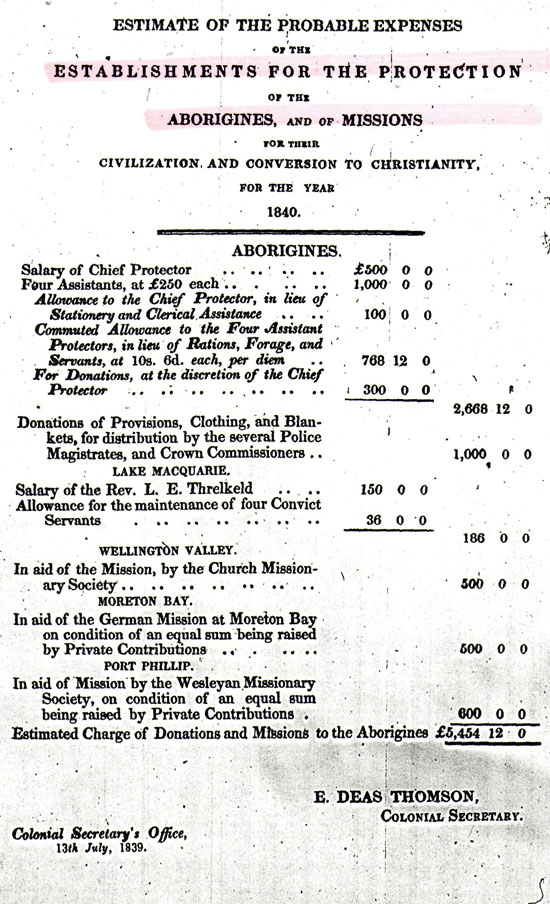
"An
unfortunate collision with the Aborigines'
28th September, 1840.
Sir
George Gipps to Lord John Russell "... Beyond the Boundaries, the Country
is also roughly divided into Districts, in each of which there is a Commissioner
of Crown Lands, who is the Chief Magistrate of it, and has under his command a
small force of Mounted Constables ... the Border Police ... the rapidity, with
which Stations are pushed into the interior, is very great; and they are
frequently formed without the permission or even the knowledge of the
Commissioner ... The persons, who form these Stations, are the real discoverers
of the Country, and they may be said to be in Australia (what the Backwoodsmen
are in America) the Pioneers of Civilization. Wherever the find good pasturage,
they fix themselves, and do not become known, even to the Commissioner, until
some accidental occurrence (perhaps an unfortunate collision with the
Aborigines) bring them under his notice, and ultimately that of the Government
... The exposure to the hostility of the Aborigines is one of the greatest
drawbacks to the advantages, which the Australian Settler enjoys ... but of
these or the dreadful consequences which follow from it, it is not now my
purpose to speak ... the Clarence River was only discovered about two years ago
by persons engaged in the cutting of Cedar ... I have now a surveying party
there; and a Commissioner of Crown Lands, with his party of Border Police
..."
HRA pages 837-840
[51]
Whitworth. Mr R.P.; The Treatment of the Aboriginals-1838 to 1847in Victoria
and Its Metropolis (Melbourne, 1888) Pages 246-247
Captain Grey's
Report on the Aborigines
8th October, 1840. Lord John
Russell to Sir George Gipps.
"Sir, I transmit to you, herewith, a Copy of a Report which I have received from Captain Grey, late Commander of an Expedition into the Interior of Australia, containing some valuable suggestions with regard to the treatment of the Aborigines. Captain Grey's suggestions appear to be founded principally on his observations of the Natives of Western Australia; but they appear to me fit for adoption generally within your Government .. (page 38) "
[HRA 7 Oct 1840 page 33]
"The whole
Machinery required to bring this plan into operation now exists in the different
Australian Colonies ..."
[Enclosure] Captain Grey to Lord John
Russell
"My Lord, I have the honour to submit to Your Lordship a report upon the best means of promoting the civilization of the Aboriginal inhabitants of Australia, which report is founded upon a careful study of the language, prejudices and traditional customs of this people ... as so small a portion of Australia is yet occupied, and the important task of so conducting the occupation of the New Districts, as to benefit the Aborigines to the best possible degree ... the whole Machinery required to bring this plan into operation now exists in the different Australian Colonies ..."
HRA 7 Oct 1840 page 33
"Report
upon the best means of promoting the civilization of the Aboriginal Inhabitants
of Australia"
[Sub-enclosure]
"1. The Aborigines of Australia having hitherto resisted all efforts which have been made for their civilization ... if they are capable of being civilized, it can be shewn that all the systems ... contained some common error ... This principle was that ... be made amenable to British laws ..."
MORE - Go to: Report by G. Grey on method for promoting civilization of aborigines
[Source: 8 Oct. 1839 HRA pp.38-40]
Act 5: "it
shall not be lawful for any aboriginal native, or half-caste ... to have ... any
kind of fire arms ..." [Disallowed
s 4 Victoria, No 8. An Act to prohibit
the Aboriginal Natives of New South Wales from having Fire Arms or Ammunition in
their possession, without the permission of a Magistrate. [11th
August, 1840]
Preamble.
No Aboriginal native or half-caste,
usually abiding with such natives, to have or keep any description of firearms,
or ammunition, without permission of a Justice. Any constable or free person may
obtain or take from any such native or half-caste, any fire arms or ammunition,
which he may have; provided no unnecessary violence be used. Penalty on persons
giving or lending fire arms to any aboriginal native or half-caste usually
abiding with such natives. Recovery and appropriation of fines. 5 William IV No.
22. Act not to extend to New Zealand.
Whereas in some parts of the Colony of
New South Wales, the aboriginal natives have obtained possession of fire arms,
and it is considered dangerous to the public security to allow the said
aboriginal natives to have, keep or use, any description of fire arms , except
or ammunition, except as hereinafter excepted: Be it therefore enacted by His
Excellency the Governor of New South Wales, with the advice of the Legislative
Council thereof, That from and after the passing of this Act, it shall not be
lawful for any aboriginal native, or half-caste, usually abiding with such
natives, to have, or keep, any kind of fire arms, or ammunition, unless with the
written permission of any Justice of the Peace, resident in the district which
any such native or half-caste shall usually frequent.
II. And be it enacted, That it shall
and may be lawful for any constable within the said Colony, or any free person
whatsoever, to obtain or take from any such aboriginal native or half-caste not
holding such permission as aforesaid, every kind of firearms or ammunition which
any such person may have, and lodge the same with the Police Magistrate of the
district in which such fire arms or ammunition shall be obtained or taken:
Provided that no personal violence be used towards any such aboriginal native or
half-caste, further than may be absolutely necessary for obtaining or taking
such fire arms or ammunition as aforesaid.
III. That it shall not be lawful for
any person to give or lend to any aboriginal native, or any half-caste usually
abiding with such natives, not holding permission as aforesaid, any gun, musket,
pistol, or any kind of fire arms or ammunition whatsoever; and if any person
whosoever shall give or lend to any aboriginal native or half-caste, not holding
such permission as aforesaid, any gun, musket, pistol, or any kind of fire arms
or ammunition whatsoever, he or she shall, for every such offence, forfeit and
pay a penalty of not less than ten pounds, nor more than twenty-five pounds, to
be recovered before any one or more Justice or Justices of the Peace for the
said Colony.
IV. And be it enacted, That all fines
to be recovered under this Act of the Governor and the Legislative Council of
the said Colony, passed in the fifth year of the reign of His late Majesty King
William the Fourth, intiuled An Act to
regulate summary proceedings before Justices of the Peace, and shall be paid
to the use of Her Majesty, Her Heirs and Successors, for the public uses of the
said Colony, and in support of the Government thereof.
V. And it be enacted, That nothing in
this Act contained, shall extend, or be construed to extend, to that part of the
Territory of New South Wales, called New Zealand.
George Gipps, Governor.
Disallowed by Lord John Russell's
Despatch, dated 11 August, 1840.""
Aborigines — Parliamentary Index
Extract from Despatch of Secretary of State respecting.. P. 752; Act of Council prohibiting them from having Fire Arms ... P. 837; Ditto, enabling them to be received as Witnesses in Criminal cases, disallowed.... P. 1379
The land boom
"It would seem that in 1840, when the (land) boom was still well maintained, the effect of the imperial measure of 1839 was to give the colonial government an increase in land revenue ... it was the colonial demand for land ... that brought in the extra revenue. The range of prices realised shows this. The average price per acre paid for more than a milhon. acres of Crown (country) land sold in the three and a half years ended 30 June 1840, was 9s. 10d., but as the boom approached its climax ... the average price paid rose almost to 12s."
[Source:
Fitzpatrick, Brian: The British Empire
in Australia, An Economic History, Foreword By Geoffrey Blainey
Macmillan 1969) (Page 55)]
"A
comprehensive annual report on the entire Aboriginal problem"
"In 1840 Gipps was required by Downing Street to forward a comprehensive annual report on the entire Aboriginal problem, and he continued to send them for the duration of his administration. These reports furnish vital information. They include reports from the mission stations, the Port Phillip Protectorate, and some eighteen land commissioners. By 1841 Stanley considered the protectorate a failure and doubted the value of mission stations. His authority to Gipps to discontinue grants to these missions was implemented in 1843."
[Source: Shaw AGL and Clark CMH, Australian Dictionary of Biography 1788-1850 MUP 1967) Page 452]
"There seemed to be at that time some likelihood of the frequent appearance of natives before the courts in Melbourne and the Government, in order to see that justice was done to them, appointed a standing counsel to defend them. Mr. Redmond Berry, then one of the two leading barristers was chosen for that purpose, and his kindness of heart, joined to a genuine zeal on behalf of these children of the forest, made him an excellent advocate of their cause. ..."
[Source: Whitworth. Mr R.P.; The Treatment of the Aboriginals-1838 to 1847in Victoria and Its Metropolis (Melbourne, 1888) Pages 246-247]
4 Victoria No. 2 [1840]
.
"For enabling the principal
Officers of Her Majesty's Ordinance to hold estates and property in the Colony
of New South Wales for military purposes and for granting certain other powers
to the said principal Officers and respective Officers resident in the said
Colony, HRA?
Page 1015."
1841
Sir George GIPPS to Lord John Russell.
(Despatch No. 35, per ship Andromache; acknowledged by Lord John Russell, 11th August, 1841.)
My Lord, Government House,
3d Feby., 1841.
With my Despatch of the 7th May last, No. 61, I had the honor to forward to Your Lordship a number of documents illustrative of the nature of the intercourse, which exists in this Colony between the European Settlers and the Aboriginal Inhabitants, an intercourse which is unhappily marked by acts of violence on both sides.
I have now the honor to forward further documents of the same nature, selected in like manner as before out of an immense mass of Papers, the correspondence on matters connected with the Aborigines having, since the appointment, of the Protectors, increased to such a degree as to form, 1 lament to say, of itself no inconsiderable evil.
Your Lordship will I am sure be sorry to learn that aggressions by the Natives on the flocks and herds of the Settlers, as well as the acts of reprisal to which they give birth, have during the last few months in the Port Phillip District increased rather than decreased in number.
The documents in the Appendix, marked A 1, A 2, consist of Reports addressed to Mr. La Trobe by the two Crown Commissioners of the Port Phillip Districts. The atrocities mentioned in these Reports mostly appear to have been committed at Stations very recently formed or occupied; and I would beg to refer Your Lordship to Mr. La Trobe's observations on this head, contained in his letter of the 7th Octt,, 1840 (Appendix B) accompanying the Reports.
Mr. La Trobe at the same time forwarded thirteen other documents relating to different aggressions, which it would be tedious to copy.
My reply to Mr. La Trobe's letter is enclosed, being marked C. The Papers next in the collection relate to a mission on which I recently employed Major Lettsom of the 80th Regt., and of which the origin was as follows:—
Towards the end of the month of May last, an attack was made by the Blacks on a Station belonging to Dr. Mackay on the Ovens River (156 miles from Melbourne on the road to Sydney), which, from the accounts I received of it, appeared to me rather to have been a preconcerted measure of revenge or retaliation than an ordinary act of rapine committed for mere wantonness or under the pressure of hunger. The Natives came suddenly on the Station, and as suddenly disappeared. They had fire arms, and used them with considerable dexterity; and another remarkable circumstance was that the attack seemed to have been purposely made at a time, when the Proprietor (Dr. Mackay) was absent.
Not many weeks after the information of this attack reached me, a gentleman, who has recently settled in that part of the country and who is a young; man of highly respectable family and connexions in England, waited upon me, and put into my hands a Paper headed "The Blacks," of which I enclose a copy (Appendix [)). All these circumstances combined induced me to think it necessary to send some person, in whom I could implicitly confide, to the-District, where such irregularities or atrocities rather were said to prevail; and 1 accordingly selected Major Lettsom of the 80th Regt., a person connected with the Colony in no other way than as serving in it with his Regiment.
The Instructions, which I gave to Major Lettsom, are contained in the enclosure marked E; and his reports to me are marked F and G.
Your Lordship will be gratified in observing that Major Lettsom considers the account given in the Paper, marked ''The Blacks," to be a very highly colored, not to say exaggerated one, and that his reports are generally favorable to the Settlers. Major Lettsom fell in with but very few Blacks, until he got to Melbourne. Near that Town however, a Tribe of Blacks, belonging to the country through which he had passed (and called the Goulburn Blacks), happened to be assembled for the purpose of forming a junction with another tribe, before proceeding to make war upon a third; and it appearing that a considerable number of these Goulburn Blacks could be identified as the perpetrators of many outrages. Major Lettsom, with the full concurrence and indeed acting- under the direction of Mr. La Trobe. put himself at the head of all the force that could be collected, and, by surprising them in their encampment, captured the whole of the two tribes; the greater part of them were set at liberty the following day, but about thirty were detained in custody until discharged by order of the Attorney General.
Your Lordship will perceive that two Blacks lost their lives on these occasions, one was killed whilst aiming a murderous blow at, Lieutt. Vignollos of the 80th Kept., the other was shot as he was attempting to escape out of Prison.
Although Major Lettsom, in taking upon himself the Military command of the Party by which the Blacks were arrested, departed in sonic degree from the Instructions which I had given to him, I do not consider that he exceeded the discretionary powers, with which any person acting in such circumstances ought to consider himself invested; and, as moreover he acted with the full concurrence and indeed under the orders of Mr. La Trobe (see enclosure II), I have signified to him my approval of his conduct.
The whole of the circumstances connected with the arrest of these persons, as well as the proceedings at the Inquests holden (in the bodies of the two men who were killed, have been before the Attorney General; and I have delayed for a considerable time the transmission of this Despatch, in the expectation that some proceeding's would have been instituted in consequence by that Officer, I have however been within the last few days informed by him that he does not consider there is any case to bring before a Court of Justice.
Major Lettsom complained to Mr. La Trobe of being obstructed in the execution of the duty with which he was charged, or at any rate of not being aided in it, by Mr. Assistant Protector Thomas; and Mr. Thomas, in a letter to the Chief Protector, of which I enclose a Copy (marked I) remonstrated against the proceedings of Major Lettsom.
Your Lordship will I am sure observe with regret that all the occurrences, alluded to in this Despatch, have taken place in those Districts of the Colony, for which Protectors of Aborigines were especially appointed by Her Majesty's Government, namely in the neighbourhood of Port Phillip, the older parts of the Colony having been, I rejoice to say, during the last six months but little disturbed with any outrages between Blacks and Whites.
By many of the Settlers, it is said that the presence of the Protectors is the occasion of outrage, inasmuch as their appointment has tended to embolden the Blacks, and to render the Stockmen or Servants of the Settlers less resolute than they used to be in defence of their Masters' property. I am myself far more disposed to attribute the increased frequency of collisions of this nature to the cause which I have already alluded to, namely, the rapidity with which people have been led from the superiority of its pasturage to form new Stations in the Port Phillip District, and by which a tract of country has been rapidly occupied by Europeans, which was until very recently the undisputed heritage of the Savage; at the same time however, I feel it my duty to declare that my hopes of any advantage being derived from the employment of the Protectors are every day diminishing.
The Chief Protector, whatever may be his other merits (and on the more confined theatre on which he acted in Van Diemen's Land I believe they were considerable), is afflicted with such a love of writing that much of his time must be spent in that way, which would be much better devoted to active employment; and his assistants are I believe even more inactive than he is; they are all encumbered, as I have before had occasion to observe, with large families, and seem to have come to Australia with the expectation of establishing Missionary Stations, rather than of itinerating with and amongst the tribes. One of them has already resigned, as reported in My Despatch of the 7th May last; another never quitted for more than a year the spot on which he first seated himself, called the Salt Water River, though there were no Blacks there; and the Chief Protector has himself, in a letter to Mr. La Trobe of the 22nd Septt., 1840, described it " as the worst that could possibly have been selected, being quite out of the way of communication with the Chief Tribes of the District, and thickly surrounded with Settlers."
Mr. La Trobe has complained nearly in terms as strong of the difficulty of getting another to move from Geelong.
In my Despatch of the 7th May last, I reported to Tour Lordship that I had sanctioned the formation of a homestead or fixed station for each Assistant Protector with a sufficiency of land attached to it to keep Settlers at a distance.
The formation of these Stations will doubtless tend to give a still more Missionary character to the duties of the Protectors. Each homestead will in fact become the seat of an establishment, nearly similar to that of Wellington Valley; though, being more under the superintendence of the Executive Government, it is to be hoped that the causes, which have rendered the Mission at Wellington of little use, may be obviated.
The principal advantage of such Missions or Stations is that they may, under proper management, be made places of refuge to the Natives and of Education for their Children; the Education Of children being perhaps the only measure, on which a reasonable hope can now be founded for effecting any improvement in the Aborigines of New South Wales.
It is evident, however, that Protectors, whose duties are confined to Missions of this sort, can exercise no influence whatever in checking the atrocities which are committed, whenever land is occupied for the first time by the flocks or herds of our Settlers. Young men, unencumbered with families, are best suited for these purposes; and accordingly I have universally selected such to be our Commissioners of Crown Lands. . I have, &c.,
Geo. Gipps. [Enclosures.]
[These papers will he found in a volume in series ///.]
[Gipps to Russell, 3d February., 1841. HRA]
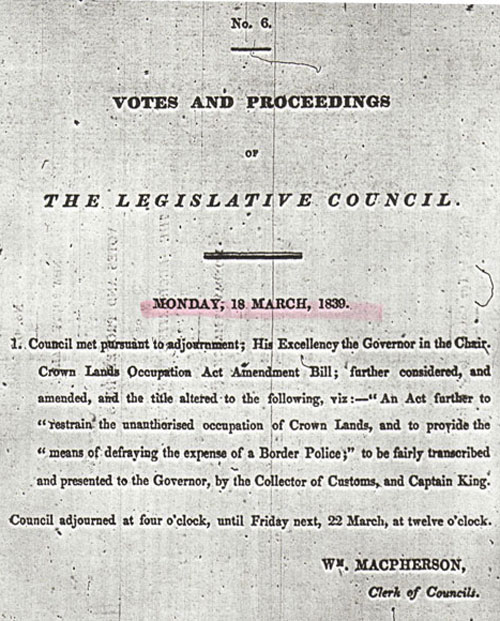
“The dreadful consequences”:
7th April, 1841
Gipps to Russell
“…
Beyond the Boundaries, the Country is also roughly divided into
Districts, in each of which there is a Commissioner of Crown Lands, who is the
Chief Magistrate of it, and has under his command a small force of Mounted
Constables, who in order that they may be distinguished from the more regular
Mounted Police of the Colony, are called by the name of the Border Police.
Within
the Limits of Location, land is either sold or let on lease; beyond the Limits
it is neither sold nor let, hut Licences are granted, at the discretion of the
Crown Commissioner, for the occupation of such portions of land as may ho
desired by Proprietors of Stock, on each of which Licences a fee of £10 is
payable annually, and an assessment under a Local Ordinance (2nd Vict., No. 27)
is levied on the Stock depastured there.
Each
allotment of land, for which a Licence is thus given, is called a Station; and
the Stations may vary in extent from 5,000 to 30,000 acres.
The
quantity of Stock, on which assessment was paid for the half year ending the
31st Deer., 1839, was 7,088 Horses; 371,699 Horned Cattle; 1,334,593 Sheep; and
the number of Licensed Stations was 694. The real quantity of Stock however in
all probability exceeded the quantity returned.
The
rapidity, with which Stations are pushed into the interior, is very great; and
they are frequently formed without the permission or even the knowledge of the
Commissioner.
Towards
the North, Stations already extend to the Country behind Moreton Bay, 300 miles
beyond the Limits of Location; To the South and West, they extend beyond Port
Phillip to the boundaries of South Australia.
The
persons, who form these Stations, are the real discoverers of the Country, and
they may be said to be in Australia (what the Backwoodsmen are in America) the
Pioneers of Civilization. Where ever they find good pasturage, they fix
themselves, and do not become known, even to the Commissioner, until some accidental
occurrence (perhaps an unfortunate collision with the Aborigines) bring them
under his notice, and ultimately under that of the Government.
The
exposure to the hostility of the Aborigines is one of the greatest drawbacks to
the advantages, which the Australian Settler enjoys in the facility of forming
such Stations; but, of these or the dreadful consequences which follow from it,
it is not now my purpose to speak.
…
Sir George Gipps to Lord John Russell.”
[Source: Sir George Gipps to Lord John Russell, Despatch No. 139, per ship Eliza Francis: acknowledged by Lord John Russell, 7th April, 1841]
1841 - Mr Frederick Walker appears on the scene
Rapid settlement, illegal until 1837 because the region was 'beyond the boundaries' proclaimed by Governor Darling in 1829, brought problems, and in 1841 squatters on the Lower Murrumbidgee petitioned the Governor to provide a police magistrate and three or lour constables to keep law and order. In their petition they pointed out that the district was 'the great thoroughfare to South Australia, Portland Bay and Port Phillip', along which thousands of sheep and cattle travelled, 'driven in many instances by some of the worst of characters, in the capacity of shepherds, stock keepers, and bullock drivers'. Moreover, 'these persons, from the facility afforded by the numerous public houses lately established on the road', were frequently intoxicated, so the highway presented 'the most appalling scenes of infamy and disorder, even on the Sabbath day!
On 27 March 1841 Governor Gipps replied that he could not accede to the petition, but undertook to direct that the Border Police under the Commissioner for Crown Lands in the Murrumbidgee District 'be kept in as efficient a state as possible'.
Legislation in 1841 provided for the establishment of benches of magistrates beyond the boundaries, so on 22 February 1847 sixteen licensed pastoralisls of the Murrumbidgee and Lachlan Pastoral Districts presented a petition on similar lines to that of 1841. They pointed out that their stations were on 'the great lines of thoroughfare leading to Melbourne and Adelaide' ...
As the stations of these pastoralists were one to two hundred miles from the courts of petty sessions at 'the Tumut and Binnilong', they requested that a court be established more conveniently, 'begging leave however respectfully to suggest that a station called Wagga Wagga 70 miles lower down the river than the Tumut court' would in their opinion 'be peculiarly eligible'. These men proved how anxious they were for this court to be established by promising to contribute, 'should it be deemed necessary by the Government, the funds necessary for the erection of suitable buildings;
This request was almost immediately acceded to. On 30 April 1847 Wagga Wagga was announced in the New South Wales Government Gazelle as a place for holding petty sessions with Mr Frederick Walker as clerk and Mr Michael Norton as chief constable. Early in May the Governor voted £410 for the year for establishing the court, and notified the bench of magistrates that it would afford him 'great pleasure to hear that your Bench and the establishment allotted to it have been brought fairly into operation;
Michael Norton, probably with the help of some magistrates, chose the site ... building was begun almost immediately and on 10 August 1847 the Bench ... sat for the first time.
The writer of an article 'Wagga Wagga Its Past and Present' in the Wagga Wagga Advertiser of 7 August 1875 said that the court room was 'a very primitive temple of justice, constructed of props and saplings, walled in and covered with bark. The browns; continued the writer, 'were slightly astonished by I his imposing evidence of the march of civilisation, and looked on ... in silent awe, if not admiration, at the tableau, especially at the very grave and reverend signors who composed the bench, and . . delivered themselves of judicial truisms' with oracular solemnity.
So a court was established and, indeed, a village, because it is extremely doubtful if any oilier buildings preceded those of the police establishment ...
[Source: Law On the Frontier; The First Ten Years of the Wagga Wagga Bench, 1844-57; A Paper Read to the Society by the President, K. J. Swan, on 19 May 1969, in the Journal of the Wagga Wagga and District Historical Society, More Men - and Women of Wagga Wagga, Number 2 (1969) (pp. 20-21)]
"An attack from the Natives"
Sir George Gipps to Lord John Russell. (Despatch No. 110, per ship St. Vincent; acknowledged by Lord Stanley, 20th October, 1841.)
My Lord, Government House,
3rd June, 1841.
I have the honor herewith to forward a Memorial which has been addressed to Your Lordship by Mr. David L. Waugh in consequence of my having declined to grant him out of the Revenue of this Colony compensation for a loss which he sustained by an attack on his Sheep Station from the Aborigines.
Your Lordship is aware that, although persons are permitted by this Government to go beyond the settled District of the Colony in search of pasturage for their increasing Hocks and herds, it always has been held that they do so at their own risk; and the present is I believe the first direct application for pecuniary compensation, which has been made by any settler for losses occasioned by an attack from the Natives.
It is quite true that, within the last few years, the occupation of lands beyond the boundaries has been licenced on the payment by each occupier of an annual fee of £10; and also that a small assessment * (* Note: See 2nd. Vict. No. 27, transmitted by Despatch No. 65., of the 6th April, 1839) is levied on all Stock depastured beyond the Boundaries of Location for the purpose of defraying: the expence of a Border Police; but it never has yet been pretended that the Government, by taking these fees or rates, makes itself liable for all losses sustained by the aggressions of the Natives; and, as very serious consequences would result from the admission of such a doctrine, I have felt it my duty strenuously to oppose the introduction of it.
Though Mr. Waugh's Memorial is dated the 11th Feby., it reached me only in a fit state for transmission to Your Lordship on the 5th ulto. I have, &c.,
Geo. Gipps. [Enclosure.]
[A copy of the petition of David Lindsay Waugh will he found in a volume in series III.]
[Sir George Gipps to Lord John Russell. 3rd June, 1841. HRA]
"Land set apart ... for the use of the Aborigines ..."
Sir George Gipps to Lord John Russell.
(Despatch No. 120, per ship St. Vincent; acknowledged by Lord Stanley, 20th October, 1841.)
My Lord, Government House,
6th June, 1841.
Recurring to the subject of Special Surveys on which I have recently had frequent occasion to address Your Lordship, I enclose herewith a Copy of a letter from the Superintendent of the District of Port Phillip, enquiring whether land set apart for the use of the Aborigines can be demanded by the Holder of an Order for a Special Survey, also a Copy of my answer to the same, declaring that no land set apart in any way for the use of the Aborigines shall be included in a Special Survey, until orders to the contrary from Your Lordship may be received.
I trust Your Lordship will approve of the decision which I have come to in this matter. I have, &c,
Geo. Gipps. [Enclosures.]
[Copies of these letters, dated 4th and 19th May, 18\41, will be found in a volume in series III.]
[Sir George Gipps to Lord John Russell. 6th June, 1841, HRA]
"Collisions between the men in charge of such Establishments and the Aborigines of the Country"
In the unsettled parts of the Colony, or in the Districts beyond what are called the Boundaries of Location, these Stipendiary Magistrates are called Crown Commissioners, or more properly Commissioners of Crown Lands, and their chief duties are to exercise a control over the very numerous grazing establishments, which have been formed in these Districts under Licences from the Government, and to prevent collisions between the men in charge of such Establishments and the Aborigines of the Country. These Commissioners also collect the fees payable on the Government Licences, as well as a small assessment on Cattle and Sheep. authorized by an Act of the Colonial Legislature, 2nd Vict., No. 27.
Go to: Administration of Justice in the Colony in 1841 (more, same document)
[Gipps to Russell, 14 Sept. 1841, HRA]
The uncivilized Natives, and their admission to give Evidence in Courts of Law.
"Amongst various points which have engaged the attention of the Aborigines Protection Society as necessary to ensure the safety and elevation of the uncivilized Natives of those parts of the Globe, on which the British Colonies or Settlements are formed, the subject of their admission to give Evidence in our Courts of Law ... "
[Source:
Hurst to La
Trobe, 22 July 1841, Bonwick Transcripts, Box 54, Mitchell
Library; in Woolmington, Jean: Aborigines
in Colonial Society (Cassell 1973) (Page 138)]
Justice Willis
... appointed a judge of the Supreme Court of New South Wales ... in 1838 ... the town of Melbourne (was) 'kept in a state of continued excitement by the proceedings of Mr Justice Willis and the extraordinary nature of the harangues he is in the habit of delivering from the Bench' ... By this time Willis had incurred the enmity of powerful interests in Melbourne ... Gipps removed Willis from office ...in 1843 ... the Port Phillip Patriot demanded that Judge Willis should not be 'sacrificed to gratify the despicable clique from whose tyranny His Honour has rescued the community' ... 'We like him the better that he has never administered one kind of justice to the rich and another kind to the poor.'"
[Source: Willis, John Walpole, Vol 2 Australian Dictionary of Biography Page 605]
"They did
not understand the nature of the pleadings ..."
"As a rule the blacks were discharged, on the grounds that they did not understand the nature of the pleadings. Of thirteen who were arraigned for murder during the years 1841 and 1842 ten were so discharged , and three were executed ... Mr Barry defended them with skill and patience but the two prime actors were sentenced to death ..."
[Source: Whitworth. Mr R.P.; The Treatment of the Aboriginals-1838 to 1847in Victoria and Its Metropolis (Melbourne, 1888) Pages 246-247]
"The
colonies and their capitalist backers"
"The imperial authorities ... were given much more worry by the New South Wales community, which was engaged in forcing the Crown to extend settlement. Certainly the introduction of private capital brought about a considerable increase of colonial revenue by sending up customs collections and land sale receipts. But the Colonies demanded appropriation of most of this for their own purposes ... the Crown had to find funds to meet the increase of administrative costs consequent upon the establishment of new centres of settlement hundreds of miles distant from Sydney ... Whitehall and its representatives took a view of the squatting dispersion which was quite different from that of the merchants and landowners who made up the Legislative Council in Sydney. Probably the determination of the imperial authorities to make the colonies and their capitalist backers pay for their own experiments can be made to explain much of Whitehall's vacillating colonial land policy in the four years 1839-42."
[Source:
Fitzpatrick, Brian: The British Empire
in Australia, An Economic History, Foreword By Geoffrey Blainey
Macmillan 1969) (Page 54)
"Should the Aboriginal resist, the result is fatal".
December 21st 1841
"In reference to this subject (note, Crown lands alienation, see Robinson's Report, below at January 1st 1845) I beg to subjoin the following from a Colonial Paper. -
Criminal Sittings, Supreme Court,
'Crown prosecutor - Yes Your Honor but what right have they to turn a Black off their run?
Judge Willis - They have a right to turn either Black or White off - I will go further and say if the Government take upon themselves to be the decisors of the Soil, the Tenant has a Warrant under the decisor to occupy the land " (page 160 missing ...?) "happens that newcomers will turn them away, the residence therefore of a Tribe depends upon the will of the Proprietor, or perhaps the caprice of some querulous stockman or overseer ... there is a warrant from the decision to occupy the soil and they can turn the black or white off their runs, should the Aboriginal resist, the result is fatal.
The Natives here complain of these infractions and of what to them appeared uncalled for, unreasonable and oppressive treatment - I do not say but some settlers have had cause of complaint against the natives, there are good and bad in all communities ..."
"Aboriginal people live in their own self-governing communities
with their own laws and means of administering justice"
... In the matter of R v Bonjon [1841] another case of an Aboriginal man charged with the murder of another Aboriginal man, the defence argued that Aboriginal people live in their own self-governing communities with their own laws and means of administering justice. The defence argued that New South Wales was occupied by the British, not conquered or ceded, and therefore had no jurisdiction over Aboriginal people. They argued that until a treaty or other form of consent was given by Aboriginal people the Crown had no jurisdiction over them or the internal affairs of their communities ... In determining this matter Justice Willis found that the Supreme Court of New South Wales has no jurisdiction over crimes committed by Aboriginal people against each other. Justice Willis stated that 'I am at present strongly lead to infer that the Aborigines must be considered and dealt with, until some further provision be made, as distinct though dependant tribes governed among themselves by their own rude laws and customs.' However Justice Willis reserved the right to alter his conclusions on these issues."
[Source:
The case of R v Bonjon [1841], in Strengthening
Community Justice, Some issues in the recognition of Aboriginal Customary
Law in New South Wales. (Aboriginal Justice Advisory Council) Page 5]
1842
An Act for the Government of New South Wales and Van Diemen's Land 1842
NSW
- Imperial Act; First
Representative Constitution (under Act of 1842), Crown Land Sales Act: and 14
years’ lease to squatters in unsettled districts, first general
election.
This document is an assent original of the Act which is the 'germ' of Australia's parliamentary system. It created Australia's first semi-representative legislature, and while it did not grant full responsible government, it was an acknowledgment on the part of the British authorities of the maturity of colonial society.
History
A Legislative Council had been established by the New South Wales Act 1823, but it consisted of nominated members only. This form of government only briefly satisfied the demands of the Colony as it emerged from its penal origins. The 1842 Act established a Legislative Council consisting of 36 members, 12 of whom were appointed by the Queen (on the advice of Her Ministers) and the rest elected by the voters in New South Wales. Eligibility to vote was based upon ownership or occupation of property set at a high value.
The Act did not establish 'responsible government' as the Governor still had overriding authority and Ministers of State were not Members of Parliament.
An Act Appointing and empowering commissioners to examine and report upon to grants of land under the Great Seal of the Colony of New South Wales
[16 August, 1842.]
6 Victoria, No. 11. An Act to amend schedule C of an Act, intituled An Act for appointing and empowering commissioners to examine and report upon claims to grants of land, under the great seal of the Colony of New South Wales."
Whereas a certain Act was passed by His Excellency the Governor of New South Wales, with the advice of the Legislative Council thereof, in the fifth the reign of his late Majesty King William the Fourth, intituled, An Act Appointing and empowering commissioners to examine and report upon to grants of land under the Great Seal of the Colony of New South Wales; Whereas it is expedient to amend schedule C of the said Act, insomuch as to the fee to be received by the secretary to the commissioners, for every final report, to be paid by the party or parties in whose favour the report is made: it is therefore enacted, by His Excellency the Governor of New South Wales, with the advice of the Legislative Council thereof, That from and after the passing Act, so much of the said Act as relates to the said fee in the schedule to Act annexed, marked C, shall be, and the same is hereby repealed. And be it enacted, That from and after the passing of this Act, the fee ... for every final report, to be the party or parties in whose favour such report is made, shall be four pounds three shillings.
GEORGE GIPPS, Governor.
First Land Sales - Brisbane 1842
Sydney Gazette July 1842
Governor Gipps declared the district of Moreton Bay was no longer to be considered a penal settlement in February 1842. The First sale of building allotments in Brisbane took place in Sydney in July of that year. The Sydney Gazette reported:
'On Thursday last, the long expected sale of building allotments, at Brisbane Town, came off: The sale was numerously attended, and the biddings spirited - the allotments, with a few exceptions consisted of thirty six perches each, and the prices given, far exceeded our most sanguine expectations. The eight allotments put up in Queen Street, realised collectively the large sum of £1,340; the largest sum given for any one allotment, being £250. The portion on the south side of the river did not go off so well but considering the inferiority of the situation, the biddings were high. We cannot help pausing here to remark that the government surveyors might, surely, for the first sale of a township, in a locality totally unknown to a majority of the purchasers, have laid out the few streets, necessary for a suburb, on a piece of land really and truly adapted to the purpose for which it is sold to the public; we are led to make these remarks from the fact that a number of these allotments on the south side of the river, are situated in a swamp which is overflowed daily, at high water. It is true that the Colonial treasurer does not undertake to give a minute description of the Crown Lands put up for sale, but when a portion of land in a new country is selected by the paid officers of the crown and brought before the public as building allotments it ought to be tacitly understood, that the successful bidder will find his purchase in every way fit for the purpose for which it is sold to him.
The large prices given for allotments is a strong proof of the interest with which the public looks forward to this fine settlement, and many persons no doubt left the sale room happy in the idea, that they had secured a future home for themselves and family. We sincerely regret that anything should have occurred to check the hopes of the purchasers of the allotments referred to.
It may therefore be considered as settled that coasters will continue to take in and discharged their cargoes at Brisbane Town, and that goods for the interior must be for sometime conveyed to Limestone, in punts small lighters or by land carriage as heretofore.
We further learn from a correspondent, that the parties who went in search of an overland route, to the Wide Bay River had been successful and that the nature of the country had fully realised the expectations held forth by the former exploring party.
[Source: Sydney Gazette July 1842
Sale of crown land
"The colonists had followed the path of political reform in England very closely and were keen for similar political reform in the Colony. They wanted to be able to elect their own representatives to the Legislative Council. Aster a great deal of lobbying, the British Parliament passed an Act in 1842 which allowed for 36 members of the Council; 12 were to be appointed by the Governor and 24 were to be elected by men who qualified by owning sufficient property. This was the first representative legislature in Australia. The governors still had more power than the Council, because, is the Council passed a law with which they disagreed, they could dissolve the Council and refer the bill to the British Parliament. Governors were financially independent because they controlled the money raised from the sale of Crown land."
[Coghlan, T.A., A.M., Inst. C.E., Government Statistician; The Wealth and Progress of New South Wales 1887-88 (Sydney: Charles Potter, Government Printer, Phillip-Street. George Robinson and Co., 361 George-Street. 1888) Pages 20-21]
"A
property franchise"
"In New South Wales an official Legislative Council was established in 1823 ... In 1842 the Council was made two-thirds elective, with a property franchise; the squatters gained the bulk of the representation."
[Source:
Miller, JDB: Australian Government and
Politics (Duckworth, 1954) Page 40]
“Sir James Stephen held this very great influence at the Colonial Office over the years when the White Australia Policy was taking shape, and was Permanent Under-Secretary in the years (1836-47) in which the White Australia Policy was given its first documentary authority ....Permanent Under-Secretary Stephen wrote a minute claiming he saw the hand of Providence in the occupation and colonisation of Australia by Britain, and laid it down that such a source of greatness must be reserved for Britain and the British ... ‘To his mind the people of Britain were the real owners of unoccupied lands in the colonies, and this land should therefore be used in their interest’ ... ‘The missionary societies had access to the Colonial Office. Sir James Stephen was a member of the committee of the Church Missionary Society’ ... he ‘appears as the main bridge between the rulers of the British Empire and the Evangelicals and missionary societies’ ... ‘Stephen’s ... insistence that Australian lands and opportunities should be reserved for British settlement were perhaps his pretension to impotence when his duty was to prevent extermination of the surviving Aboriginal occupiers of lands suitable for cultivation and grazing .... Stephen, in referring to the annihilation of the Aborigines, wrote: ‘The causes and consequences of this state of things are alike clear and irremediable, nor do I suppose that it is possible to discover any method by which the impending catastrophe, namely, the elimination of the black race, can be averted” ...
[Source:
Lockwood,
R: British Imperial Influences on the Foundation of the White Australia
Policy in Labour History Bulletin
of the Society for the Study of Labour History, Number Seven, November,1964
(Australia) Page 25 onwards
A
promising attempt to utilise the aborigines
"By far the most promising attempt to utilise them (aborigines) was the formation of a corps of native police. In 1836 that experiment had first been made; the blacks had been enrolled and found to be of some little use, but the protectors were opposed to the attempt, and on their arrival the corps was disbanded. In 1842, however ... a second attempt (was) more effectual. Twenty five of the Westernport natives were enrolled, and a camp formed near Melbourne ... they soon made a smart troop. They were utilised not only in suppressing the outrages of their fellow country-men but also in the capture of white bushrangers ..."
Whitworth.
Mr R.P.; The Treatment of the Aboriginals-1838 to 1847in Victoria
and Its Metropolis (Melbourne, 1888) Page 251
1843
Stanley to Gipps, 6 July 1843. (HRA),
1, xxiii, p.9; in Woolmington, Jean: ibid
(Page 143)
Coghlan,
T.A., A.M., Inst. C.E., Government Statistician; The Wealth and Progress of New South Wales 1887-88 (Sydney: Charles
Potter, Government Printer, Phillip-Street. George Robinson and Co., 361
George-Street. 1888) Page 23
The Banks, and
the flocks
"That there had been much pastoral settlement within the boundaries, on freehold alienated by the Crown, is indicated by the presence there in 1843 of one-third of the colonial flocks, which aggregated five milhon. head of sheep ... But the Banks and the freehold pastoralists alike encouraged the movement of flocks beyond the boundaries. An embryo flockmaster might not have much difficulty in getting a start by placing his few sheep 'on thirds', i.e., in getting pasture in return for a third of the flock and the increase, with a large owner, and a contemporary squatter records, 'any man who (invests) 1,000 pounds in one of the Sydney banks will readily get credit for 3,000 pounds worth of stock ...."
[Source:
Harris, Alexander: Settlers and
Convicts, by an Emigrant Mechanic (London, Cox 1847 (282) in
Fitzpatrick, Brian: The British
Empire in Australia, An Economic History, Foreword By Geoffrey Blainey
Macmillan 1969) (Page 37)
The
inadmissibility of Aboriginal Evidence
6th July 1843 "The main point of Gipps' Despatch of April 1841- the inadmissibility of Aboriginal Evidence – was given consideration by the British Government in 1843. An Act was passed by Parliament, and sent to Gipps to be placed before the Legislative Council. '.. to pass Laws for the admission, in certain Cases, of unsworn testimony Civil and Criminal proceedings, the object being to provide for the admission of the Evidence of Aboriginal Natives. The circumstances, which have given rise to the passing of this Act, have been so fully entered into in previous correspondence that it is only necessary for me to instruct you to propose to the Legislative Council of New South Wales a Law for giving effect to the provisions of the Act of Parliament.'
[Stanley to Gipps, 6 July 1843 (HRA) 1, xxiii, p 9
"a small
property qualification ..."
"The great event of Governor Gipp's time was undoubtedly the introduction of the new Constitution, by the establishment of a Legislative Council composed of thirty-six members, twelve of whom were to be nominated by the Crown, and the remainder elected by those who were placed on the electoral roll, a small property qualification being required. The new Council met on 1st August, 1843 ... Sir George Gipps was succeeded as governor by Sir Charles Augustus Fitzroy ... "
[Source:
Coghlan, T.A., A.M., Inst. C.E., Government Statistician; The
Wealth and Progress of New South Wales 1887-88 (Sydney: Charles Potter,
Government Printer, Phillip-Street. George Robinson and Co.,
“A notable
land law”
In 1843 “a notable land law came into operation ... the notable Imperial Statute (5 & 6 Vict. C.36) which raised the upset price of Crown Lands in Australia ... to one pound an acre ... free grants might only be made to military or naval settlers – a special privilege which was freely used and more freely abused ... Another mischievous proviso allowed special sales of large blocks of 20,000 acres and upwards to capitalists.”
[Source: Reeves Pember W: The Land Question, in State Experiments in Australia & New Zealand Vol !, Macmillan of Australia, 1969, (first published 1902), Page 224 onwards]
1844
In April 1844 Mitchell was elected to the Legislative Council ... He resigned August 1844 ..."
[Source:
Mitchell, Sir Thomas Livingstone (in Shaw AGL and Clark CMH, Australian
Dictionary of Biography 1788-1850 MUP 1967) Page 240
The
House of Commons Reports, 1844
Still searching for these. They have to be microfiched somewhere
"In the House of Commons Reports, printed in 1844, will be found some three hundred and fifty pages relative to the blacks of Victoria-letters, reports, memoranda by hundreds of different observers, and all tell the same tale. One worthy missionary says that 'the conduct of the females, even young children, is most painful'. He declares they are 'cradled in prostitution and fostered in licentiousness.' ... We cannot doubt that there were many women among the blacks whose conduct was on the whole seemly, but as a rule they were ready enough to offer themselves to the shepherds and stockmen on the outstations. Unfortunately these latter were not men of gentlemanly feeling ... the only obstacle being the discontent of the black men, for the husbands and fathers accepted the white man's gifts as an ample equivalent ... This state of affairs was well known to the authorities of the colony, but it is hard to see what they could have done to prevent it, so long as there was full consent between the parties. It sometimes happened, however, that the white men would purchase or steal a woman and forcibly detain her. That was a matter in which the Government could interfere. In 1837 a proclamation was published, and in 1839 it was reprinted and made known to all the squatters, wherein it was stated that if the holder of a license, or his overseer, was known to have detained, or permitted his men to detain, the black women of the district at their huts, the license would be at once withdrawn. Unfortunately there were a few cases known in which the employers themselves joined their men in these degraded practices, for in the first year or two there came a few squatters here and there who had sprung from the convict ranks, and who set a bad example to those around them; but sooner or later the majority of these had their licenses withdrawn. If we allow that there was really no corruption of the native women, the state of affairs becomes merely an illustration of the low moral tone prevalent in the inferior types of humanity ... But the pity of it was that these convict shepherds were mostly men who had been steeped in the vices of (the) great cities (of the old world) and brought out to this sunny land, not merely degraded minds, but also bodies tainted with indelible disease, which they transmitted to the unfortunate women of the tribes. Among these the poison spread with incredible virulence, , and therein lay the first of half-a-dozen causes that marked the race from the very first for inevitable destruction. Unfortunately, the disease spread so widely that it never could afterwards be stamped out, though as far as white men were concerned it might have terminated in 1842 and 1843. For at that time the arrival of respectable immigrants by thousands cast a different complexion on the morals of the bush ... by a preponderance of respectable men in the bush the evil ways of the past times were gradually discountenanced, and the blacks often saved from the dangers of their own ignorance."
[Source:
Whitworth. Mr R.P.; The Treatment of the Aboriginals-1838 to 1847,
in Victoria and Its Metropolis (Melbourne,
1888) Page 232-3]
[71]
Callaghan's
Acts and Ordinances,
Vol 1 1844 p373-374, in The Acts And
Ordinances of New South Wales 1 Victoria and 2 Victoria 1838, by His
Excellency Sir George Gipps with the Advice of the Legislative Council 1838 p 4
(Also Callaghan Vol 1 p 374); Queen Victoria's Ordinance of 21 May 1839, the
treatment of the Aboriginal peoples.
[72]
Eyre, on the abundant wild food available to Aborigines,1845, vol 2,
pp250-254, in Sahlins M, Stone Age
Economics (Tavistock Publications 1972, p25-26).
Fitzpatrick,
Brian: The British Empire in
Australia, An Economic History, Foreword By Geoffrey Blainey Macmillan
1969) (Page ) "
"
1845
The Chief Protective Officer and the rights of aborigines
January 1st 1845
"Chief Protector's Office
to His Honor, C.F. Latrobe Esq., Superintendant.
Sir,
I have the honor to present the following Report of my Department for the Year 1845 ...G.A. Robinson, C.P.A. ... (page missing?) about eighteen hundred, and the tribes, East of Goulburn, and North of the mountains five hundred:-
Hitherto, I have purposely refrained from submitting the question of Rights of the to a Reasonable share in the Soil, from a conviction that it was not necessary, whilst the lands of the Crown were held, under yearly License and subject to the surveillance of Government Commissioners and second because it was not desirable to raise what might have been considered at that time a vexatious question. Now however that a probability exists of the waste lands being alienated and leased to emigrants for a period of Years, I think I should be guilty of dereliction of duty were I to omit bringing this subject under the notice of Her Majesty's Government, and first I would respectfully suggest that land be retained to be held by the Government for behoof (?) of the Natives.
2nd. That the four Reserves named in margin selected by me in 1841, and sanctioned by His Excellency for the Western District with the Reserve at the Barwon, be retained for the purposes mentioned.
3rd. That the Reserve for the North Western District in addition to the one at the Loddon be selected- the same for the Goulburn and South East district including Gipps Land -
A Paper on the appropriation of Crown lands I beg to enclose. -
4th. The future protection and support for the Aboriginal Natives would seem to require fixed Localities, because the Natives would under the late Regulations were said to have a right in the property of the Soil, and were liable to be driven away from their own land -
He must watch over the rights and interests of the Natives, protect them as far as he can by his personal exertions and influence from any encroachments on their property, and from Acts of Cruelty, oppression or injustice, and faithfully represent their wants, wishes and grievances, if such representations be found necessary through the Chief Protector to the Governor of the Colony8th clause Lord Glenelg's Instructions
Go to: Gipps: "No sign of improvement in the condition of the aboriginals"
"Well-known by name"
"The blacks who had committed the outrages were all well-known by name, the leaders being Cocknose, Jupiter, Bumbletoe, and Roger ... The aborigines then lost heart and retired.
(Whitworth. Mr R.P.; The Treatment of the Aboriginals-1838 to 1847in Victoria and Its Metropolis (Melbourne, 1888) Page 248)
Go to: "The race was doomed to destruction"
Gipps to Stanley, Report on the Aborigines in the district of Murrumbidgee
26th December,1845
(in Gipps to Stanley, 1 April 1846, Historical Records of Australia)
[Enclosure No. 10]
MR. H. BINGHAM TO COLONIAL SECRETARY THOMSON
Head Quarters, Tumut River.
Sir,
I do myself the honor to report, for the information of His Excellency the Governor. that the Aboriginal Natives remain at present quiet, at the advanced Stations on the Murray, Edward and Murrumbidgee Rivers; and tho' they appear at times in very large Bodies, my Division of Mounted Police stationed in that part of my District have preserved peace between the Natives and the Settlers during the very anxious period when the Rivers and creeks are flooded. One Aboriginal Native was shot dead by two Servants of Mr. Hogg on the Logan River in this District, under circumstances which are still under continued and patient enquiry. I regret to add that a respectable young Man, a Mr. Algeo, a Superintendent, whom I had seen a short time previous, lost his life in crossing one of those numerous Creeks, having been carried away by the Strong Current; the Division of Police have lost one troop Horse by accident, from a rotten Bank overhanging the River giving way with His weight, and apparently unable to extricate himself from the rotten character of the Banks at both sides of the partially flooded Waters. An attempt was said to have been made on the lives of two Shepherds of Mr. Boyd's on the Edward River by the Aboriginal Natives, but. assistance appearing, the Natives retired without doing any injury.
I have. &c., HENRY BINGHAM, C.C.L.
1846
Colony of North Australia established by Letters Patent
In 1846 a colony of North Australia was established by Letters Patent and intended for settlement. This colony included the present area of the Northern Territory. These Letters Patent were revoked in December the same year and all plans for settlement abandoned.
[New South Wales documents; Long Title: Ralph Darling's Commission as Governor of New South Wales, 1825,
Provenance: British Government, Location: State Records New South Wales, Reference:
SRNSW: X23]
Gipps to Stanley, Report on the Aborigines of New England
[Enclosure No. 5]
1 January 1846
MR. G.J. MACDONALD TO COLONIAL SECRETARY THOMSON
Commissioner of Crown Lands Office,
.New England, 1st January,1846
In attention to your letter of the 2nd Ultimo, 1 now do myself I he honor of transmitting you my Annual Report upon the condition of the Aboriginal Tribes frequenting the District of New England.
It affords me great satisfaction to be enabled again lo acquaint you that, during the past year, no Act of outrage or violence has been committed by the Aborigines upon the Persons or Property of the British Population, with the exception of their occasionally spearing Cattle In the neighbourhood of the vast Ravines on the Eastern fall of the Table Land; in every other respect the intercourse between the Native Tribes and White population has been amicable amd friendly compared with that of former years.
There is no apparent decrease in the Number of the Natives and no indication of a change for the better in Social or moral improvement in any Shape; nor indeed does there appear to be any well grounded hope of ultimately effecting any general amelioration in the condition of so scattered, disunited, and indolent a race as the Papuas Australia.
I be:; to state in conclusion that my earnest endeavours will be continued ed to promote the harmony and good feeling, which at present animates the two Races in their intercourse with each other, is well as to carry out in every way. that may be in my power, the humane views and Instructions of Her Majesty's Government on the subject of the Aborigines. 1 have. &c.
G.J.MACDONALD, J.P., C.C.L.
Oliver Fry, Commissioner for Crown Lands, Clarence River

[Source: O'Sullivan, John; Mounted Police in N.S.W., Rigby (1979)]
Gipps to Stanley, Report on the Aborigines of the Clarence River
[Enclosure No. 3.]
Mr O. Fry to Colonial Secretary Thomson.
Commissioner of Crown Lands Office,
Clarence River, 6th January. 1846.
Sir.
In forwarding the Annual Report on the State of the Aborigines in the District of Clarence River during the Year 1845, I regret the necessity of having lo enumerate a series of outrages falling nothing short, either in number or atrocity, of the melancholy catalogue furnished in my report for the year 1844.
In the month of February, a Shepherd in the employ of Mr. Archibald Boyd was murdered at that Gentleman's Station, on one of the Southern branches of the River Clarence, on which occasion three and four hundred sheep were destroyed. In the March also, one of Messrs. .Mann and Hook's Shepherds was killed, and a flock of one Thousand sheep driven away from their Station which is situated on the same stream as and within about thirty miles of Mr. Loyd's; by far the greater portion of the sheep were destroyed, in consequence of the overseer's delaying to send information of the occurrence to the Police, until the flock had been several days in the possession of the Natives. This was an outrage of a peculiarly distressing nature, as the unfortunate man who was murdered had hut recently arrived from England and left behind him a wife and two infant children.
One of the sheep stations of Messrs. Bundock on the upper part. of the Richmond River was twice attacked, during the mouth of .June; on the last occasion, the hut was plundered of all its contents, and the watchman dangerously speared in three several places. Aln Attack was also made in the same month on Mr. McLean's Station, but no loss or injury was sustained. In addition to the above more heinous offences, a quantity of Cattle have been killed during the year on the respective runs of the following Gentlemen : Mr. Fawcett, Mr. Irving, Mr. Wyndham, Mr. Eaton and Mr. E. Hamilton.
As it affords reason to anticipate the discontinuance by the Natives in this locality of outrages, such as I have detailed, It is some satisfaction to me to be enabled to state that all the preceding depredations have been committed by the Tribes on the outskirts of the District, who have but recently come in contact with Europeans, and that nothing can be more peaceable than the disposition evinced by the Aboriginal inhabitants of the Interior and more settled parts of the District.
I have, &c.,
Oliver Fry
Gipps to Stanley, Report on the Aborigines in the District of Liverpool Plains
[Enclosure No.6]
10th January 1846
MR. F. ALLMAN, JR., TO COLONIAL SECRETARY THOMSON
Border Police Office, Liverpool Plains
Sir,
According to I last instructions received from your Officece, dated 2nd July. 1841, covering a despatch from Lord John Russell, I do myself the honor, for the information of Sir George Gipps, to forward a Report of the result of my observations on the habits and condition of the Aborigines in this District during the past year.
I cannot say that anything has come to my knowledge which would warrant my differing from the opinions and views expressed in my Report of the 1st January, 1845.
I may remark generally that instances of outrage on the part of the more distant Tribes are becoming less frequent. Mr. Commissioner Mitchell in the course of duty has lately entered into communication with several Tribes, who inhabit the Darling and "Port Bourke" and who had never before seen a while man. The information afforded by this Officer I shall have the honor of placing before the Governor: but the result, of all will be found that the Natives have a fixed and rooted aversion to any settled habits, or to becoming available for the purposes of social life.
I can only repent that I think any Expenditure from the Land Fund would be useless.
I have, &c.,
F. ALLMAN, Junr., J.P., C.C.Lands.
Gipps to Stanley, Report on the Aborigines of the Darling Downs
incomplete, previous page missing
1 April 1846
" ... The Darling Downs District as far as I have been able to ascertain maintains six tribes, numbering from 70 to100 for each Tribe and more than half of these arc women and children: but: it is impossible to arrive at an accurate estimate of their number or proportions as they amalgamate so much with the neighbouring Tribes from Moreton Bay, The Clarence River and New England.
They are a fine athletic race but shew no disposition to work, and are still too wild to attempt successfully any plan of making them useful.
As yet there are only two or three instances of their attaching themselves to a particular Station; and. for some time to come, it is not to be expected that they will forego their wandering habits.
I am inclined lo hope, however, that their continual intercourse with the Europeans will work a considerable Improvement in their conditions and habits during the course of the present Year.
I have, &c.,
CHAS. ROLLESTON, Comr..
Gipps to Stanley, Report on the Aborigines of the Macleay River
24th December 1846
[Enclosure No. 4.]
Mr. R.G. MASSIE TO COLONIAL SECRETARY THOMSON:
Commissioner of Crown Lands Office, McLeay River
Sir.
In compliance with the usual Regulations, I have the honor to forward my annual report on the state of the Aborigines of this District
I am happy to Inform you that I continue to retain the confidence of all the neighbouring Tribes by steadily adhering to the principle which has guided me throughout in the intimate connection 1 have had with the native black population of this part of the Colony, and that they are as fully as ever impressed with the idea that, an the retribution will be certain and heavy if they commit the slightest aggression on the Whites, so punishment will be equally inflicted on any while person wantonly injuring or oppressing them.
In the last twelve months, there has been but one solitary instance of outrage on the part of the Natives in which an unfortunate Hut keeper was severely illtreated and the hut robbed. Two out of the three offenders 1 have already been fortunate enough to secure, and they are now lying in Sydney Gaol awaiting trial.
There has not been a single complaint made against any of the white population of either cruelty or oppression upon the Natives. nor has there been any ground for complaint.
The collisions between different Tribes in this neighbourhood are as constant as ever; they are however, rarely if ever attended with loss of life. At the same time, I am anxious to suppress them as much as lies in my power, as I am not one of those, who think they should be permitted the unrestricted exercise of their own custom, when not immediately in the presence of Europeans or in situations where the indulgence of them would prove dangerous to the white population. It is a palpable absurdity to suppose that any race of people will make any satisfactory Steps in civilization. when they are allowed by constituted authorities the unrestrained indulgence of barbarous laws and customs, which are in themselves totally subversive of anything approaching to civilization.
Of the advancement the Aborigines of this District have made in civilization. 1 have little or nothing favorable to state. Their is the same hopeless apathy and apparent contempt of all useful arts, the same wandering and erratic habits, the same rudeness and destitution which have been ever the distinguishing features of the native population of Australia: and they appear only to put a value upon an intercourse with their white Brethren as affording them the means of indulging in propensities and injurious habits that hitherto they have been strangers to. They have got rid of their native simplicity and in exchange have got acquainted with every vice and profligacy that can he instilled in their too willing cars by the lawless Stockmen and Shepherds, who, from the nature of the Service, are generally the forerunners of Civilization in this Colony: in fact the savage is spoiled and the civilized man is not yet formed.
I have again most respectfully to urge upon the attention of Her Majesty's Government the state of the half castes, or the children of the female Natives by White fathers, many of whom are to be met with in every District of the Colony, living in the same destitute' and barbarous way as their Mothers. My earnest desire is and ever has been to wean these. from the wild mode of life, which in the natural course of events will be their fate, and to effect which there would not he that trouble and difficulty, which attends all attempts effectually to civilize the natives, as the half castes almost all display an aptitude to learn and a disposition to adapt themselves to European Customs and habits, encouraging to those who are most apathetic in such a cause. Those children would prove hereafter a valuable medium of communication between the white and black population and well qualified to act us Interpreters in courts of Law.
I have had a halfcaste boy under my protection for the last three years, who displays a greater altitude for learning than is to be met with in most white boys of his age.
He was given to me by a Tribe of blacks In this neighborhood in 1843. who stated that his Mother was dead and they knew not what to do with him: since which time he has been under my care, and. if I can be the menus of rescuing one human being from that ignorant and wild life which under other circumstances would have been his fate, I shall indeed esteem myself most fortunate and consider no time or trouble 1 have bestowed misapplied.
I have, &c. ROBERT GEO MASSIE, C.C. Lands.
Gipps to Stanley, Report on the Aborigines in the district of Bligh
1 April 1846
[Enclosure No. 7]
REPORT on the Aborigines by Graham D. Hunter, Commissioner of Crown lands, District of Bligh, for the Year 1845.
In forwarding my Report on the Aborigines of this District, required by Circular Letter of the 2nd July. 1841, for the year ending 1845, I have the honor to submit every information that I consider may be consistent with what is required by the Government.
The transactions of the past year, amongst the Aborigines in the long inhabited parts of this District, meet with little or no alteration; in almost every station, there will be found a few of the natives employed which has been the case for many years. The longer they are employed at these Stations, the more useful they become, provided they are treated kindly and without abuse.
In making this Report at present, I am sorry I cannot forward so favorable an account of those who inhabit more distant parts where new Stations are formed; for some considerable time back I have been in constant communication with the adjoining Commissioner (at Wellington) so as to afford every protection to both the white and the black people, there being a large portion of the Districts far in the interior much disturbed; but by keeping Mounted police on patrol constantly in the neighbourhood, we have succeeded in securing those parts from further aggression.
I cannot state with any accuracy as to the number of the Aborigines in this District; in some parts they are more numerous than in others. Where stations have been formed for any length of time, their numbers appear to decrease. I am not aware of any particular cause this arises from. It may be said that intoxicating liquor is the reason, but in many parts of the Country seldom or ever spirits are to be found, and yet the Aborigines are on the decrease.
The prospect of the Aborigines of this Country being brought into a slate of civilization. I am afraid will he a more difficult task than is generally supposed: and, without civilization, we cannot look forward to advancement. When the children are taken and put to school. their abilities are found equal to any and become soon perfectly reconciled to the customs of the white people.
I have at various times used my endeavours to cause them to part with their children (more especially as there are many half caste children amongst them) that they might be sent to some school ; but in few instances am I aware of any person having succeeded in persuading them: to take their children by force would be, I consider, against the wishes of Government and my general Instructions.
Since I had had the appointment of Crown Land Commissioner, there has generally been one of the Aborigines attached to the party, who remains perfectly reconciled so long as the other blacks do not interfere or urge him to go to the bush; on such occasions it being their wish to go, I have given leave without hesitation. By so doing. I find they will return much sooner, not being longer absent in many cases than three or four days.
It would be worthy to remark by my experience for the last six years that the Aborigines can by a proper treatment be made of great benefit, more particularly at Police Stations where I consider their services almost indispensable from the character of the country and the extraordinary duties that have to be performed by Mounted Police, when on bush duty. Their services are then of great importance, without which in many instances it would be almost impossible to arrive at a satisfactory conclusion.
GRAHAM D. HUNTER, C.C.L.
Gipps to Stanley, Report on the Aborigines in the district of Wellington
15th January, 1846
[Enclosure No. 8]
MR. W.H. WRIGHT TO COLONIAL SECRETARY THOMSON
Commissioner of Crown Lands Office, Wellington,
Sir,
In compliance with the directions contained in your letter of the 2nd July, 1841, have the honor to forward, for the information of His Excellency the Governor, my annual Report on the State of the Aborigines in this District.
With reference to the number of Aborigines within my Distric. I am disposed to think that in my former Reports I have formed rather an over Estimate; and that eight hundred (800) may be considered as the actual number of those formerly included ; one hundred may more properly be considered as belonging to the Districts within the boundaries of location, and the blacks of the Bogan I do not believe so numerous as I reported. Four hundred (400) may be considered as occupying the most settled parts of the District, and in a great measure attached to the different Stations from which they derive and look for their principal subsistence. The other portion occasionally visit the Stations and obtain food whilst they remain; but their general mode of life is little affected by the vicinity of -the Whites. These generally known as "Myall ' or wild blacks are joined at certain periods by large parties of Aborigines frequenting the country westward of the settled portions as far us the Darling River, when as many as one hundred and fifty or two hundred men are sometimes assembled besides Women and Children.
The Aborigines inhabiting the settled part of the District are generally in small parties or one family at each Station, where one or more are employed by the Settlers in carrying water, herding the Milch Cows, or similar jobs, for which they receive Slops, Tobacco and food. For sheep washing or other regular employment for short periods, they are sometimes engaged and receive wages in money; but the customs of the Natives prevent a permanent engagement on their part except in one or two instances, where individuals have disregarded their old superstitions; for in general they dare not, if called upon by the Old men of the Tribe, refuse to join in their meetings for "making young men'' and performing other rites. They are however extremely useful to the Settlers and receive from them kind treatment.
I regret to have to report that during the past Year the "Myall" Tribes or those of the unsettled portions of the District have committed many outrages on the persons and properly of the Settlers on the Macquarie River, and have evinced a boldness and determination which I believe lo have been unprecedented amongst the Aborigines.
From the time (Octr., 1844) that, the Gerawhey Blacks drove Mr. Kinghorne's Superintendent and men from his Station in the flood which then covered the Country, Aborigines of that Tribe have been constantly threatening and actually committing depredations on the Settlers, and Warrants for the apprehension of eight individuals of that Tribe were issued. But, although fully aware of the fact and its intention, from the secure retreat they possessed among the Macquarie Marshes and being generally informed of the approach of any policemen, they only become bolder, and. in September last, had assembled to the number of about forty men at a Station near Mount Foster, which they had stated their determination to plunder as soon as the dray which had brought the Supplies and its attendants should return.
At this juncture, a party of Mounted Police under Sergeant Anderson who had information of their intention came upon them; mid. as most of the individuals named in the Warrants (which he held) were identified amongst the Tribe, he endeavoured to capture them, but being attacked and one of his party wounded he was compelled to fire. I. is to be lamented that as many as ten Natives were shot in this encounter with the Police. At the same time I am convinced that, but for the appearance of the Police at this time and the Check given to the Aborigines, they would have pillaged many of the lower Stations and in all probability have murdered some of the Inhabitants.
Immediately before this a body of blacks assembled from the Bogan, Lachlan, and country between the Macquarie and Darling Rivers, and among them I regret to say several of the Aborigines looked upon as domesticated, in all one hundred and fifty or two hundred men.
On the 19th August, they came on the Macquarie and during that and the following day they plundered five Stations.
They were pursued by two of the Bligh District Border Police and a party of Settlers, who, after an obstinate resistance by the Natives, two of whom were shot, recovered some of the stolen properly.
For particulars of the subject of the two last paragraphs. I beg to refer His Excellency the Governor to my Letters of the 3rd and 20th September and 20th December last.
It is impossible but that the many annoyances and alarms, to which the Settlers on the Lower Macquarie have been subjected by the "Myall" tribes, has produced a feeling of animosity and dislike towards those Aborigines; but I am happy to say that it has made them more sensible of the value, of those Aborigines who have been faithful to them; and I fully hope, that the detachment of police now stationed on the Macquarie River at Warran will deter the Natives from repeating outrages, whilst the Settlers, in the increased security they will feel, will be more disposed to forget injuries and carry on a friendly intercourse with the Myall Tribes if they appear at the Stations.
W.H. WRIGHT, Commr. of C. Lands.
Gipps to Stanley, Report on the Aborigines in the district of Lachlan
3rd January, 1846
[Enclosure. No.9]
MR. E. BECKHAM TO COLONIAL SECRETARY THOMSON.
Commissioner of Crown Lands Office. Binalong.
Sir,
In compliance with the order contained in your circular of the 2nd December, 1845, I do myself the honor to forward the accompanying Annual Report on the State of the Aborigines inhabiting the Lachlan District for the Year ended the 31st December, 1845.
1 have. &c.
EDGAR BECKHAM, C. C. Lands, Lachlan District.
Report upon the condition, etc., of the Aborigines inhabiting the Lachlan District during the year 1845.
Question 1. Relating to the condition of the Natives.
I do not consider the condition of the Aborigines in any way improving, neither do their habits change, nor do I think it probable that any improvement will take place so long as they possess their present spirit for a wandering life; and I deem it quite impossible to induce them entirely to resign and forget their natural habits. I have known instances of children, having been brought up at Stations until they attained the age of fifteen or sixteen without ever mixing with their tribe, leave their Master and adopt the wild bush life. The natives, who are termed civilized "which are those who frequent the Settlers' Huts" cannot lie induced to follow any settled employment.
Question 7. Their Numbers. There are about seven hundred Aborigines in the Lachlan
Question 3. Residence of any particular place. The Blacks have no fixed place of residence, although each tribe have their own particular portion of a River and Country, which they seldom leave for any long period except for the purpose of attacking some neighbouring tribe or holding a .Jubilee. They wander from place to place in their own district, generally forming their camps in the vicinity of some Station.
Question 4. The social condition of the Natives.
The Natives lead a desultory life, both sexes mixing indiscriminately in the same camp which they form with bark or boughs. Many of the men have from four to six wives, which they call "Gins." Some few lives are lost in the engagements which often take place between the tribes of adjoining districts for the sake of the Gins.
Question 5. The present state and prospect of the natives.
Their present state is but little changed from what it originally was, and I do not consider their future prospects likely to improve so long as they continue in their present uncivilized state. The Settlers generally treat the Natives with great kindness in giving them provisions, Blankets. Tobacco, etc., which tends in a great measure to deter the natives from spearing and destroying the Stock, and prevents many disputes and collisions which might otherwise occur between the Settlers and Aborigines; as the Country becomes inhabited by Europeans, the Natives Gradually disappear.
EDGAR BECKHAM, C. C. Lands. Lachlan District.