Work in progress. This page updated 22/04/2006
Note: This web page is part of a research blog, and will expand.
Chapter 5.
February
1875
– August 1899
"The Evidence Further Amendment Act:
'declarations in lieu of oaths permitted.'"
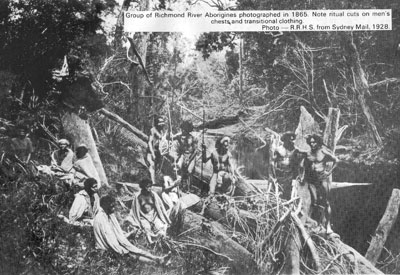
Richmond River (Bundjalung Nation) Tribe members, 1865
[Source: Oakes, M.J., The Aborigines of the Richmond Area (Richmond River Historical Society, Pamphlet No. 2]
Documents
1875
09/02/1875-21/03/1877 GOVERNMENT: John (later Sir John) Robertson, Premier (Liberal) See: Sir John Robertson and land reforms )
1876
Select
Committee on the condition of the Aborigines
Checklist of Royal Commissions Select Committees of Parliament and Boards of Inquiry, Index NSW 1855-1960; "304. SC (Select Committee) on condition of the aborigines. (19.12. 1876) These Documents are missing from the archives.
Aboriginal evidence
Go to: Evidence Further Amendment Act 1876 (40 Vic. No. 8); declarations in lieu of oaths permitted
"Fresh
Blood, Old Wounds": Tasmania and Guns
1877
18/12/1877-6/12/1878 GOVERNMENT: Farnell, James Squire, Premier (Conservative)
JS Farnell, secretary for lands
"In 1872-75 Farnell was secretary for lands in Henry Parkes's first government. In 1872-73 he bore the brunt of the rush for mineral leases and dealt with applications for three-quarters of a million acres ... In 1877 ... as the secretary for lands, became the first native-born prime minister of New South Wales ..."
Royal Commission into "the present condition of the Aborigines"
"In
1877 a Royal Commission was appointed 'to inquire into the present condition of
the aborigines of the colony, and advise as to the best means of caring for and
dealing with them in the future.' "[Whitworth. Mr
R.P.; The Treatment of the Aboriginals-1838 to 1847in Victoria
and Its Metropolis (Melbourne, 1888) Page 253
1880
Parliamentary Votes and Proceedings, "Aboriginal natives"
Legislative
Council, Wednesday 30 June,1880
Aboriginal
Natives
June 3rd
1880
Appointment of protectors of the blacks
.. protection of the aboriginal natives from oppression and outrage on the part
of Her Majesty's demoralised white subjects in New South Wales, [p3114]
Adjournment, Protection of Aborigines [pp1314-1318]
House
adjourned at 23 minutes before 1 o'clock a.m.
Parliamentary Votes and Proceedings, "Aboriginal natives"
Legislative
Council.
Wednesday,
30 June, 1880.
Aboriginal
Natives—Church and School Lands Dedication Bill (No. 2)—Volunteer Land
Orders Hill—Messages from Assembly Bill—Wharfage and Tonnage Rates Bill)—
Adjournment (Protection of Aborigines)---Supreme Court Temporary Judge Act
Continuation Bill (Second Reading).
The
President took the chair at
half-past 4 o'clock p.m.
ABORIGINAL
NATIVES. Mr.
C. CAMPBELL asked the Vice-President of
the Executive Council,— Does the Government purpose appointing
protectors of the blacks in the
districts of The Macintyre, The Barwon, The Darling, The Lachlan, The
Murrumbidgee, and The Murray, with a view to
the protection of the aboriginal
natives from
oppression and outrage on the part of Her Majesty's demoralised white
subjects in New South Wales?
Sir
JOHN ROBERTSON replied: It does not seem to me that there is any reason for
the protection of aborigines in the districts named any more than in other
districts. I do not know why they should be selected. I may be permitted to say
that the whole matter of the protection of the aborigines of the colony is under
the consideration of the Government.
Adjournment
PROTECTION
OF ABORIGINES.
Mr.
C. CAMPBELL moved the adjournment of the House in order to make a few remarks
on the subject of the question he had just addressed to the Representative of
the Government. He was pleased to hear that the matter was .under the
consideration of the Government. His own view on this subject was that any
portion of the great body of mankind which had been separated from the rest of
the civilised races for centuries could scarcely be restored to equality.
Therefore it might be supposed that he was indifferent to what was called
civilising the aborigines of this country. He thought they were out of the reach
of the influences of civilisation, and possibly of the influences of
Christianity. But however that might be, the first step to be taken on the part
of the Colonial Government ought to be to protect them from outrage by the
British portion of the community. The reason why he mentioned the five districts
was because there was still a great number of natives in them, and
it would
be useless
to appoint protectors to portions of the colony now
scarcely inhabited by aboriginal natives. Wherever there were rivers abounding
in fish there were still many aborigines ; and he maintained that great wrong to
them might have been averted by the appointment of gentlemen holding the
office of Police Magistrate and having protective powers given to them as in the
colony of South Australia. He alluded particularly to those outrages inflicted
in consequence of the aboriginal women being subjected to the lust of the white
man. About three years ago he was in one of the districts named, when
application was made to the gentleman with whom he was residing by a black to
assist him in recovering his gin who was kept away from him by force. It was
pointed out to the gentleman that he had no power to interfere. He had heard
of a case in which an overseer had promised an aboriginal a quantity of goods,
tobacco, etc., for the labours of his wife, and after obtaining what he sought
with the woman he refused to give the blackfellow the promised articles, and as
the black was importunate, the overseer had him tied to a dray and cruelly
flogged. A few weeks ago there was a good deal of excitement about a black boy
being brought by stockmen into one of the civilised districts. When he was in
the district he spoke of, it was a common practice to buy a black boy
for
£5,
and although doubtless it was an illegal act he did not see that much harm
was done in bringing the boys into contact with the white population. But the
fact that they were liable to such illegal acts showed how necessary it was to
give them such protection as that contemplated in the question.
Motion made, and question proposed.
Sir JOHN ROBERTSON hardly knew what his honorable
and learned friend had in his mind when he put the question, unless it were
the buying and selling of black boys, of which he seemed to approve. For his own
part, he had a great objection to the practice, and if the facts could be proved
the Government would do all in their power to put it down. But it was denied;
and who knew whether it was true or not ? He had no sympathy with those who
bartered in human flesh. It was usually put forward that the Governments and
the people of the colony had not been
good to the blacks; and he quite agreed with his
honorable friend that they might have done more good to them. But having had
experience in other colonies, especially in Queensland, he could say that
our squatters never treated the blacks here as they
had been treated in that
part of Australia. No
one in the Chamber had been so much
in the backwoods as he and Mr. Ogilvie ; but he defied any one to say that our
squatters refused the
blacks
permission
to "come in," as
it was
called, which refusal
was the
practice in
the northern colony.
When he was
out in that country, having
large stations there, he
endeavoured to put down the
practice of debarring the blacks from the stations, but he found it out of his
power to resist it. If
one man had 15 or 18 square miles of territory and others had the same areas
adjoining, What
was to become of these poor
blacks if they were not allowed on the land?
In New South Wales he usually made friends with a prominent member of the
tribe and gave him sufficient consideration to make peace with
the blacks,
and there was no instance in which they were refused
to "come in" on the run. He knew the proprietors of runs in this
colony had almost
invariably been
exceedingly kind to the blacks.
True, some of the convict servants,
in olden times, were
very cruel to these people ; and their
conduct was very different from that of their employers. The honorable member said the districts
mentioned required peculiar consideration in reference to the blacks. But we had to go only 3 miles from Sydney to find
blacks who required protection more than those in any other district.
Let him go to Rose Bay and there he would see young children—of course
in the guardianship of their parents— and any man might
have them for a shilling. He could not understand why the Police Magistrate did not take the
children from the women and put them into the Reformatory. A few days ago a clergyman came to him
at the head of a deputation, to
represent the manner in which these people were
treated in the interior,
and this case at Rose Bay was
brought under his notice. No power was given to
issue
prosecution, but it
was pointed out
that the
Government had an
establishment near these
women to which the
children might be
taken. Although we might not
have done so much as we ought to have done for the blacks,
at any rate
they received rations
sufficient for their support; they also received
clothing, and blankets had always been supplied to them. If, however, the
blankets were given to them earlier than June, they sold them, and if they were
given later people complained if the cold weather came in a little sooner than
usual. What can be done with people who could not in these small matters take
care of themselves? The other day a gentleman came to him to recommend the
establishment of a school for aborigines in The Murrumbidgee district, and he
immediately authorised the school without troubling about the mode of action
or whether it came within the rule or not. The honorable member said we ought to
appoint a Police Magistrate to protect the blacks. Some of them had been
provided for, and a boat was given to
them, but they quarrelled about it and it
had to be given into the custody of the local Police Magistrate. The general
matter might well be left in the hands of the Government, and at the present
time they were giving it anxious consideration. It was, however, a difficult
problem. We could not pretend to provide schools for them, or to improve their
morals; they had no idea of morality. In the case the honorable and learned
member referred to, the complaint of the aboriginal was not that his gin was
the victim of immorality, but that he derived no profit from it. If we wanted to
save the poor young children he had mentioned, their cases should be brought
before the Police Court, and if the mothers were unfit to have charge of them,
the children ought to be put in the Reformatory. We had a suitable place for
them, capable of accommodating twenty-five girls, and there were now only four
inmates. It was a discredit to the magistracy of the country that the
children were not better cared for. It would be an act of philanthropy for some
one to look after them. The Government were certainly not amenable to the
complaints made by the honorable member.
Mr.
OGILVIE said the subject was one with which he was conversant, having passed a
large portion of his life in the backwoods and taken a great interest in the
aborigines. He quite agreed with the Vice-President of the Executive Council [Sir
John Robertson.]
that
it was exceedingly difficult to know what ought to be done with these people.
Neither the colonists nor the Government could be charged with having illtreated
them, though the Government perhaps had not done as much as it might have done
in their behalf. They who knew most about the matter must be aware that the
great agency in effecting the misery and destruction of the blacks was the
intoxicating liquor they obtained, and every means practicable should be taken
to prevent it from being supplied to them. Parliament had passed a law
prohibiting the practice, but the law remained a dead-letter, sufficient trouble
not having been taken to give it force. If the police in the different districts
were strongly enjoined to watch public-houses in order to procure convictions
for this offence, an improved state of the condition of the blacks might be
brought about. But he had known even Police Magistrates to supply them with
intoxicating drinks. He had known a Police Magistrate to speak of the
prohibitory
law as an improper one, more righteous to break than to observe. In the
districts where these things took place it was not likely that the police would
take much trouble to enforce the law. Something might be done to compel these
officers to do their duty in this respect. With regard to the female children ho
thought the suggestion of the Vice-President of the Executive Council was right,
that they should be taken away from parents who were found willing to trade them
in the way ho described. But he would not advocate their entire separation from
their parents by shutting them up in reformatories to which the mothers had no
access. Although the mothers might not be fit to be trusted with their children
in this respect, as a matter of fact they had great affection for them, and to
be deprived of them would inflict great grief and sorrow. Therefore ho thought
it desirable that the children should be taken from the parents and put under
proper control, the parents being allowed access to them. Institutions of this
kind had been established in South Australia for several years; the children
were gathered together in schools and taken care of. If anything of that kind
could be done for the aboriginal children of this colony it would be highly
desirable. Any attempts
Mr. FOSTER thought the state of the aboriginal inhabitants of the colony was a blot on the British name. We came here as British subjects and took up the country in millions of acres appropriating it to our own use, and the smallness of the amount we had contributed to the welfare of those we dispossessed was disgraceful. When we saw the state in which they were placed we could not acquit ourselves of blame. The wrong no doubt was one of neglect rather than of illtreatment. The blacks here had not been so badly treated as in other countries. The people could not escape the blame of neglect by throwing it on the Government, though a great deal might have been, and had not been, done by the Government, who even now might do more. The honorable and learned member, Mr. Charles Campbell, suggested that some officers like protectors of the blacks should be appointed, and this was reasonable. How could these people who did not know right from wrong know how to protect themselves ? Were they to be left to the philanthropy of persons whose interference was looked on as officious? These aborigines were expected to subject themselves to the laws of the country and to have the benefit of those laws. They did not know what benefit the laws afforded, and surely we might appoint persons to see what protection could be given to them. If there had been a protector of the blacks near Sydney he might have prevented the abuse of the children referred to by the Vice-President of the Executive Council. It was a breach of the law, according to the ages of the children, and would subject the perpetrators to severe penalties. A person whose business it was to protect the children might avert the evil to a very great extent. Not long ago the same thing was going on in the interior, and a philanthropic gentleman spoke of it to the police and they said it was not their business to interfere, not being instructed to do so. He spoke to the Superintendent of the district, and under that officer's authority the infamous state of things was put down. The camps of the blacks had been used in a way that was a disgrace to any Christian country. If the laws were put in force more zealously, the blacks would be in a better position ; nine-tenths of the wrongs they suffered were not owing to any defect in the law, but to the want of vigour in its administration. Nothing could be more philanthropic and more consistent with our duty as a Christian people, than to strive to enable these tribes to know the benefits of the law under which they lived. The appointment of officers, like the protectors of the blacks in Victoria and South Australia, to look after these people, and see that they were not wronged, would admit of the law being carried out effectively. He could not agree with what fell from Mr. Ogilvie as to the utter impossibility of doing anything to christianise the blacks. Efforts of that kind had and were now being made by philanthropic individuals and were exceedingly successful. It was true that the blacks had little idea of morality in our sense of the word; but it was true they had feelings like those of other human beings, which were being outraged every day. A gentleman who devoted himself to their interests told him that lately one of these unfortunate girls requested his protection from the brutality to which she was subjected by her tribe. She was put with others under protection. He did not think it likely that the whole of the blacks could be christianised; but something might be done in individual cases, and he was glad that a society was established for that purpose, and to this the Government might very properly give a little encouragement. The
main thing, however, was that the Government should deal with the matter having respect to their own powers ; and by the appointment of protectors...
1882
Supply
of alcohol to Aborigines forbidden
Licensing
Act 1882 (45 Vic. No. 14) [Repealed by Act
18, 1898] (supply to aboriginal natives of any age forbidden. Mc)
Parliamentary Votes and Proceedings, Provision for Aborigines
Legislative
Council Provision for Aborigines [20 Sept 1882] (p473)
1882 Select
Committee; Aboriginal mission stations
Checklist
of Royal Commissions Select Committees of Parliament and Boards of Inquiry, Index
NSW 1855-1960; "Inquiry into working of aboriginal mission stations at
Warangesda and Maloga (23.6.1882) (8.8.1882), NSW
Pp. 1883 (v.3) 937-941
1883
Legislative Assembly; 21 February 1883
Parliamentary Votes and Proceedings, Ministerial Statement, Treatment of Aborigines
4 Jan 1883
Adjournment. [ASSEMBLY]
PAGE MISSING (Page 31)
Sir HENRY PARKES : I cannot help the honorable gentleman saying "No." I allow him to say the most outrageous things and I never say " No." Surely then the honorable gentleman will allow me to make an explanation ! That explanation is that this office was created in the interests of the blacks, and that Mr. Thornton was appointed to it as a gentleman whom we believed to be in every way qualified to look after the interests of these people. With regard to the allegation that these people were left in a stale of starvation on Christmas day, or any other day, I am sure honorable members will at once know that all I can do in such a case is to apply a remedy when I am made acquainted with the evil. When I received from the honorable member a letter informing me of this case 1 did not lose, a single hour in causing an inquiry to be made.
Mr. McELHONE: Hear, hear!
Sir HENRY PARKES: I caused inquiry to be made of the Protector of the Aborigines, and I specially sent a police officer to inquire into the allegations brought under my notice by the honorable member. I gave instructions that whatever was required for the necessities and comfort of these people should be supplied, without reference to anybody else. I ask the House. what more could I or any other person possibly do? it seems to me, to say the least of it—I will not say an ungracious thing, because I cannot expect anything gracious from the honorable member—but it does seem a most unjustifiable thing to make an affected interest in these unfortunate people a means of heaping insult and untruthful representation upon me.
Mr. McELHONE, in explanation : I should state that the honorable gentleman's colleague, the Colonial Treasurer, instructed Mr. Hill to supply the aborigines at Botany with rations. Mr. Hill, although not legally appointed to the office of Protector of the Aborigines, voluntarily discharged its duties for a period of two years, at the end of which time Mr. George Thornton received the appointment he now holds, Mr. Hill receiving no notice that his services would no longer be required.
Question resolved in the affirmative. House adjourned at l.25 p.m.
1884
Parliamentary Votes and Proceedings; the Aborigines Protection Board
[17
April 1884] Legislative Assembly
“Aborigines
Protection Board.
Proposed
vote, .£6,600.
Mr.
O'CONNOR drew attention to the item, ‘Aid to Association for Protection of
Aborigines in
proportion of £2 for
every £1 raised by private contributions, .£2,000.’
The aborigines were the true
natives of the colony, but by our audacity and by
the spirit of adventure of our race had supplanted them. We had taken lands from them, and we were bound to attend to
the wants of those who were left.
It was a dishonor to the country that a vote for the sustenance of the
aborigines should
be granted conditionally on the public subscribing an amount equal
to half of that which was
voted by Parliament.
In the
name of common humanity and
the dignity of our race, was this right?
The aborigines had no special representative in this Assembly, they
had no
particular interest
in the country,
but he
hoped that
honorable members would be animated by a spirit of fairness and honesty,
and refuse to
agree this vote with the
condition to which objected. Suppose
a sum of £1,000 I not subscribed by the public !
AN HonORAble MEmBer
:
More
shame to the public!
Mr.
O'CONNOR : The poor
blackfellow would go without blankets
and with out food.
Mr.
R. H. D. WhitE
: A great
many of them are
without food and
blankets
now
!
Mr.
O'CONNOR : More shame on us! Was it not dishonoring and humiliating for
the vote to be submitted to Parliament the condition to which he referred?
We ought to make provision for the protection of the aborigines
without any such stipulation. All nations which had invaded other countries had
made ample provision for the people whom they supplanted. The people of
England were taxed to the extent of .£20,000,000 for the liberation of the
blacks of the West Indies. It was unbecoming of a free and £ prosperous country
like this to surround a Vote for the protection of the aborigines with a
condition which was not applied to any other vote, and he asked the Colonial
Secretary to withdraw the condition attached to the item to which he had drawn
his attention.
Mr.
STUART : I am quite sure the Committee will re-echo to a great extent the views
put forward by my impetuous friend, the honorable member for West Sydney. One
would imagine from the way in which the honorable member hurled indignant
remonstrances against the manner in which this vote has been placed upon
the Estimates that the Government were placing greater restrictions upon the
expenditure of the money. The honorable member will recollect that in the year
before last there appeared upon the Estimates for the first time a vote for
the laudable purpose of aiding the aborigines —excepting of course the annual
vote for blankets, which is included in the Stores Department. I find that when
the vote was under consideration last session I said :
‘Last
year was the first time that any care at all was shown towards the aborigines,
and then a secretary was appointed, whose salary was paid out of the advance
vote.’
In
1882 a sum of .£200 was voted for a secretary to the Aborigines Protection
Board, and last year the sum of 3,600 was placed upon the Estimates for the
purpose of protecting these persons. The vote appeared upon the Estimates in
this form : "Aid to the Association for the Protection of the Aborigines,
.£2,000 ; towards the formation of stations and otherwise in aid of the
aborigines, £1,000." With regard to the first of these items, it became
a question in what proportion the amount voted should be paid. It is customary
for the Government to aid institutions having benevolent objects in view m the
proportion of.£1 to £1; some are aided in the proportion of 10s. to £1. I
believe that my honorable friend, Sir John Robertson, is the patron of the
Society for the Protection of the Aborigines, and the honorable gentleman
stated, at a public meeting of that society, that he would recommend the
Government of which he was a member to contribute .£2 for every .£1 raised by
the society. That proposal, however, fell through, and the amount was not placed
upon the Estimates. Last year £2,000 was voted, and that vote appears upon the
Estimates now before us. But .£1,000 was also voted without any restriction
whatever. The Board for the Protection of the Aborigines were allowed to deal
with that sum. In the first instance, the Honorable George Thornton was
appointed Protector of the Aborigines ; but as the work opened up it was found
desirable to intrust to a board the duties of the protector. That board
consisted
of six members, of which the Honorable George Thornton was elected the first
chairman. He has since
resigned, but the
board
is carried on; and
the Committee are now asked to vote £4,000 in lieu of the £1,000 which
was voted
last year. The honorable
member for West Sydney (Mr. O'Connor), who addresses us on this subject in
such an impassioned manner,
may be correct in saying that the total vote of £6,000
is unworthy of the dignity
of the
nation and
the liberality
of the House; but the
sum of £4,000 is
three times as much as the sum voted
last year for the board to dispose of
as they think proper. In
addition to the distribution of this vote, however, the board has the control
of the blankets, the money for which is voted under
the Stores Department. The Society for the Protection of the
Aborigines has
formed certain stations,
which are called mission stations, with the benevolent object of endeavouring in
some measure to raise the social and moral status of the aborigines. I was only
too glad to find that
my predecessors
in office had taken up this
matter, and I hope that the House will continue to vote money in assistance of
so benevolent a design. In establishing these stations the society interweaves
with their benevolent object the
imparting of
religious instruction and duties. This is a
work which the state cannot undertake. Whether for good or for evil the state has decided that it will not
interfere in religious matters. But
this society, while it is doing work of a
religious and moral character, is at the same time carrying out
a highly
benevolent work ; and the state is willing
to aid the society, not by way of granting aid to religion but in order to take advantage of the benevolent instincts of the association
to do something towards
improving the social and moral welfare of the aborigines. I have no doubt that the society will raise the £l,000, and if it does
so it will be the channel for the expenditure of the £2,000 contributed by the
Government towards the objects of the institution. The
Aborigines Protection Board will have placed at their disposal £4,000 for the furtherance of
a most useful work. I
commend for the perusal of
honorable members the report of the board, which I laid upon the table the other
day. When they have digested that report I am sure they will come to the
conclusion that the board is beginning a really good work —a
work which I quite agree
with the honorable member
for West Sydney (Mr. O’Connor) ought to have been mm. many years ago if
the country had been alive to its duty in this matter. But it is better to begin
late than never. I do not think it would be prudent to place on the Estimates at
once a large sum for this purpose. Let the board go on with their work. Last year
they had £1,000 at their disposal, this year they will have £4,000. If
next year it is found that they satisfactorily appropriate a larger sum of money, I
feel satisfied that they will not appeal in vain to the generosity of this
House.
Mr. GARRARD said that the honorable member for West Sydney (Mr.O'Connor) did not appear to have examined these items very attentively, but he was glad that the honorable member had referred to the matter. His eloquent language would, perhaps, have the effect of reminding some honorable members their duty as the descendents of those who first took possession of this land towards the survivors of the aboriginal race. The honorable member seemed to have been under the impression that it was necessary for the Association for the Protection of the Aborigines to raise £1,000 before they were entitled to receive any of the £2,000 which appeared upon this vote, hut he took it that the society would receive £2 for every £1 they raised. The whole colony was under a debt of gratitude to those gentlemen who had in first instance established mission stations, for the improvement of the conditions of the aborigines. Their action appeared to have awakened the country to a sense of' its responsibility in the matter. He believed that Mr. Matthews, of Maloga, initiated the work.
Mr.
Farnell : Efforts were made
forty-five years ago !
Mr.
GARRARD : But the first systematic and successful
effort was
made by Mr. Matthews,
and it
was repeated at
the Warangesda Station. The
Association for the Protection of the Aborigines had
taken into its care the
conduct of these two stations, and it
was pleasing to
know that
a number
of charitably disposed persons
had contributed to the cost of
their maintenance, and
that the Government now saw their way to place at
the disposal of the
Aborigines Protection
Board a sum of £4,000 instead of the
£1,000 voted
last year. He shared in the regret
expressed by
the honorable member for West Sydney (Mr.O’Connor) that
some steps
were not taken
long ago to brighten the last days of an expiring race. The
expenditure of this
vote, however, would go some way towards
wiping out
the disgrace which had hitherto attached to the colony by reason
of its neglect
to care for the Welfare of these unfortunate wretches - for wretched
in the
extreme they certainly were.
He hoped, however, that the board
would exercise such
influence as it possessed
to prevent the blacks from coming into
the centres of population,
where they saw nothing but worst side of our civilisation. They would be
far better
off in the country districts.
A
number of the unfortunate people had been wandering about the streets of
the metropolis during the past weeks. The annual distribution of blankets which was made on the 24th May appeared to
have attracted them to the city earlier than usual. He cheerfully
voted
for the increased estimate.
Mr.
B. H. D. WHITE was also very pleased that the vote had been increased. He
was satisfied
that only a very few members of
the House were acquainted with the deplorable condition of the
aborigines. Many of them could not obtain sufficient to eat,
and were reduced to a state almost of
starvation. He
had discovered that some blacks had lately died at Port Stephens
in a state of absolute
destitution. The
few blacks
who were able to earn a living were eaten
out of camp by the others. He
intended to bring under the notice of the board the state of want to which the
blacks in his electorate —and there were a great many—were
reduced; and he hoped that there
would next year be a further increase in the vote.
Mr. GARRETT intended to support the vote; but he objected to the organisation
for the expenditure of the money. He had no confidence in voluntary boards so
far as the expenditure of public money was concerned. It would be far better to
leave the expenditure of the money in the hands of a responsible minister ;
under the present arrangement
that responsibility was
frittered away through the Minister to the
under-secretary, and through the
undersecretary to a board who were not paid for their services.
He believed that
Mr.
FREMLIN could not support this
vote, because he did not believe that as a rule the expenditure of the money
had the beneficial effect which it
was supposed to have. As
regarded the blacks at Botany, he was aware that they had been supplied with
boats and fishing lines and other means of gaining a livelihood; but this
distribution had been attended by the most disappointing results. They were too prone to
exchange for grog everything which was given to
them. He could not help
expressing his contempt for the ill-judged sympathy with the blacks which was
manifested by some members of the board whose names it was quite unnecessary to
mention. When the House
sanctioned the
expenditure of so large a
sum of money we had a right to expect that
the board would take some more definite action. It was a disgrace to the community that the blacks should come into our
centres of population exposing
their peculiar vices side by side
with the vices of our own people. . The
honorable member for
Balmain (Mr. Garrard) had
expressed some very benevolent sentiments as to our duty towards the aboriginal
race; but if
England were
to take
it upon herself
to provide
food and clothing for the aboriginal race
of every country of which she took possession she would have more than enough to do. Many of the
Mr. BARBOUR said there were doubtless good and bad aboriginals as there were also good and bad white men; but under any circumstances we should consider the welfare of the children of the aboriginals who were receiving education, combined with domestic training, in the institutions which were referred to. It had been observed that the blacks were given to habits of intemperance; but there were many white men who rendered themselves objectionable upon this score, and we had no right to expect that the blacks would be absolutely free from vices of this description. We could certainly do a great deal towards enabling them to become useful members of society, and in this respect the mission stations were carrying out a very important work. The girls in these institutions, he believed, were taught to sew, while the boys were trained in various descriptions of farm-work. He had had frequent opportunities of observing the working of these institutions, and he felt persuaded that they were of great utility.
Mr. O'CONNOR said that the money was either necessary or not. If not, it ought not to appear on the Estimates. If it was necessary, it ought not to be dependent upon any contingency whatever. That we had improved upon what was done by our predecessors was to a certain extent creditable to ourselves; but if our predecessors had neglected to do their duty to the aborigines that was no reason why we should do it badly if we did it at all. There was not a more charitable member in the House than the honorable member for Redfern (Mr. Fremlin), yet that honorable member said that we ought to let the aborigines starve because some of them were not pure blacks. If they were not pure blacks, it was because of the viciousness of the whites. We ought to take these people under our tender care. The honorable members asked what the British did in the parts of the world where their power was predominant; but he would point out that in no part of the world did the British nation rule so cheaply as here. In other colonies standing armies had to be maintained ; but in Australia we had nothing more to do than to preserve the emblems of peace. We had only to make a provision for those unfortunate aborigines, who are rapidly dying out. It must be known to the Colonial Secretary that innumerable complaints had been made about these people being in want. Why were they allowed to get into that condition? They had not the power to take care of themselves, and we ought to provide them with their necessities in every possible way. We were called upon by every feeling of humanity to do it, and he hoped the Colonial Secretary would withdraw the condition upon which the money was to be granted. He would be glad if the Colonial Secretary would tell him who the members of the board were.
Mr.
STUART: I understood that the honorable member had read the report which the
names of the six members of the board are attached. There is a board, consisting of
six members, for the protection of the aborigines. There is also voluntary
society, of which the honorable
Mr.
O'CONNOR said that every one of the gentlemen whose names the Colonial Secretary
had mentioned was as good any of the honorable gentlemen's colleagues, and could
be trusted to expend this money for the benefit
of the aborigines.
We ought
not to deal with the aborigines as we dealt with a school of arts; they were in
an entirely different position. He was sure it was the wish of the people of this country that
these unfortunate people should be well cared for.
Mr.
TAYLOR had
heard no explanation as to why the item should be put on the Estimates
in this manner: the money should
be provided without any
conditions whatever.
Mr.
STUART : Do we not grant all the aid afforded to charitable societies on these
conditions?
Mr.
A.G. TAYLOR, asked whether the Colonial Secretary could
not see the difference
between a blackfellow and a mechanics’ institute? The people of the colony did not support
the aborigines. What
was everybody's business was nobody’s
business. It was
the duty of the state to provide in a direct manner
for people
whose country we possessed. Why should we encumber the grant with conditions? He moved :
That
the item, "Aid to Association for
the Protection of Aborigines in the proportion of £2 for every £1 raised by private contributions, £2,000," be omitted.
Mr.
BARBOUR hoped that the motion would not be carried.
Some honorable members did not
appear to understand this matter. The fact was that a number of charitable people thought it their duty
contribute a sum of money
for the assistance of the
aborigines, and to encourage them in
their philanthropic
efforts the Government gave .£2 for every £ which those people contributed.
In
addition to this, however, the Government placed on the Estimates a sum of .£4,000
to be spent for the benefit of the
aborigines entirely regardless of what was being done by
the association.
Mr.
YOUNG thought every honorable member would consider
that all
money which was really
spent for the benefit of the aborigines was very properly spent, and
he could not
understand on what principle the honorable member for Mudgee
moved the omission of
the item. He did not think the sum at all too much. If twice
as much could
be spent judiciously on behalf of
the aborigines, he would willingly vote for it.
Mr.
BURNS would recommend the honorable member to withdraw his
amendment.. We ought only to be too
glad that a society of this kind, for which the money was intended, was trying
to benefit the aborigines of the colony in this way, and
it ought to be
quite sufficient
for the Committee to know
that the money was properly spent.
Mr.
O'CONNOR also hoped the honorable member would withdraw the amendment.
Amendment,
by leave, withdrawn.
Vote
agreed to.
Permanent
and Volunteer Military Forces.
Motion
(by Mr. Stuart) proposed :
That the estimates, "General staff,
£3074"; " Artillery Force,
£:33,347 " ; Artillery Reserve
Force, £1,520"; " Works of defence, £1,500"; "Volunteer
Force, £50,220"; " Volunteer Naval
Artillery, £500"; Naval
Brigade, £5,817"; and "Training-ship Wolverine, £4,200,"be
postponed..
The
General Staff. Proposed
vote, £3,074.
Mr.
A. G. TAYLOR said he intended to move a reduction in this estimate, and he would
keep the Committee a considerable time in trying to effect the reduction. If
honorable members were earnest in their expressed desire to retrench the public
expenditure, no better opportunity was afforded than by the military vote.
During the last ten years we bad spent £1,000,000 upon our military forces.
That money had come out of the pockets of the working-people of the colony, and
what had we to show them for it ? Nothing but a miserable lot
of painted soldiers and
military … (etc.)”
1885
"Yet even after the appearance of white explorers and settlers,
little was discovered or recorded of any local tribal history ..."
1886
Parliamentary Votes
and
Proceedings, 1886
Legislative
Assembly Aborigines and disgraceful scenes [4 May 1886] (p1644) Aboriginal
Rations [9 June 1886] (p2515)
Aborigines
of the Colony
[10 June 1886] (p2557)
Relief
to Aborigines
[16 June 1886] (p2674)
"the
board for the protection of aborigines and aboriginal housing" [19 Aug
1886] (p4160)
1887
Parliamentary Votes
and
Proceedings, 1887
Legislative
Assembly Supply of Rations and Railway Passes to Aborigines [10 May 1887]
(p1397) Relief to the Aborigines [8 Nov 1887] (p1032) The Aborigines
[16 Nov 1887] (p1272)
Parliamentary Votes and Proceedings; Relief to the Aborigines
8 Nov., 1887
RELIEF TO THE ABORIGINES
"Mr. DOWEL rose to move :
'That this House will, on Tuesday next, resolve itself into a Committee of the Whole to consider its address to the Governor, praying that his Excellency will be pleased to cause to be placed on the estimates for 1888 a sum not exceeding £10,000, for the purpose of supplying the aborigines throughout the colony with rations, clothing, and shelter.'
He said: I think that this motion requires very few words from me to command the attention of hon. members. I was struck some time back with the small amount winch was placed on the estimates for the relief of the aborigines, I am sure that during last winter almost every hon. member must have had brought under his notice personally, or through the press, the extreme destitution and disease which was prevailing amongst the aborigines. I take it that the House will most willingly grant the amount stated in my motion. We have taken the country from the blacks, and at the present time they are in a most destitute condition. Their number is reduced to something like 6,000, and out of that number there are 2,000 who are diseased or infirm, and unable to work. There are about 1,000 who are robust and strong, and desirous of working, or who could be made, to work, all that they require being a small amount of assistance. The balance consists of children, from about 14 years of age downwards. It would be a disgrace to our civilisation to allow those unfortunate people to be wiped out of existence without making some effort to render their declining days peaceful and comfortable. We find that 2,000 out of the 6,000 are so decrepit and diseased as to be unable to work. I know of many hon. members who, out of their own pockets, last winter relieved this unfortunate section of the community, and that in many cases owing to the actual want of the necessaries of life, combined with the severity of the weather, some of the aborigines perished. I shall not make any lengthy remarks upon this subject tonight ; but will reserve what I have to say until the House goes into Committee. I trust that hon. members will do all they can to assist me in impressing upon the Government the necessity for expending a decent sum of money to make these poor, wretched people more comfortable than they are at the present time. We build grand palatial residences for the poor and sick of our own race ; but what have we done for the blacks! Nothing, comparatively speaking. We have taken from them their hunting-ground—-in fact everything they possess, and we occupy their country. I think that many of our rich men should assist most liberally in increasing the proposed vote of £10,000. Rich men like the Tysons, the Dangars, the Campbells, and the Whites, who are making their living out of the land the blacks used to occupy, should as well as Parliament do something to relieve the necessities of this unfortunate class of the community. Question proposed.
Sir HENRY PARKES: I must ask the hon. member in this case to withdraw his motion. The Government are fully alive to their obligations, with regard to this unfortunate race; and as we intend to make more liberal provision for them on the estimates than has hitherto been made. I think the hon. member might, leave the matter in our hands. It is a most difficult thing to deal with. I assure the hon. member and the House that we are fully alive to the duties winch devolve upon us in doing whatever we can to alleviate the condition of life in which these unfortunate people are placed, that we are not insensible to the difficulties surrounding any attempt to afford them substantial relief, and that to some extent we have paid a good deal of attention to the nature of those difficulties. When I assure the hon. member of all that, and. of our desire to do whatever we can for the relief of the aborigines, I trust he will not think it necessary to go into Committee upon this subject. I think I can appeal to the hon. member's good sense not to press the matter any further.
Mr. J. P. ABBOTT : I think the hon. member might accept the suggestion the Colonial Secretary. Yet I cannot allow the resolution, to be withdrawn without drawing attention to what appears to me to be disgraceful neglect, whether on the part of officers in the department of the Colonial Secretary, or on the part of the board appointed to look after the aborigines, I cannot say. During the winter the Reverend Dr. White, of Singleton, a well-known charitable man in that district, directed attention again and again of the Aborigines' Board, with reference to the wants of some of the blacks there. He wrote again and again not only to the Colonial Secretary's predecessor, but I think also to the hon. gentleman himself, and a very lengthy correspondence was published in the local papers, in which it was pointed out that not one of the letters addressed by this gentleman, who, if he had written upon any subject, had a right to receive a reply on account of his position in the country, to the Colonial Secretary was acknowledged. 1 think the reverend Gentleman had good cause for complaint, and by directing public attention to the matter. Having regard to the multitudinous duties devolving upon the department of the Colonial Secretary, probably all that could be done was to refer the letters to the board appointed to deal with the aborigines, and it was their bounden, duty to reply to them. The reverend gentleman, however, appears to have received no replies to any of his communications. I hope the Colonial Secretary will look into the matter himself, and see that the board discharge their duties. I am told that at Long Bay, a place not very distant from Sydney, there has been a lavish and wasteful expenditure of money by the Aborigines' Board. The money must have been taken out of the aborigines' vote, and I am told that it has been expended in a most improper way in the erection of a pavilion and other buildings which were altogether unnecessary, and which cannot add to the comfort of, or be of any service whatever to, the aborigines. I believe that a few of the poor blacks are kept about the place occasionally ; but I am informed that the money so wastefully spent in this locality would have been the means of relieving the distress of many blacks in the past winter. I hope the Colonial Secretary will, inquire as to what money has been expended at Long Bay.
Sir HENRY PARKES: If I may be allowed to say a few words in reference to what has fallen from the hon. member for Wentworth, I would state that I have given as much personal attention to this as I could, and that it is my intention to personally investigate several conditions of it. Among others, I have in the last few months sought to enlist new agencies on the part of some of aborigines who are grouped in different parts—and especially in the far southern part—of the country. I have tried in many ways to do what I could to bring about a better state of things. With regard to the particular case to which attention has been called, I will see that inquiry is made into the matter, with a view to ascertain the real facts, without any delay. As to the letters of the Reverend Dr. White, although I have a distinct recollection of his name m connection with the subject, I cannot at this moment venture to state what are the particulars, as far as they are within my knowledge ; but it is more than likely that any letters from this gentleman which came to me would to referred to the board. I do not, however, distinctly remember what occurred.
Mr. DOWEL, in reply : After the statement made by the Premier, I will, with the concurrence of the House, withdraw my motion. I am quite sure that the hon. gentleman will do justice to the question. I intended to speak at length upon the question, for I have a large amount of information. I have resided in the interior for upwards of thirty years, and I have often come into contact with the unfortunate race to which my motion refers. Although in some instances, such as that to which the hon. member for Wentworth has referred, the aborigines' vote has not, perhaps, been applied m the best possible manner, still I am certain that the necessities of the case require that a larger amount of money should be placed at the disposal of the board if they are to do anything like justice to tins unfortunate race. I do not think we shall be long troubled with them, because they are dying out very rapidly at the rate of 500 a year, if we can possibly do anything to make the last days of this race comfortable and happy, we shall only be discharging our duty. If we can do anything at all towards educating, schooling, feeding, and training the young aborigines from the age of 14 downwards, we shall have done something which we have a right to do, I find that out of 2,000 aboriginal children only 272 are going to school. I think that is a disgrace to the Education Department, and I hope the gentlemen, termed truant inspectors, will give their attention to this matter. With the concurrence of the House I shall withdraw the motion. Motion, by leave, withdrawn." (Pages 1132-1033)
"ABORIGINAL POPULATION AND VITAL STATISTICS.
Aboriginal adults decreasing.
It is stated in the annual report of the Aborigines Protection Board that there were 5,012 aborigines in New South Wales in 1887, as compared with 4,893 in 1886. The increase, however, consists entirely in the number of children, the adults, both male and female, having decreased. There were 2,741 half-castes in the Colony in 18S6, and 2,860 in I887. Compared with the above returns, the number enumerated by the census appears .small, and shows that the aboriginals passed over as being in a wild state far nut numbered those within the bounds of civilization.
Crimes and misfortunes of native blacks.
It has been the misfortune of the aborigines of Australia, as it was of the Carribee, the North American Indian, and the Hottentot, to be found in the way of European colonization ; and the blacks have not seen the white man take possession of their territory without many an attempt, by deeds of cunning and of blood, to stop the invasion and to avenge the injury. It would be easy to gather from the records of British colonization in Australia many instances of horrible crimes committed by the aborigines. They are, in fact, partakers of the worst passions of human nature. But it must not be forgotten that, amongst the people of British origin who settled upon the land, formerly occupied by the blacks alone, were many whose crimes against the aborigines at least equalled in atrocity any committed by that unfortunate race. Cunning and ferocity were the natural concomitants of such a struggle; and the remembrance of what cunning and ferocity have done tends to make the colonists slow to recognize any characteristics of an opposite kind in the blacks.
Oral traditions
There is, however, evidence from their songs and their cherished traditions, (Vide, Kaniilaroi and other Australian Languages, by Rev. W. Ridley, M.A.) that they are by no means destitute of some qualities in which civilized men glory —such as the power of inventing tragic and sarcastic fiction, tin; thirst for religious mystery, stoical contempt of pain, and reverence for departed friends and ancestors. The manner in which they have displayed these characteristics presents such a strange mixture of wisdom and folly, of elevating and degrading thoughts, of interesting and of repulsive traditions, of pathetic and grotesque observances, that in order to account for the apparent, contradictions, recourse must be had to the .supposition that, this race has descended from an ancient and higher civilization, of which they have retained some memorials".
[Source: Coghlan. TA, Government Statistician The wealth and Progress of New South Wales 1887-88, Sydney: Charles Potter, Government Printer (1888) page 328]
1888
Parliamentary Votes and Proceedings, Aborigines Protection Board
Legislative Assembly
27 June 1888, (p5877-5884)
SUPPLY.
COLONIAL SECRETARY
Aborigines Protection Board
Proposed vote, £8,450.
Mr McELHONE said that when this question was under discussion on a previous occasion the hon. member for Northumberland, Mr. Melville, stated that some blacks at La Perouse had not received their proper rations. With regard to one member of the board, the Hon. R Hill, it was not possible that any one could be kinder to to the aborigines than he was. That was true of the whole of Mr. Hill's family. Mo doubt some abuses might have crept into the supply of comforts to the aborigines, and the blacks were as much given to lying as white people were. If they were left to the tender mercies of the head of the refreshment committee the hon. member for East Sydney, Mr. Burdekin, no doubt they might have some cause to cry out, because he did not believe that hon. member devoted much of his time or means to looking after the aborigines. Within this last fortnight he saw a number of blacks at Breeza, including gins and children, some of them being very old, and they had not yet received their blankets for tho present year. It was the custom to distribute blankets among the black-fellows about the Queen's Birthday. - In the northern and southern districts it was extremely cold in the month of May ; and, in fact, in any part of the country the 24th of May was too late in the year to give these blankets. At Breeza an old gin of 60 or 70 years of age complained to him that she had not received her blankets, and that tho same was the case with the other blacks. The custom was to send the blankets to a police station, but there was
no police officer at Breeza, and those black-fellows would have to go to Gunnedah, a distance of 25 miles, in order to get them. They could not get to Gunnedah by rail, because they would first have to go there to get an order from the police officer or magistrate to travel on the railway. These blankets should be left at railway-stations where blacks were known to reside. Prior to the appointment of this board the. blacks were always allowed to travel free by tram without any special interference. Aborigines going on board any of the coasting steamers were allowed to travel free, and before the existence of the Aborigines' Board they were carried free on all the railways of the colony on presenting themselves at the station. But probably owing to some ridiculous idea on the part of the hon. member for East Sydney, Mr. Burdekin - and the assumption was only natural after the insane placard the hon. gentleman had caused to be issued, prohibiting hon. members from getting ''tick" at the refreshment-room — this hon. gentleman might have suggested the present absurd practice of compelling these unfortunate blacks to go, perhaps, 20 or .30 miles to obtain a free railway pass from the police authorities. He hoped that the Secretary for Public Works would at once issue instructions that on presenting themselves at a railway-station aborigines should be allowed without question to travel free on the railways. This was the least we could do for the unfortunate people whom we had robbed of their land.
Mr. GOULD heartily concurred in the remarks of the hon. gentleman as to the treatment of the aborigines. No doubt the Secretary for Public Works would take steps to see that in future they were allowed to travel free by rail without requiring a pass, to obtain which they were now put to so much trouble and inconvenience. During the last two or three years cases had come within his knowledge in which these poor blackfellows had not received proper treatment; but he could not agree with the hon. member for The Upper Hunter in attributing the blame to the hon. member for East Sydney, Mr. Burdekin. He had had occasion to see that hon. gentleman with other members of the board, and he had at all times expressed his willingness to do all he could to assist the blackfellows. Not only was the issue o£ blankets in some parts of the country delayed until the weather was cold and inclement, but the quality of the blankets was very inferior. They were almost useless for purposes of warmth. More generous treatment should be given to the aborigines in regard to blankets and clothing. Homes should also be provided for them in which they might go and rest undisturbed. Many of them were willing to work, and areas of land might be set apart on which they could make a living for themselves. He was glad to notice that an additional sum of £2,000 was proposed to be voted in the estimates for the maintenance of old and infirm aborigines, the money to be expended under the authority of the board. He was quite sure that the board would be able to expend every shilling of the vote with credit to the colony and with benefit to the unfortunate recipients. These poor people, who were the original owners of the soil, had had to give way before the advance of civilisation. Before many years were past, there would not be a blackfellow in the country; and it, was not expecting too much at our hands that we should make tins miserable remnant of the race as happy and comfortable as possible, by providing them with shelter from the weather, with warm clothing, and also with food where they were unable to procure it themselves. With regard to the present system requiring these unfortunate people to obtain railway passes, a case occurred in his own district, in which an unfortunate blackwoman was seriously ill. The medical officer of the district stated that it was absolutely necessary that she should go to Newcastle for a change. Before she could leave, application had to be made to the Serjeant of police of the district for a free pass. This application had then to be referred to the board, and afterwards to the inspector of: police at Maitland ; and two or three weeks elapsed before the unfortunate woman could be carried in the railway.
Mr. McELHONE : Did not she die in the meantime?
Mr. GOULD said he thought she died about that time, but he was not sure. All this would have been obviated if the old system had not been altered, under which a blackfellow's colour was his pass. It had been suggested that to prevent tho§ blacks from parting with their blankets; to unscrupulous white people, the blankets should have a distinctive colour, so that any transfer of them could be detected.. Instead of there; being any complaint of illiberal treatment of the aborigines, the reverse should be the case, and the action of the Government towards them should be characterised by generosity.
Mr. BURDEKIN said that he did not think it necessary to defend himself against any attack made on him by the hon. member for The Upper Hunter; but.' there were one or two matters to the hon., member referred, respecting which be wished to say a few words. The hon., member referred to tile La Perouse blacks, and said that they had not been supplied with blankets and food. The moment that the matter was referred to in the House, he consulted that most excellent gentleman, Mr. Richard Hill, who. had always taken a great interest in the blacks, and he was assured that there had been no neglect, and that the. usual blankets and food had been supplied. The blacks being of a roving disposition, it was quite possible that there were, some new arrivals at the camp who had not been supplied. At any rate, Mr. Hill went to the camp, and saw that all the wants of the blacks were supplied. As to the charge of inattention to the blacks, all that he could say was that the board were only too anxious, at all times, to have cases of destitution reported to them, so that they might afford the necessary relief. Since he had been a member of the board, there had not been a meeting at which every requisition sent in was attended to. rations, clothing, and, where needed, medical advice and medical comforts, were supplied ; and in some case houses were provided for them, where the circumstances did not permit of their being taken to a public institution. At the last meeting of the board a voucher was sent to the Colonial Secretary for £115 for the blacks at Lismore. This showed distinctly that there was not so much inattention to the wants of the blacks as the hon. member for The Upper Hunter alleged. There was a great deal of force in what the hon. member had said about the women ands children at Breeza not being supplied with blankets. Hitherto the practice had been to distribute the blankets through the different police magistrates; but he thought that it was a good suggestion that, where there was no police magistrate for 20 or 30 miles, the blankets should be distributed by the police officers. He would have much pleasure in bringing the suggestion under the notice of the board. The hon., member for Patrick's Plains said that the blankets were distributed at too late a period in the year. The practice had been distribute them on the Queen's Birthday; but on its being suggested to the House that, owing to the coldness of the weather, they ought to be; distributed earlier, lie brought the matter under the notice of the board, and the blankets were sent out forthwith. It could hardly be said that the railway-stations were proper places at which to distribute the blankets. the work of the board could not be satisfactorily or economically performed, except through the police. A complaint was made that the, blacks were not allowed to travel free by rail. There were very good reasons for that. Was it in the interests of morality, was it charity, to induce these people to congregate in towns? They were very fond of drink, and in the interests of morality, as well as of their health, it was advisable to keep them away from centres of population as much as possible. There was a gathering of blacks on the occasion of the opening of the Bondi Aquarium, and people who saw them about the streets of the city must have regretted that they bad been brought here for such a purpose. The board did all in their power to see that they were sent to their respective homes as quickly as possible. A further complaint was that the blacks were not allowed to travel on the Botany tram. Was it not infinitely better that they should remain at their camp, than that they should be allowed to ride to Sydney, with the result that they would not return home until late at night, and then generally in an intoxicated condition? The hon. member for Patrick's Plains said that the blankets were very thin and of poor quality. He had recently examined the blankets which were being issued, and he thought that no reasonable exception could be taken to them. Possibly some. inferior blankets were on hand in some of the country districts, and they had been distributed.
Mr. C. A.. LEE : Why not supply more than one blanket in the colder districts?
Mr. BUKDEKIN said that unfortunately the blacks would drink intoxicating liquor, and if they were supplied with more than one blanket, the chances were that the extra blankets would he bartered away for grog. One blanket was as much as they cared to carry about from place to place. At one time they were supplied with boots ; but it was found that after they bad worn them once or twice, they disposed of them, and it was simply a waste of money to give them the articles. The hon., member for The Gwydir could state that ho had had no difficulty in getting huts erected where they wen; required for the blacks in his district. The board did all in their power to make the unfortunate people as comfortable as possible. The hon. member for Patrick's Plains suggested that the blacks should be assisted in the way of offering them encouragement to earn their own living. Whenever blacks asked for boats or fishing nets, and they were known lo be people who would take care of them, they were supplied with what they wanted. In many parts of the country reserves were set apart for the occupation of the aborigines, and it was the constant endeavour of the board to induce them to settle there. The were supplied with seed, and helped in any way which would induce them to become reputable members of society. As to food, they were induced, as far as possible, to depend upon the natural game for meat; but they were provided with tea, flour, and sugar. The men also were supplied with shirts and trousers, and the women with warm petticoats. He would appeal to the hon. member for Argyle to say whether, immediately he brought under the notice of the board the necessity for paying greater attention to the wants of the aborigines in his district, his representations were not at once attended to? He thought he had shown that this very important matter of the care of the aborigines had not been neglected. Everything that could be done in reason was done, and any suggestions from hon. members or others received instant attention.
Mr. HASSALL said that if there was any cause for regret it was that still greater provision was not made for the unfortunate aborigines. He was sure that the House would unhesitatingly pass a much larger vote than that now submitted.
Sir HENRY PARKES : It is a good advance upon last year's vote !
Mr. HASSALL said it was very necessary that there should be a considerable advance upon last year's vote, having regard to the altered circumstances in which the aborigines were placed. A few" years ago they could wander about the country as they pleased, getting abundance of game, whereas now the country was covered with a network of wire fences, the fish in the rivers was destroyed by the drought, and the game was destroyed m order to send the skins to market, so that the unfortunate aborigines were debarred from obtaining the food to which they were accustomed. The consequence was, that they congregated about stations, where, he was glad to say, the spirit of christianity still prevailed among the settlers, who relieved their wants as far as they could. A few years ago the aborigines were largely employed as shepherds; but when the new order of things came about, und the country was enclosed with fences, they were deprived of that occupation, and now they were literally wanderers upon the face of the earth, subsisting upon charity. For these reasons he would suggest that greater provision be made tor them in their declining years. They could not exist much longer. He ventured to say that in the course of the next fifty years a blackfellow would be a rarity m New South Wales. The majority of the aborigines in Queensland were making their way to the Cape York Peninsula, where there was no settlement of white men, and when; they would be undisturbed. They could retain their vitality when they were undisturbed ; but as soon as they were brought into contact with civilisation they began to die out. It was a mistake to set apart special reserves for their use. They preferred to wander about the country ; and they would rather do that with only one meal a day than remain settled in one place where they were well cared for, and had three meals a day supplied to them. This habit was bred in them ; and it was cruelty in the shape of kindness to restrict them to a circumscribed area. He thought it would be a wise plan to authorise responsible persons in various localities where the blacks were in the habit of congregating to supply them with food and other necessaries, the Government supplying the blankets, as at present. Some time ago a number of blacks from Queensland assembled at a .station in the electorate he represented for the purpose of performing some tribal ceremony. There were about 200 of them, and it is feared that so large a number would be unable to find sufficient game to support them, and that they would suffer hardship m consequence. The case was represented to the Government who no doubt acting on the recommendation of the Aborigines' Protection Hoard, sent up a supply of food for the blacks during the time they were congregated together. He brought another case under the notice of the Colonial Secretary— that of an old blackfellow- who refused to leave the part of the country where he had been brought up. and to accompany a gentleman on whom he had been dependent to another part of the country, and he was glad to say that the hon. gentleman did not hesitate a moment in attending to it. He was instrumental m getting that blackfellow a. small hut in which he could live in peace and comfort, the people in the district providing him with food and clothing. The man said he thought it was about time that he was made king ; he wanted to have the dignity of being possessed of a small place of his own. When he applied to the Government they did not hesitate for a moment to do what he suggested. Another aboriginal, on hearing of what had been done for that man, came and demanded a 10 acre block, thinking that he could go and cultivate the soil. .It would be a hazardous experiment, however, to employ the blacks in the cultivation of the soil in the expectation that they would be able to support themselves. They would rather wander about the country free as the wind ; if they only knew that there were places where they could get food. We had taken from these people their country, and they were entitled to our sympathy. They were fast dying out ; but not in the natural order| of things. It was owing to the vices which which our so called civilisation made them acquainted. It was said that the blacks drank and gambled ; but who had taught them to do it? We, who had taken away their territory, and who were hounding them out of existence. Instead of putting into the hands of the blacks the means to gamble we might supply them with food and clothing as long as they remained among us.
Mr. SEE admitted that good had been done in providing for the blacks, but thought that a great deal remained to be done. The fact that the alms which were doled out to the blacks passed through the hands of the police ought not to be lost sight of. Nothing could be more degrading than that. Instead of elevating them and finding them employment, we took the aboriginals to the police station to receive assistance at the hands of the police, whom they regarded as their natural enemies. Some other means of providing for them ought to be devised. We ought in give the blacks to understand, delusive as the idea might be, that they were in some way earning the assistance which they received. No doubt these people were difficult to deal with, but we ought to preserve them as long as we could. .In roaming about the country they got into more temptation, and became more dissipated, than they would be it they remained in one place and had some employment. He thought that the Colonial Secretary should endeavour to devise some means of affording them employment. It was proposed to vote for the aboriginals a sum of 8,000, and there were about 8,000 of these people in the country, so thy would receive about £1 each per annum Something ought to be done to take the children off the streets and send them to school.
Mr. BURDEKIN : The children are sent to school!
Mr. SEE said that there were 398 aboriginal children attending school, of whom 350 were at public schools, and forty-nine private schools. The black race was fast dying out. He could remember the time when then; were almost as many blacks in the northern district as there were now all over the colony. There must be some reason for their dying out; he thought it was because they were not treated as human beings. As long as we enabled them to exist we thought we done enough. The small dole which allowed them was not as much as ought to be demanded on behalf of those whose territory we had appropriated. The natural enemies of' the blacks were grog and tobacco, which they got in spite of the law. A suitable area of land ought to be provided for cultivation by the blacks; mission stations ought to be provided for them ; and they ought to be placed under proper supervision. They might also be educated, and raised to a much better condition than they were in at present. We had only supplied the aboriginals with food, clothes, and blankets up to the present time. This did not seem to him to be sufficient for these people, many of whom were respectable and intelligent. He hoped the matter would receive more attention at the hands of the Colonial Secretary than it had hitherto received. He thought a great deal more than Parliament had yet undertaken might be done for these unfortunate people.
Mr. COPELAND would ask the Colonial Secretary to consent to progress being reported, because he was desirous of raising a question of privilege affecting an hon. member's seat? He was unable to do so earlier in the evening, because he had not the necessary papers, and he would be unable to move m the matter tomorrow, because it was imperative that he should leave for Melbourne tomorrow afternoon.
Sir HENRY PARKES Let us have this vote first !
Mr. S. W. MOORE thought the statement of the hon. member for Grafton, that the blacks regarded the police as their natural enemies, was incorrect, and that the Government might advantageously employ them as trackers to a greater extent than had hitherto been done. In this capacity they had already rendered great service to the country m tracking cattle-stealers and bushrangers.
Mr. McELHONE would ask the Colonial Secretary whether he would advise the Aborigines Board to abolish the present system under which free passes on .the railways were issued to the aborigines ?
Sir HENRY PARKES : I say at once that I will make the best arrangements I can to prevent any aboriginal from being refused a passage on our railways. But I think there must be some regulation, which I think can be easily devised, other than allowing any station-master in the country to take any blacks to any point.
Mr. McELHONE : That was the custom for years!
Sir HENRY PARKES : That maybe. Practically I will do what the hon., member wants. It can, perhaps, be done in a different manner from the one which has prevailed hitherto. I am as much in favour of any facility being given to these unfortunate people to travel from one point to another as the hon., member himself can be. 1 will undertake to see that it is done.
Mr. BURDEKIN desired to point out that there was no difficulty in the way of the blacks travelling at the present time. All police magistrates were provided with books of forms ; and if an aboriginal not near to a police magistrate desired to travel, all that he would have to do would be to apply to the nearest police officer, in which ease the necessary form would be forwarded. As a matter of policy, it was much more desirable to keep these people m the country instead of allowing them to congregate in towns.
Mr. DOWEL was pleased that the Government had in some small degree recognised their responsibility by placing an increased sum upon the estimates for the unfortunate blacks. Still, he would like to see a much larger sum placed upon the estimates, as he believed the House would willingly vote it. There could be no doubt that the blacks had m the past been very badly treated, and many complaints had been lodged against the administration of the Aborigines Protection Board. He believed that their shortcomings arose, not from the want of inclination, but from the want of means.He could say from his own knowledge that at the present time the aborigines were not being treated as they should be treated. He would ask the hon. member for East Sydney (Mr. Burdekin) whether he considered that the miserable ration doled out to the blacks was sufficient to preserve human life. The ration consisted of a little flour, tea, and sugar, and did not include a particle of meat. Their fish and game had been to a great extent taken away from them, and some substitute should be found for it. It seemed extraordinary that out of a population of 3,000 aboriginal children under the age of 14 only 50 were compelled to attend the public schools.
Mr. McELHONE : Consider where they live !
Mr. DOWEL said that white children lived in the back country, and we took the public schools to them. Why should not the aborigines be treated in the same way as the white children? There was no reason, in his opinion, why the state should not educate these children in a manner that would enable them to perform higher and better functions in the the community.
Mr. McELHONE: Rubbish !
Mr. DOWEL said he could tell the hon. member a fact which occurred in the town of Yass. About four years ago twenty-live black children were attending the public school there; but on one bright morning they were expelled, because they were not properly clothed—because the state had signally failed in its duty to this class. The Catholic nuns of the town took the children in hand, and had clothed, fed, and educated them ever since. The Government, he was informed, had recognised their responsibilities, and given the nuns a certain sum to provide for the education of the blacks. The hon., member for Yass Plains had brought under the notice of the Aborigines Protection Hoard the state of the blacks in Yass, and got for them 5 or 7 acres, upon which they were now encamped. The men were housed, clothed, and fed, and put in the way of earning their livelihood ; and that was what should be done in other parts of the colony. He would impress on the board the necessity for including some meat in the rations. A few weeks ago, in New England, he met with some seventeen blacks, who had had to travel 15 and 20 miles to get a poor dole of flour, tea, and sugar—a ration that was scarcely sufficient to keep life together. They complained to him most bitterly of being unable to get any meat. One of them—; Lord Nelson, as he was called—had begged and prayed him to get some meat for him ; and he had undertaken to see that he was provided with meat. It was said that the police had neglected their duty to the blacks ; but in the, depth of last winter, when his hon. friend, Mr.Hassall, brought under his notice the case of two gins, who were perishing on a station, the Superintendent of Police at Tamworth, immediately he received the letter, communicated at once by wire with the police at Wee Waa, and the women were promptly relieved with rations. The sum which the Government had placed on the estimates for the relief of this unfortunate class was a very small sum, and he hoped that a larger amount would appear the next estimates. In his opinion, with proper care, the blacks could be made a very valuable class in the community. There were upwards of 3,000 aborigines and half-castes of the age of 14 years and downwards. Many of them knew no fear, and were indifferent as to whether they broke the law or not. In his opinion, these were an exceedingly dangerous element in the community, and every possible care should be taken to make them good members of society. It was the duty of Parliament to try to do as much as possible for this unfortunate class who, in bygone days, had rendered invaluable services to the country as black-trackers, and to pastoralists as pioneers of otherwise impenetrable country. Men like the Dangars, the Campbells, the Tysons, and others whom lie could name, were in duty bound, in his opinion, to come forward and largely supplement what Parliament voted to assist in making the last hours of these unfortunate people happy and comfortable. He hoped that the Government, on some future occasion, would largely increase the Vote.
Mr. KELLY said he was as jealous of the public money as any man m the House, or in the country; but he did not object to increase the vote, so as to give the blackfellows a little more in the shape of comfort. Thirty years ago, he was what was called a protector of blacks. In those days, blackfellows were just, as unpopular in the interior as were Chinamen today in Sydney ; and the man who said a word for for a blackfellow where he lived was regarded in much the same light as he would be regarded now were he to say a word in favour of a Chinaman.
Mr. McELHONE : That was because they used to spear a few head of cattle !
Mr. KELLY: No. The real reason was that some use was made of them. They used to work, and the working men did not like them for the same reason that did not now like the Chinamen. During even his lifetime he remembered when a man would have to fight if he tried to say anything in favour of a blackfellow. Now, however, hon. members, spoke kindly of the blackfellows, simply because there were no votes behind this question, and it was thought to be nothing to vote £8,000 or £10,000 in this way, because the blacks did not go into the working man's road. If the vote were £80,000 it would not be challenged. The vote of a few thousands to encourage immigration used, however, to be challenged, not because the money was cared for, but because working men were not wanted here, he thought facilities should be given to enable parties of twenty or thirty aborigines to visit the Melbourne exhibition. The hon. member for Patrick's Plains suggested that it would be to the advantage of the blacks to place them on farms, so that they might cultivate the soil. As one brought up among the blacks, he knew that such a scheme, was impossible. No matter how well off a black-fellow might be, he was never contented if he had not a free leg. He would always endeavour to wander about the locality where he was born.
Mr. McELHONE said the hon. member for East Sydney, Mr. Burdekin, had misunderstood him. He was referring to places like Breeza, where there were no police authorities, and the blacks had to get people to write for passes tor them, or they had to travel 25 miles before they could get passes. It was a matter of indifference to the country whether they were allowed to travel tree or not; it would certainly do no harm. He failed to see why blacks should be expected to pay more than members of Parliament-. It was cruel to attempt to keep these people in one place;. They would travel about, as it was their nature to ramble He trusted the Colonial Secretary would see that imperative instructions wore given to all .station-masters to allow the blacks to travel free on the railways without orders. The whole of this country once belonged to the blacks ; it had now been taken from them; and surely the Government could afford to be as liberal to the blacks as private individuals were? All private steamship owners in the colony gave free passages and food to the blacks.
Mr. COLLS said that when he arrived in Yass, forty-two years ago, there were 600 blacks in the district, and now the number was reduced to fifty or sixty. About eight years ago they were in a very destitute condition, and he applied to the present Premier, who was then at the head ..."
PAGE MISSING
Aborigines
Protection Board
[5 Dec.1888] (p944)
1889
Parliamentary
Proceedings, 1889
Legislative
Assembly Mission to the Aborigines [15 May 1889] (p1243) Aborigines
(Sir Henry Parkes) [23 May 1889] (p1540) Aborigines in want of rations
[16 Aug 1889] (p4162) Aborigines Protection Board [22 Aug 1889]
(p4347-4355)
Cooper v Stuart
The Privy Council declared in 1889 in the well-known case of Cooper v Stuart that New South Wales was a settled colony.
1890
"Names of
Aborigines recommended for clothing"
"Financial
Records. 12. Tabulated expenditure at Aboriginal stations, 1887-90, CGS 13 ...
These volumes show the expenditure of the Board on the upkeep of its stations,
and also act as a form of census of the Aborigine people on the upkeep of its
stations. They are arranged alphabetically by name of station, then
chronologically ... Table A gives the monthly total of Aborigines in the
district, with divisions according to age and sex, and whether full-blood or
half-caste; the number of Aborigines receiving rations, clothing etc. and the
total amount of money spent ... Volume 7/3641 ... an undated listing of the
numbers of Aborigines in each district of New South Wales ... (noting whether
male, female, or children, Aborigine or half-caste, and the number at school); a
Government Stores Department Minute paper ... which encloses several returns of
Aborigines in the Grafton sub-district 1886-1887; and a letter from the Police
Officer, Grafton, dated 16 February 1887, enclosing a list of names of
Aborigines recommended for clothing ..."[9]
1891
Parliamentary
Votes
and
Proceedings, 1891
Legislative
Assembly Brewarrina [2 Sept 1891] (p1353)
Parliamentary
Votes
and
Proceedings, 1892
Legislative
Assembly Coloured Labour "Federation Bill .. Queensland reverting to
coloured labour" [18 Feb 1892] (p5429) Black Labour in Queensland
[23 Feb 1892] (p5556) Coloured Children in Government Asylums [23 Feb
1892] (p5557) Brewarrina Aboriginal Mission [23 Mar 1892] (p6826) Protection
of Aborigines [1 April 1892] (p7348) Brewarrina Aboriginal Mission
Station [13 Sept 1892] (p339)
1893
Parliamentary
Votes
and
Proceedings, 1893
Reserve
for use of Aborigines (revocation of Reserve in Macquarie County) [26 Oct, 1893] Legislative
Assembly
1894
Parliamentary
Proceedings, 1894
Supply,
Aborigines Protection Board [7 Feb 1894] Legislative Assembly (misuse of funds) (p541);
Aboriginals employed in shearing sheds (as cheap labour) [5 Sept 1894]
Legislative Assembly (p190)
A Mission
Church
"In
November 1894, the aborigines Committee, now called the La Perouse Aborigines
Christian Endeavour Society, built a mission church and began publication of
'The Aborigines Advocate ..."[11]
1895
Supply, Aborigines Protection Board
[ASSEMBLY.]
[1 Oct., 1895.]
.
Adjournment.
Page
1285
Aborigines
Protection Board.
Proposed
vote, .£9,090.
Mr.
McELHONE (Sydney—Fitzroy) [10-41]: I notice that the salary of the secretary
of this board is put down at .£100, hut that a foot-note says that he is also
an officer of the Police Department at a salary of .£214 per annum. I should
like to know what his total salary is? If hon. members will look at the schedule
to the estimates, they will find that some officers draw two or three salaries,
and this is a case in point. If this officer is not sufficiently paid in the
Police Department, give him the salary he is entitled to there; but I object
to any man holding a dual position.
Mr.
Reid : We are going to reorganise
the whole service. I
am against any man
holding
two positions, and
we intend to do something to prevent it.
Mr.
McELHONE : If he is not fully paid, pay him fully for his services in the Police
Department; but do not give him two positions. J am almost willing to give the.
Government their estimates in globo, after the statement the Premier has
made about reorganisation.
Mr.
REID : I agree with the hon., member ; we
are going to abolish all these dual positions !
Mr.
McELHONE: I move :
That the item "Secretary. .," be reduced by £50.
Mi.
CHANTER (Deniliquin) [10-1G] : I trust that the hon., member will not press the
amendment. I believe he and other hon. members are very desirous that the money
voted year by year to sustain the aborigines, who are fast dying out, should be
expended in a proper manner. The board have an opportunity of obtaining the
services of as careful and capable an officer as there is in any department of
the state in the person o£ this official whose salary is proposed to be
reduced. The members of the board receive no remuneration for their services,
and are compelled to have as secretary a careful man to spend, in a proper
manner, the large sum of money at their disposal. If this officer's services are
dispensed with, the board will have to get some one from outside at a salary of
at least £300 a year, instead of £I00 a year. We cannot get any competent man
to fulfil the duties for £100 a year.
Mr.
Affleck : There are plenty !
Mr.
CHANTER: It is impossible to get a man for that salary to deal with thousands of
pounds, and attend to all the correspondence. I hope the Committee will not
strike a blow at this officer while allowing so many large salaries to go untouched.
1 would ask the hon. member to withdraw his amendment.
Mr.
CANN (Broken Hill) [10-49] : I would also ask the hon., member to withdraw his
amendment, because if he reduces the salary by £50 it will be impossible to get
any one to take the position. We have the assurance of the Premier that these
dual positions shall be abolished. Many persons would be willing to perform the
duties of this office for £100 a year, and to provide sufficient security.
Mr.
McElHoNE : I am quite willing to
withdraw my motion if the Committee desires me to do so !
Motion,
by leave, withdrawn.
Mr.
PERRY (Ballina) [10-52]: I see there is a considerable reduction in this item. I
hope it is not caused by a reduction of the allowances to the aborigines.
Mr.
BrunkeR: That is all due to the
revised system of keeping accounts !
Mr.
GORMLY (Wagga Wagga) [10-53]: 1 am glad to hear the assurance of the Minister
that there is no reduction in the amount given to the aborigines, which up to
the present has been very small. Considering that we have taken from them all
their possessions we should certainly be more liberal. The provisions now
granted to them are by no means equal to their needs. If the board finds that
there ti not adequate provision made, 1 hope the Government will not hesitate to
give all the relief required, and 1 am sure Parliament will sustain them.
Vote
agreed to.
Progress
reported.” [12]
Large landholders
“ADJOURNMENT.
APPOINTMENT to LOcai. land boaRD,
YounG
Motion
(by Mr. BRUNKER) proposed:
That this House do now adjourn.
Mr.
J. C. WATSON (Young) [10-50] : I desire some explanation with regard to an
appointment made to the local land board in the district I represent. Some time
ago … there was a vacancy on the local land board, and in view of the fact
that the re-valuation of special areas will come within the purview of the board
I have been urging the filling up of the vacancy. I have been informed that the
vacancy has recently been, filled, and am surprised to find that one of the
local squatters has been appointed. There is already a large landholder upon the
board, and it seems to me only right that one of the representatives of the
smaller holders should have been appointed … There is already a squatter on
the board, which means two squatters and the chairman …. (etc. etc.)” [13]
1897
Parliamentary Votes and Proceedings,
Aborigines:
Railways
(Aborigines no longer able to travel free, to be discouraged in wandering
habits), Labour Bureau: Railway Passes (persons, presumably non
Aboriginal, obtaining railway passes through Labour Bureau) Guardians of
State Children: Claims (State Children's Relief Board, race not specified)
[27 Oct 1897] Legislative Assembly (p4199); Supply, Aborigines Protection
Board (inadequate funding, badly administered: "our duty to the blacks
was to make their remaining days as comfortable as we could") [10 Nov 1897]
Legislative Assembly (p4543)
Aborigines Protection Board Ledger, 1891-97
This volume is a record of the financial workings of the Board, both
at Head Office and in relation to Mission Stations. These Stations were
administered by the Aborigines Protection Association, a private body, until
1893, when responsibility for their maintenance was taken over by the Board.
There are two main parts to this ledger. The first gives various financial
details under different headings. They include: subscriptions promised,
donations in kind; Government grants; donations; salaries; rents; incidentals;
printing, and Trust Account. There are similar headings for the Mission Stations
(Cumeroogunga; Warangesda; Brewarrina. At the end of the volume are details of
trust accounts for individual Aborigines. [14]
1898
Government
political allegiance
Freetrade
Party: George Houston REID, Premier, 03.08.94 - 13.09.99
Coloured Races Restriction and Regulation Act
1896
(60 Vic. No. 41)
[Repealed by Act 34, 1924]; Royal Assent withheld.
Supply
of alcohol
Liquor Act
1898 (No. 18 of 1898)
[Repealed by Act 42, 1912]. Repealed 1881 Act.
Provides for a penalty for supplying liquor to Aboriginals or children.
45 Vic. No. 14, s.50
Section 48.
"Every holder
of a license under this Part who allows, in or on his licensed premises, any
aboriginal native of Australia of any age to be supplied with liquor (and
whether the liquor be for consumption on the premises or not), or any person
apparently under the age of sixteen years, to be supplied with liquor, by
purchase or otherwise, for consumption on such premises, shall, as well as the
person who actually gives or supplies the liquor, be each liable to a penalty
not exceeding ten pounds nor less than forty shillings."
1899
Aborigines
Mission
"...
the La Perouse Aborigines Mission became involved with the La Perouse community,
and in 1899 assumed management of the reserve as the New South Wales Aborigines
Mission ..."[15]
THE
NEXT CHAPTER IS CHAPTER 6
[6] Have to find the next page …
[9]:
Aborigines Welfare Board, in State Records New South Wales, Concise
Guide to the State Archives (A-B): Page 1
[11]
La Perouse and the Missionary Movement, in Randwick City Library and
Information Service, Randwick, a
Social History Page 2
[12] New South Wales Parliamentary Proceedings;
the Aborigines Protection Board [17 April 1884] Legislative Assembly
(p2843);
[13] New South Wales Parliamentary Votes and Proceedings, Assembly, 1 Oct 1895, Page 1285
[14]:
Aborigines Welfare Board, in State Records New South Wales, Concise
Guide to the State Archives (A-B): Page 1
[15]
La Perouse and the Missionary Movement in Randwick City Library and
Information Service, Randwick, a
Social History Page2